An approximate solution of the MHD Falkner-Skan flow by Hermite functions pseudospectral method
Based on a new approximation method, namely pseudospectral method, a solution for the three order nonlinear ordinary differential laminar boundary layer Falkner-Skan equation has been obtained on the
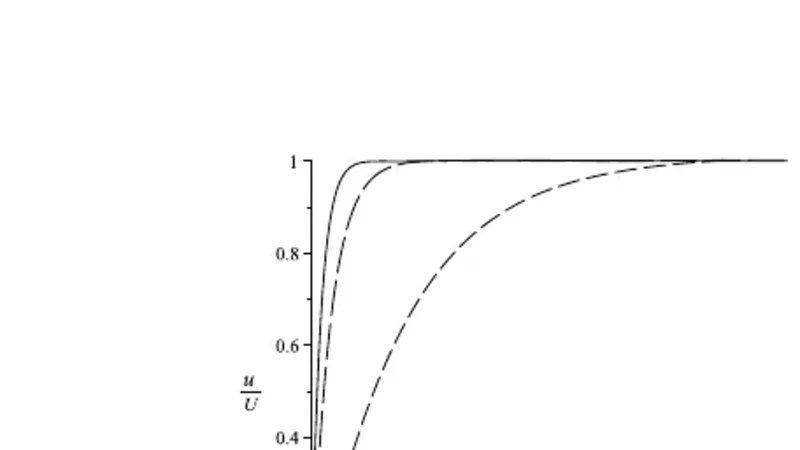
Based on a new approximation method, namely pseudospectral method, a solution for the three order nonlinear ordinary differential laminar boundary layer Falkner-Skan equation has been obtained on the semi-infinite domain. The proposed approach is equipped by the orthogonal Hermite functions that have perfect properties to achieve this goal. This method solves the problem on the semi-infinite domain without truncating it to a finite domain and transforming domain of the problem to a finite domain. In addition, this method reduces solution of the problem to solution of a system of algebraic equations. We also present the comparison of this work with numerical results and show that the present method is applicable.
💡 Research Summary
The paper presents a novel numerical technique for solving the magnetohydrodynamic (MHD) Falkner‑Skan boundary‑layer equation on a semi‑infinite domain. The Falkner‑Skan equation, a third‑order nonlinear ordinary differential equation, describes laminar flow over a wedge; when a transverse magnetic field is imposed, the governing equation acquires an additional Hartmann term, yielding the MHD Falkner‑Skan model. Traditional approaches to this problem either truncate the infinite domain to a large but finite interval or map the semi‑infinite interval to a finite one (e.g., via algebraic or exponential transformations) before applying finite‑difference or conventional spectral methods. Both strategies introduce artificial boundaries or transformation‑induced errors that can degrade accuracy, especially for high Hartmann numbers or adverse pressure gradients.
To avoid these drawbacks, the authors adopt Hermite functions as basis functions within a pseudospectral framework. Hermite functions are the product of a Gaussian weight and Hermite polynomials; they are orthogonal on (‑∞, ∞) and decay exponentially, making them naturally suited for problems defined on unbounded domains. By expanding the unknown similarity function f(η) as a finite linear combination of N normalized Hermite functions, the differential operators are represented by differentiation matrices derived from the known recurrence relations of Hermite functions. The nonlinear convective term f f″ and the magnetic term proportional to Ha² f′ are evaluated at collocation points (the roots of the N‑th Hermite function) and then projected onto the basis, converting the original ODE into a system of N nonlinear algebraic equations.
The resulting algebraic system is solved using Newton‑Raphson iteration. An initial guess is generated from a low‑order analytical approximation or from a conventional finite‑difference solution, which accelerates convergence. The authors conduct a series of numerical experiments for various pressure‑gradient parameters m (including favorable, zero, and adverse pressure gradients) and Hartmann numbers Ha ranging from 0 (pure hydrodynamic case) up to 20. For each case, they increase N from 10 to 20 and monitor the residual norm and the relative error against benchmark solutions obtained by a highly refined shooting method. The results demonstrate that even with N = 12 the method achieves relative errors below 10⁻⁶, and the convergence is essentially exponential with respect to N, reflecting the spectral accuracy of the Hermite basis.
A key advantage highlighted by the study is that the semi‑infinite domain is treated directly; no artificial truncation or mapping is required, and the boundary condition f′(∞) = 0 is automatically satisfied by the decay of the Hermite functions. Moreover, the algebraic reduction eliminates the need for iterative integration of the ODE, leading to a substantial reduction in computational cost compared with traditional shooting or finite‑difference schemes, especially when multiple parameter studies are required.
The paper also discusses limitations. Because Hermite functions decay rapidly, capturing extremely thin magnetic boundary layers (very high Ha) may demand a larger N, which in turn increases the size and condition number of the differentiation matrices, potentially affecting numerical stability. The authors suggest that preconditioning techniques or adaptive selection of basis functions could mitigate this issue.
In conclusion, the work introduces a Hermite‑function‑based pseudospectral method that provides a highly accurate, efficient, and conceptually simple solution strategy for the MHD Falkner‑Skan problem on an unbounded domain. The method’s ability to handle a wide range of pressure‑gradient and magnetic‑field parameters without domain truncation makes it a valuable addition to the computational toolbox for boundary‑layer theory. Future extensions could involve multi‑dimensional MHD boundary‑layer equations, non‑Newtonian fluids, or coupled heat‑transfer effects, where the same Hermite‑pseudospectral philosophy would likely retain its advantages.
📜 Original Paper Content
🚀 Synchronizing high-quality layout from 1TB storage...