Community Structure of the Physical Review Citation Network
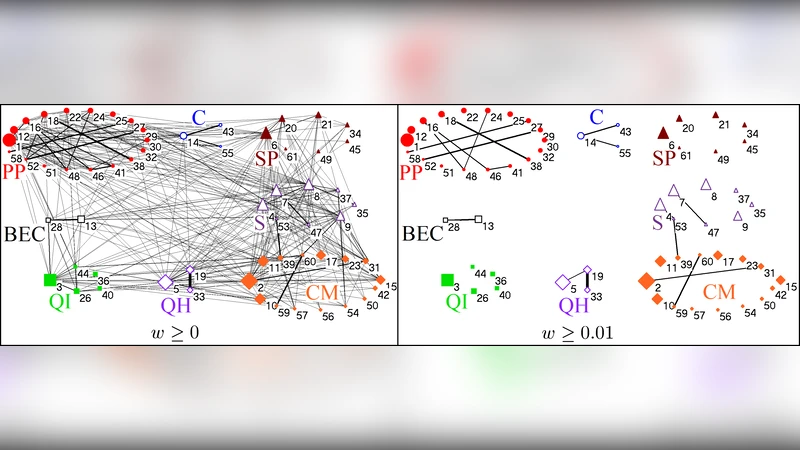
We investigate the community structure of physics subfields in the citation network of all Physical Review publications between 1893 and August 2007. We focus on well-cited publications (those receiving more than 100 citations), and apply modularity maximization to uncover major communities that correspond to clearly-identifiable subfields of physics. While most of the links between communities connect those with obvious intellectual overlap, there sometimes exist unexpected connections between disparate fields due to the development of a widely-applicable theoretical technique or by cross fertilization between theory and experiment. We also examine communities decade by decade and also uncover a small number of significant links between communities that are widely separated in time.
💡 Research Summary
The paper presents a comprehensive investigation of the community structure within the citation network of all Physical Review publications spanning from 1893 to August 2007. By restricting the analysis to highly cited papers—those that have received more than 100 citations—the authors focus on a subset of roughly 23,000 documents that are presumed to represent the most influential works in physics. These papers are modeled as nodes in a directed, weighted graph where each edge corresponds to a citation and its weight reflects the number of times the citing paper references the cited work.
Community detection is performed using the Louvain algorithm, a fast modularity‑maximization method that iteratively aggregates nodes into clusters to increase the overall modularity score. Multiple random initializations are employed to ensure stability of the partitioning. The resulting decomposition yields twelve major communities, each aligning closely with traditional subfields of physics such as quantum electronics, statistical physics, nuclear and particle physics, condensed matter, astrophysics, quantum information, nonlinear dynamics, and biophysics. Within each community the internal citation density is markedly higher than between communities, confirming that the method successfully isolates cohesive scholarly domains.
Inter‑community link strengths are quantified by examining the off‑diagonal entries of the modularity matrix. As expected, many strong connections occur between fields with obvious intellectual overlap—for example, condensed matter and materials science, or nuclear physics and high‑energy particle physics. More intriguing, however, are the robust ties that bridge seemingly disparate areas. The paper highlights links between quantum information and statistical physics, and between nonlinear dynamics and biophysics, attributing these to the diffusion of broadly applicable theoretical tools (e.g., entanglement measures, complex‑network analysis) and to cross‑fertilization between theory and experiment. Such “unexpected” edges illustrate how methodological innovations can propagate across disciplinary boundaries, creating new avenues of research.
A temporal dimension is added by applying a sliding ten‑year window to the citation data, thereby constructing a series of decade‑specific networks. This longitudinal approach reveals how community composition evolves over time. Notably, the quantum electronics and condensed‑matter communities begin to merge in the 1970s, reflecting the rise of semiconductor physics and quantum device engineering. In the early 1990s a distinct quantum‑computing community emerges, which later (around the early 2000s) becomes tightly coupled with statistical physics—a pattern explained by the reliance of quantum algorithm complexity analysis on statistical‑mechanical concepts. Moreover, the authors identify a small number of significant links that connect communities separated by many decades, suggesting that certain techniques (e.g., laser technology) have long‑term, far‑reaching impacts.
The discussion emphasizes that modularity‑based community detection provides a powerful lens for mapping the intellectual landscape of physics, uncovering both expected and surprising relationships among subfields. The authors argue that the identified cross‑field connections point to fertile ground for interdisciplinary collaboration and may help anticipate future research trends. Limitations are acknowledged, including the exclusion of low‑citation papers and the reliance on a single journal family. The paper concludes by proposing extensions such as incorporating the full citation corpus, comparing results with other bibliometric databases, and employing dynamic network models to capture the continuous evolution of scientific knowledge.
Comments & Academic Discussion
Loading comments...
Leave a Comment