Vector Fields and Flows on Differentiable Stacks
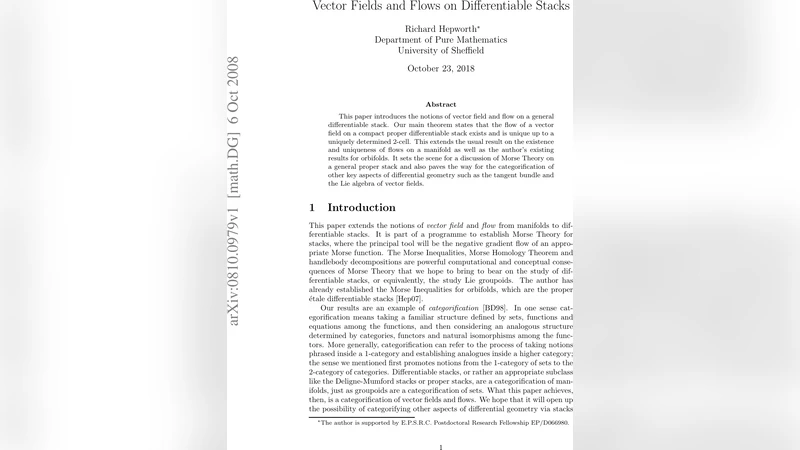
This paper introduces the notions of vector field and flow on a general differentiable stack. Our main theorem states that the flow of a vector field on a compact proper differentiable stack exists and is unique up to a uniquely determined 2-cell. This extends the usual result on the existence and uniqueness of flows on a manifold as well as the author’s existing results for orbifolds. It sets the scene for a discussion of Morse Theory on a general proper stack and also paves the way for the categorification of other key aspects of differential geometry such as the tangent bundle and the Lie algebra of vector fields.
💡 Research Summary
The paper “Vector Fields and Flows on Differentiable Stacks” develops a systematic theory of vector fields and their flows on the broad class of differentiable stacks, extending the familiar manifold picture to a higher‑categorical setting. The author first constructs a “tangent stack” functor (T: \mathbf{StDiff}\to\mathbf{StDiff}) as a lax functor that agrees with the ordinary tangent bundle functor on manifolds via the Yoneda embedding. By representing a stack (X) with a Lie groupoid (\Gamma), the tangent stack (T X) is shown to be represented by the tangent Lie groupoid (T!\Gamma); this gives a concrete model for the abstract construction.
A vector field on a stack (X) is defined as a morphism (X\colon X\to T X) together with a 2‑cell (a_X: X\Rightarrow \operatorname{id}_X\circ\pi_X), where (\pi_X:T X\to X) is the projection. For manifolds the 2‑cell collapses, recovering the usual equation (\pi_M\circ X = \operatorname{id}_M). In the stack context the projection need not be an isomorphism, so the extra 2‑cell records the deviation.
A flow of a vector field (X) is a morphism (\Phi\colon X\times\mathbb R\to X) equipped with two 2‑cells (t_\Phi) and (e_\Phi) satisfying analogues of the differential equation (\partial_t\Phi = X\circ\Phi) and the initial condition (\Phi(-,0)=\operatorname{id}). Moreover a compatibility condition (equation (4) in the paper) imposes a coherence relation between the two 2‑cells, reflecting the higher‑categorical weakening of the classical equations.
The central theorem has two parts. First, if the stack (X) is compact and proper (the diagonal map is representable), then a flow (\Phi) of any vector field on (X) exists. Second, any two such flows (\Phi,\Psi) are related by a unique 2‑cell (\eta:\Phi\Rightarrow\Psi) determined solely by the data ((t_\Phi,e_\Phi,t_\Psi,e_\Psi)). This provides a higher‑categorical analogue of the classical existence‑and‑uniqueness theorem for ODEs on manifolds. Properness includes manifolds, orbifolds, (S^1)-gerbes, and global quotients by compact Lie groups, so the result recovers all familiar cases and adds many new ones.
Beyond existence and uniqueness, the paper outlines several structural consequences. The tangent stack is naturally a 2‑vector bundle (a bundle of 2‑vector spaces) over (X); this permits the definition of Riemannian metrics, gradients, and hence Morse functions on stacks. The collection of vector fields on a stack forms a Lie 2‑algebra, extending the ordinary Lie algebra of vector fields. For compact proper stacks, the groupoid of vector fields is equivalent to the groupoid of weak (\mathbb R)-actions, mirroring the classical identification of vector fields with 1‑parameter diffeomorphism groups. These ideas are placed in the framework of Baez–Crans 2‑vector spaces.
The paper is organized as follows:
- Section 2 builds the tangent stack functor, proves its compatibility with Yoneda, and shows that for a Lie groupoid presentation the tangent stack is represented by the tangent Lie groupoid.
- Section 3 defines vector fields, discusses equivalences, and relates vector fields on a stack to vector fields on its presenting Lie groupoid (or on the stack of torsors).
- Section 4 introduces integral morphisms, integral 2‑morphisms, and the full definition of flows; it proves the existence, uniqueness, and representability results mentioned above.
- Section 5 works out the global‑quotient case (
Comments & Academic Discussion
Loading comments...
Leave a Comment