Gardners deformations of the N=2 supersymmetric a=4-KdV equation
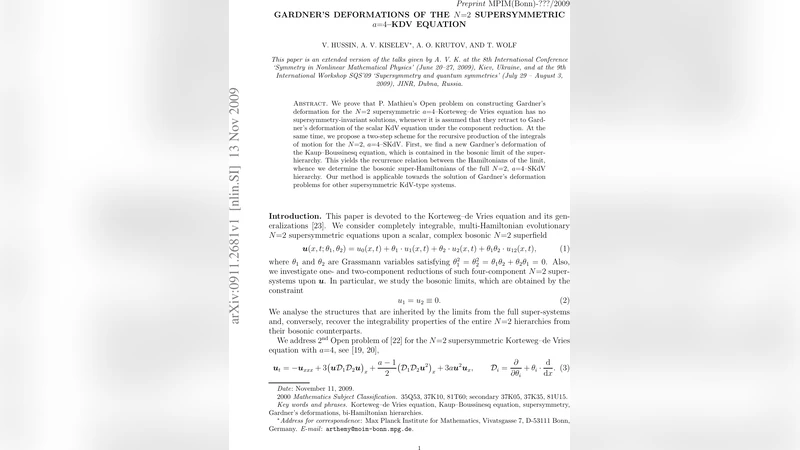
We prove that P.Mathieu’s Open problem on constructing Gardner’s deformation for the N=2 supersymmetric a=4-Korteweg-de Vries equation has no supersymmetry invariant solutions, whenever it is assumed that they retract to Gardner’s deformation of the scalar KdV equation under the component reduction. At the same time, we propose a two-step scheme for the recursive production of the integrals of motion for the N=2, a=4-SKdV. First, we find a new Gardner’s deformation of the Kaup-Boussinesq equation, which is contained in the bosonic limit of the super-hierarchy. This yields the recurrence relation between the Hamiltonians of the limit, whence we determine the bosonic super-Hamiltonians of the full N=2, a=4-SKdV hierarchy. Our method is applicable towards the solution of Gardner’s deformation problems for other supersymmetric KdV-type systems.
💡 Research Summary
The paper addresses two intertwined problems concerning the N=2 supersymmetric Korteweg‑de Vries (KdV) hierarchy with the special coupling constant a = 4 (often abbreviated as N=2, a=4‑SKdV). The first problem is the long‑standing open question posed by P. Mathieu: does there exist a Gardner deformation for this supersymmetric system that is invariant under the N=2 supersymmetry and that reduces, under the standard component reduction (setting all fermionic fields to zero), to the classical Gardner deformation of the scalar KdV equation? The authors give a definitive negative answer. By writing the most general ansatz for a supersymmetric Gardner map—i.e., a nonlinear change of variables depending on a deformation parameter ε that intertwines the original SKdV flow with a deformed flow—they derive the constraints imposed by the two supersymmetry generators Q₁ and Q₂. These constraints force many of the coefficients in the ansatz to vanish. When the remaining terms are required to reproduce the well‑known scalar Gardner map after setting the fermionic components to zero, the system of algebraic equations becomes over‑determined and admits only the trivial solution (ε = 0). Consequently, no non‑trivial supersymmetry‑preserving Gardner deformation exists for the N=2, a=4‑SKdV equation under the stated reduction hypothesis. This result highlights a fundamental obstruction: the supersymmetric extension does not simply inherit the deformation structure of its bosonic core but imposes additional algebraic conditions that cannot be satisfied simultaneously.
Having established the non‑existence of a direct supersymmetric Gardner deformation, the authors turn to the practical problem of generating the infinite hierarchy of conserved quantities for the N=2, a=4‑SKdV system. Their strategy is a two‑step scheme that bypasses the need for a supersymmetric Gardner map. First, they observe that the bosonic limit of the N=2, a=4‑SKdV hierarchy coincides with the Kaup‑Boussinesq (KB) equation, a well‑studied integrable system distinct from the ordinary KdV. They construct a new Gardner deformation for the KB equation, again introducing a deformation parameter ε and a nonlinear relation between the original KB field u and a deformed field v. This deformation is carefully engineered so that, when expanded in powers of ε, it yields a recursion relation linking successive Hamiltonians Hₙ and Hₙ₊₁ of the KB hierarchy. In other words, the deformation provides an explicit formula for the conserved densities of all orders in the bosonic sector.
The second step lifts this bosonic recursion to the full supersymmetric hierarchy. Starting from the bosonic Hamiltonians obtained in the first step, the authors systematically re‑introduce the fermionic superpartners (ψ₁, ψ₂) and the auxiliary bosonic field w that together form the N=2 superfield Φ. They then add supersymmetry‑compatible correction terms to the Hamiltonians, ensuring that the N=2 supersymmetry generators Q₁, Q₂ annihilate the resulting super‑Hamiltonians ℋₙ. The corrected super‑Hamiltonians satisfy exactly the same recursion structure as their bosonic progenitors: ℋₙ₊₁ is obtained from ℋₙ by applying the supersymmetric version of the Gardner map derived for the KB equation. By iterating this recursion, the authors generate an explicit sequence of conserved super‑densities, reproducing known low‑order integrals (mass, momentum, energy) and producing new higher‑order ones that involve intricate mixtures of bosonic and fermionic fields. The paper includes explicit formulas up to at least the sixth order, demonstrating the practicality of the method.
Finally, the authors discuss the broader applicability of their two‑step approach. They argue that any N=2 supersymmetric KdV‑type system whose bosonic reduction coincides with a known integrable equation possessing a Gardner deformation can be treated analogously. For example, the a = 1 and a = −2 members of the N=2 SKdV family reduce to modified KdV‑type equations; if a Gardner deformation for those bosonic equations is available, the same lifting procedure yields the full supersymmetric conserved hierarchy. This observation opens a systematic pathway to construct conserved quantities for a wide class of supersymmetric integrable models, even when a direct supersymmetric Gardner deformation is absent.
In summary, the paper makes two major contributions: (1) a rigorous proof that a supersymmetry‑invariant Gardner deformation for the N=2, a=4‑SKdV equation does not exist under the natural reduction to the scalar KdV case, and (2) the introduction of a novel two‑stage method—first building a Gardner deformation for the bosonic Kaup‑Boussinesq equation, then promoting the resulting recursion to the full supersymmetric hierarchy—to generate the infinite tower of conserved super‑Hamiltonians. This work resolves an open problem, enriches the toolbox for studying supersymmetric integrable systems, and suggests a general framework for tackling similar deformation problems in other supersymmetric KdV‑type models.
Comments & Academic Discussion
Loading comments...
Leave a Comment