The compositional structure of multipartite quantum entanglement
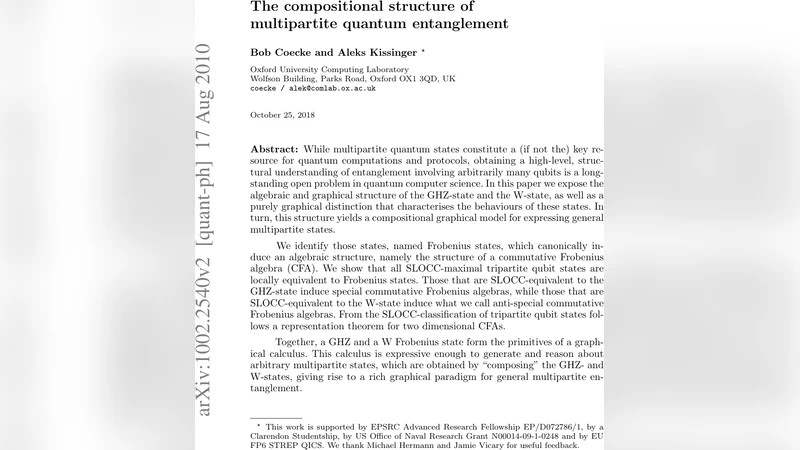
While multipartite quantum states constitute a (if not the) key resource for quantum computations and protocols, obtaining a high-level, structural understanding of entanglement involving arbitrarily many qubits is a long-standing open problem in quantum computer science. In this paper we expose the algebraic and graphical structure of the GHZ-state and the W-state, as well as a purely graphical distinction that characterises the behaviours of these states. In turn, this structure yields a compositional graphical model for expressing general multipartite states. We identify those states, named Frobenius states, which canonically induce an algebraic structure, namely the structure of a commutative Frobenius algebra (CFA). We show that all SLOCC-maximal tripartite qubit states are locally equivalent to Frobenius states. Those that are SLOCC-equivalent to the GHZ-state induce special commutative Frobenius algebras, while those that are SLOCC-equivalent to the W-state induce what we call anti-special commutative Frobenius algebras. From the SLOCC-classification of tripartite qubit states follows a representation theorem for two dimensional CFAs. Together, a GHZ and a W Frobenius state form the primitives of a graphical calculus. This calculus is expressive enough to generate and reason about arbitrary multipartite states, which are obtained by “composing” the GHZ- and W-states, giving rise to a rich graphical paradigm for general multipartite entanglement.
💡 Research Summary
The paper tackles the long‑standing problem of obtaining a high‑level, structural understanding of multipartite entanglement by exposing an algebraic and graphical framework centred on two canonical three‑qubit states: the GHZ state and the W state. The authors first show that each of these states induces a commutative Frobenius algebra (CFA) on the underlying two‑dimensional Hilbert space. The GHZ‑induced CFA is “special”: its multiplication and comultiplication are mutually inverse, which in the graphical language translates into the ability to eliminate loops. The W‑induced CFA is “anti‑special”: multiplication and comultiplication are not inverses, leading to a graphical calculus where loops can coexist with branching structures. This purely graphical distinction (presence or absence of removable loops) provides an immediate visual test for the type of entanglement a state exhibits.
From this observation the authors introduce the notion of a “Frobenius state”: any multipartite quantum state that, up to local invertible (SLOCC) operations, canonically gives rise to a CFA. They prove that every SLOCC‑maximal three‑qubit state is locally equivalent to a Frobenius state, and that the SLOCC classification of three‑qubit states collapses into exactly two families—those equivalent to GHZ (special CFAs) and those equivalent to W (anti‑special CFAs). Consequently, a representation theorem for two‑dimensional CFAs follows directly from the known SLOCC classification.
The central technical contribution is a compositional graphical calculus built from the GHZ‑ and W‑Frobenius states as primitive generators. Using the standard diagrammatic operations of composition, tensoring, copying, and deleting, one can construct arbitrary multipartite states by “gluing’’ together copies of the GHZ and W diagrams. The calculus respects the algebraic equations of the underlying CFAs, so that diagrammatic rewrite rules automatically capture state equivalences, SLOCC transformations, and entanglement properties. In effect, the calculus provides a high‑level language for building and reasoning about any multipartite entangled state without resorting to explicit tensor calculations.
The authors illustrate the expressive power of the calculus by showing how known families of states (e.g., graph states, Dicke states) can be generated, and how new, previously uncharacterised families emerge from mixed GHZ‑W compositions. They also discuss practical implications: quantum circuit synthesis can be guided by diagrammatic optimisation, error‑correcting codes can be understood as particular CFA‑structures, and multipartite communication protocols (secret sharing, remote state preparation) can be designed and verified graphically.
In summary, the paper establishes a deep link between multipartite entanglement, commutative Frobenius algebras, and a purely graphical language. By identifying GHZ and W as the fundamental Frobenius primitives, it delivers a compositional framework that unifies the classification, construction, and manipulation of arbitrary multipartite quantum states, opening new avenues for both theoretical insight and practical quantum engineering.
Comments & Academic Discussion
Loading comments...
Leave a Comment