High resolution dynamical mapping of social interactions with active RFID
In this paper we present an experimental framework to gather data on face-to-face social interactions between individuals, with a high spatial and temporal resolution. We use active Radio Frequency Identification (RFID) devices that assess contacts w…
Authors: Alain Barrat, Ciro Cattuto, Vittoria Colizza
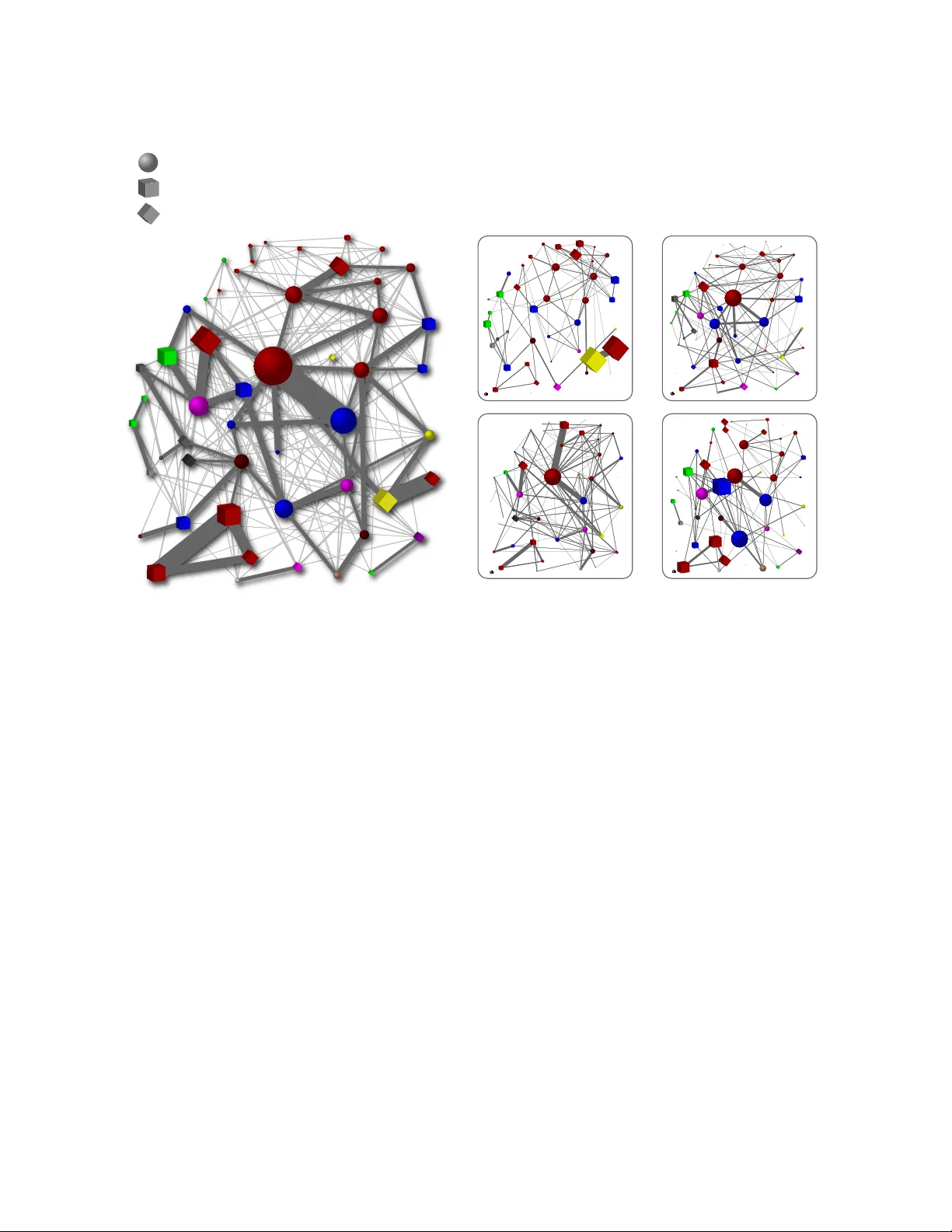
High resolution dynamical mapping of so cial in teractions with activ e RFID Alain Barrat, 1, 2 Ciro Cattuto, 2 Vittoria Colizza, 2 Jean-F ran¸ cois Pin ton, 3 W outer V an den Broeck, 2 and Alessandro V espignani 2, 4 1 Centr e de Physique Th ´ eorique (CNRS UMR 6207), Marseil le, F r anc e 2 Complex Networks and Systems Gr oup, ISI F oundation, T urin 10133, Italy 3 L ab or atoir e de Physique de l’ENS Lyon (CNRS UMR 5672), Lyon, F r anc e 4 Scho ol of Informatics and Bio c omplexity Institute, Indiana University, Blo omington, IN 47408, USA Abstract In this pap er we presen t an exp erimen tal framework to gather data on face-to-face so cial in- teractions b et w een individuals, with a high spatial and temp oral resolution. W e use activ e Radio F requency Iden tification (RFID) devices that assess contacts with one another b y exchanging low- p o w er radio pac kets. When individuals w ear the b eacons as a badge, a p ersisten t radio con tact b et w een the RFID devices can b e used as a proxy for a so cial in teraction b et ween individuals. W e presen t the results of a pilot study and a subsequent preliminary data analysis, that pro vides an assessmen t of our metho d and highlights its versatilit y and applicabilit y in man y areas concerned with human dynamics. P ACS n umbers: Keyw ords: RFID, sensor net w orks, h uman dynamics, social netw ork analysis, epidemiology 1 I. INTR ODUCTION So cial interaction patterns suc h as contacts and mixing patterns among individuals hav e a direct impact on diverse phenomena studied in v arious research areas. Clear-cut examples are the transmission of infectious diseases b y the respiratory or close-con tact route, and collectiv e opinion formation. The av ailability of representativ e data on such patterns has long b een a concern since it used to b e notoriously difficult to collect it. The av ailable metho ds usually rely on surveys and pap er-diary metho dologies [1] which are often slo w, inaccurate, and intrusiv e. No v el tec hnologies, ho wev er, afford new and promising means of collecting this essential data. Con tact patterns data is indeed muc h needed. Recen t studies of e-mail [3] and cellular phone call exc hanges [5, 6], collaboration net works [4], sexual contact netw orks [2], and mo- bilit y by air trav el [7], ha v e revealed the presence of complex prop erties and heterogeneities. In particular, the num b er of in teraction partners from one individual to the other is sub ject to large fluctuations that hav e non-trivial consequences on the dynamical pro cesses taking place on these net works [8, 9, 10]. A detailed c haracterization of these structures is therefore of utmost imp ortance for the understanding of many phenomena, and crucially depends on the av ailability of represen tative empirical data. While imp ortan t progress has b een achiev ed in the last decade or so, more is b ound to come, for most of these recen t characterizations of complex net works focused on static configurations in which the temporal dimension w as not considered, mostly b ecause of lac k of data. Examples of prop erties that arise in this temp oral dimension are duration, fre- quency , concurrency , and causalit y . F or instance, if an individual A meets first B then C, an information or a virus can spread from B to A and then to C, but not from C to B. In the image of a static netw ork in con trast, the links allow propagation in b oth cases. The fact that these static netw orks are in fact “summaries” of man y different interactions that do not o ccur simultaneously , might conceal imp ortan t insights. The few cases in which temp oral asp ects hav e b een considered in more detail, indeed rev ealed imp ortan t conse- quences [11, 12, 13, 14, 15, 16, 17, 18, 19]. Sev eral more recen t studies hav e demonstrated the p oten tial of using no vel technologies suc h as Blueto oth and Wifi for collecting data on b oth the structural and temporal asp ects of so cial interaction patterns [16, 18, 19, 20]. Ho wev er, their spatial resolution in these is 2 at b est of the order of 10 meters, and the temp oral resolution of the order of 2-5 min utes. Moreo ver, these tec hnologies detect local proximit y b et w een devices, whic h do es not imply a priori a so cial in teraction b etw een the individuals carrying these devices. Finally , these studies concern small groups and are not easily repro ducible. In this pap er, we present a no v el exp erimental framework based on active RFID de- vices that o vercomes these limitations. W e discuss a recently p erformed pilot study , and a data analysis that highligh ts the main adv antages of this new data collection tec hnique. Non-tec hnical accounts and supplementary material can b e found on the w ebsite of the So cioP atterns pro ject [21]. I I. METHODOLOGY, EXPERIMENTS, D A T A A. Activ e RFID-based exp erimen tal framew ork The prop osed experimental framew ork aims at measuring the con tact patterns of a group of in teracting individuals in a spatially bounded setting, suc h as a set of offices or a confer- ence. The participants are ask ed to carry small RFID tags [22], henceforth called b e ac ons . These b eacons con tin uously broadcast small data pack ets whic h are received b y a num b er of stations and rela yed through a lo cal netw ork to a serv er. The stations are installed at fixed lo cations in the en vironmen t. The b eacons and stations we used were created b y and obtained from the OpenBeacon pro ject [23]. RFID tags acting as b eacons can b e used to deplo y indo ors lo cativ e systems [24] that trac k the lo cation of the tags. Problems related to multiple path, phase fluctuations, etc. tend how ever to limit the precision of the spatial lo calization of the tags. Because of this, lo cativ e tec hnologies are typically not viable, at lo w cost, to infer face-to-face con tact b e- t ween individuals w earing RFID tags. Mo ving from c ontact infer enc e to direct c ontact dete ction enabled us to b ypass these limitations. T o this end, w e lev eraged the Op enBeacon activ e RFID platform [23] and op erate the RFID tags a bi-directional fashion. That is, tags no longer act as simple b eacons that passiv ely emit signals to b e receiv ed and pro cessed b y a centralized post-pro cessing set- up. They rather exc hange messages in a peer-to-p eer fashion to sense their neigh b orhoo d and assess directly con tacts with nearby tags. 3 A high spatial resolution of less then 1 − 2 meters is attained by using very lo w radio p o w er lev els for the contact sensing. F urthermore, assuming that the sub jects wear the tags on their chest, the b ody effectiv ely acts as a shield for the sensing signals. This w ay , con tacts are detected only when participan ts actually face one another. If a sensed contact p ersists for a few seconds, then given the short range and the face-to-face requirement, it is reasonable to assume that the exp erimen t is able to detect an ongoing so cial con tact (as e.g. a conv ersation). After the b eacons detect a contact, they broadcast a rep ort message at a higher p o wer lev el. These rep orts are receiv ed b y the stations and rela yed to the monitoring infrastructure. The rep orts are stored with a time stamp, the id of the rela ying station and the id of the tags which participate in the con tact even t (up to 4 sim ultaneous contacts are recorded, using the current hardw are). After a suitable tuning of the system parameters, w e can easily record individual con tacts in a crowded ro om with just a small num b er of receiving stations. The raw data series is made with an effectiv e sampling frequency under one second. In man y instances of data pro cessing, w e applied a coarse graining filter using time windows of 20 seconds (see next section). This v alue is chosen in order to minimize statistical errors, and corresp onds moreo ver to a typical timescale for social interactions. W e finally note that messages betw een tags and/or stations are encrypted and that the entire data managemen t is completely anon ymous. B. Visualization The pilot studies w e conducted so far w ere accompanied with publicly displa yed, dynamic visualizations of the contacts b et w een individuals. This is achiev ed by defining a contact net work in which the b eacons/p ersons are no des and the con tacts are edges. Two differen t t yp es of visualizations can b e display ed, pro viding snapshots resp ectively of the instanta- ne ous state of the net work, and of the cumulative state since a given time (e.g. the start of the experiment, or the start of the da y in a m ulti-da y exp erimen t). The ’instan taneous’ visualization additionally displays marks for the stations, which are p ositioned in a fixed la yout. The lo cation of the b eacon marks in the visualization is driv en by a force-directed la yout algorithm. Springs are asso ciated with b oth the explicitly shown con tact edges and the edges b et ween b eacons and stations, whic h are not sho wn. The rest length of these 4 springs is in v ersely proportional to the strength of the respective con tact or b eacon-station pro ximity estimations. The mo del is regularly up dated based on the live data feed, and the view is up dated after each iteration of the algorithm, up to 25 times p er second. The result is a contin uously morphing netw ork representation in which the marks of b eacons that are in contact try to o ccupy adjacen t p ositions, and to mov e tow ards the marks of the closest stations. The other visual enco dings are as follo ws: Edge thic kness and transparency enco de con tact strength; Beacon mark size enco des the num b er of contacts rep orted by the b eacon; Station mark size enco des the n umber and pro ximity of the closest b eacons. The main net work view is furthermore flank ed by a side-bar with v arious data p oin ts and charts, which are dynamically up dated as w ell. Figure 1 shows a snapshot of the visualization. Sample movies can b e viewed on the w ebsite of the So ciopatterns pro ject [21]. These visualizations w ere primarily dev elop ed to visually follo w and insp ect the ongoing exp erimen t and as an aid in explaining it, but w e also introduced certain affordances. One suc h feature consists of enabling the participan ts to tap their b eacon by pressing a button. The visualization immediately reacts by highligh ting the corresp onding b eacon mark and temp orarily sho wing a small table with some detailed con textual data in the side-bar. Other affordances that w ere effectively exploited by the participan ts are the lo calization of people and the identification of an observed but unknown contact partner of a kno wn p erson. C. A pilot study W e hav e deploy ed our measuring infrastructure in a pilot exp eriment of limited size. The exp erimen t to ok place during the workshop “F acing the challenge of Infectious Diseases” at the ISI F oundation on Octob er 13 − 17, 2008. P articipants to the workshop w ere offered to volun teer to participate to the exp erimen t, and a large part agreed. This allo wed us to gather data in a v ery dynamical context with p erio ds of high so cial in teraction (coffee and lunc h breaks) and other p erio ds in which the participan ts sit together but (almost) do not in teract in a pairwise fashion. The exp erimen t in volv ed ab out 50 attendees o ver four da ys. W e placed rep orting stations in the main areas in which p eople w ere exp ected to b e during the sessions and breaks – namely the conference ro om, the bar (where coffee breaks were taking place) and the cafeteria area (where lunc h w as served). W e also put a station in the 5 FIG. 1: A snapshot of the visualization. The main view shows the instantaneous state of the con tact net work at a giv en time during lunch hour. The beacons are lab eled with their id s, and can also b e labeled with a v ailable metadata (such as e.g. the actual names of the persons). White edges represent contacts. The b eacons are p ositioned near the stations where their signals are receiv ed. The y ellow circle b ehind b eacon 4532 highligh ts a tap while some related data is shown in the side-bar. lobb y which is also suited for discussions (see Figure 2). Figure 1 presents a snapshot of the visualization obtained during the lunc h break of the third da y of the conference, showing a n umber of b eacons in the cafeteria area where p eople ha ve lunch, while others are having coffee at the bar. The new firmw are prov ed to b e as muc h reliable in a real-world setting as it app eared to b e in our preliminary exp erimen ts. The measuring infrastructure received approximately 2 · 10 6 data pack ets p er day from the v arious b eacons, among which 5 · 10 5 pac kets rep orting a contact. Around 150 Mb of raw compressed data were pro cessed. Some ca veats hav e to b e rep orted: b ecause of technical issues (some b eacons had to b e c hanged during the 6 lobby cafeteria bar conf. room FIG. 2: Left: photo of a b eacon (Courtesy of M. Meriac [23]). Righ t: map of the exp eriment premises. The circles denote the p ositions of the rep orting stations. exp erimen t, some batteries failed and had to b e replaced), some beacons disapp eared from the data for few hours. Moreov er, beacons w ere ob viously track ed only when within range of the stations. W e will see in the next section that, despite these issues corresp onding to sampling problems, the data analysis rev eals interesting patterns and shows the large p oten tial of our experimental setup. I I I. RESUL TS OF THE PILOT STUDY A. Con tacts c haracterization Let us first fo cus on the analysis of the contacts b etw een individuals. W e define as a “con tact even t” b et ween t wo b eacons A and B the exchange of at least one data pack et b et w een the t wo b eacons in a 20 s time-windo w. W e then define as the duration of the con tact A-B the time during which pac kets are exc hanged betw een them at least ev ery 20 s . The contact is considered as brok en whenever more than 20 s o ccur without a pack et exc hange. The c hoice of a 20 s windo w is based on the frequency with which pac k ets are sent b y beacons, and corresp onds to a reasonable time-scale for so cial in teraction (e.g. encounter, brief con versation, etc.). Given this definition, w e can measure b oth the duration of eac h con tact and the interv als b etw een t wo contacts. Figure 3(left) shows the distribution of the contact durations obtained using the whole dataset collected during the four conference da ys. A v ery broad distribution is observ ed, close to a p o w er-law with exp onen t ' − 2. 7 Qualitativ ely , this b eha vior is not unexp ected: there are comparativ ely few long-lasting con tacts and a m ultitude of brief con tacts. A similar result has been rep orted for the duration of contacts b etw een Blueto oth devices [19], with differen t exponents dep ending on the experimental set-up. Our measuremen ts, ho wev er, ac hiev e higher spatial and temp oral accuracy than previous studies, and reliably select face-to-face interactions at close range, allo wing to detect so cial interactions of a con versational t yp e. These measuremen ts clearly sho w that no c haracteristic time of in teraction can b e determined but that these in teractions can o ccur on many differen t timescales. W e c heck ed the robustness of the rep orted b eha vior along sev eral lines. First, we verified that the distribution is the same o v er different p erio ds of time: few hours, a whole da y , or the whole conference. W e also chec k ed that it is in v ariant across randomly selected groups of individuals (see Figure 3(left)), sho wing that eac h individual has a broad distribution of con tact durations. The obtained global heterogeneity therefore stems from an heterogeneity of the con tact patterns of eac h individual, and not from an heterogeneit y due to the difference of b eha vior among individuals. The distribution of contact durations remains unchanged, ev en by assuming a stricter definition of contact. The left panel of Figure 3 shows the result obtained b y defining stronger contacts as the ones in whic h at least 5 data pack ets are exc hanged in a 20 s window (instead of 1 data pac ket only for the standard definition of a contact even t). Let us now turn to the inter-con tact time interv als, for which previous studies [18, 19] ha ve also rep orted broad distributions. Time interv als b et w een con tacts can in fact b e defined in three differen t w a ys. One can measure the time betw een any t wo reported contact ev ents, regardless of the inv olv ed b eacons, th us yielding a characterization of the global dynamic/so cial activity of the group under study . W e observe a broad distribution close to a p ow er-law with exp onen t − 2 . 5 (not sho wn, see the Sociopatterns pro ject w ebsite [21]). Differen t measures, which are more imp ortan t in relation with spreading pro cesses, fo cus on (i) the time in terv als b et w een t wo con tacts in v olving a given particular beacon, and (ii) the time interv als b et ween tw o con tacts in volving the same pair of b eacons. Figure 3(righ t) displa ys these distributions, showing that also in this case a broad b eha vior is obtained. This b eha vior is robust with resp ect to possible (heavy) data loss, as sho wn by the distribution obtained b y remo ving the data coming from 20 randomly selected b eacons that represent more than 30% of the whole dataset. The stronger con tact definition also yield similar 8 10 1 10 2 10 3 contact duration ∆ t (s) 10 -5 10 -4 10 -3 10 -2 10 -1 10 0 P( ∆ t) stronger contacts all contacts contacts of a single tag contacts of a single tag 10 1 10 2 10 3 10 4 interval ∆ t between contacts (s) 10 -5 10 -4 10 -3 10 -2 10 -1 10 0 P( ∆ t) one common tag common pair of tags 20 tags removed stronger contacts FIG. 3: Left: Distribution of con tact durations obtained by considering: all contact ev ents; the stronger con tacts only (i.e. exc hange of at least 5 data pac kets b et ween 2 b eacons in a 20 s time windo w); the contacts of tw o individuals selected at random. Right: Distribution of time in terv als b et w een contacts: inv olving at least one common b eacon; in volving the same pair of b eacons; remo ving 20 randomly selected b eacons; considering stronger con tacts only . results. The results presen ted here are not unexp ected, since burst y b eha viors and broad distri- butions of ev ents durations or in ter-even t interv als ha v e b een rep orted in other studies on h uman behavior. It is nonetheless striking to observ e that our exp erimen tal setup based on a new technology aimed at contact detection yields high quality data within a relatively small exp erimen t, in agreemen t with the expected b eha vior. W e foresee that larger exp erimen ts will allow to obtain larger statistics and to in vestigate more in detail the so cial and dynam- ical aspects of con tact and mixing patterns, through a detailed characterization of the links (in termittency , p ersistence, etc.) and of the no des (role inference, inclusion of background information, etc.). B. So cial net w orks The data on so cial contacts can b e used to build aggregated net works of interactions b et w een individuals on an y timescale larger than the time resolution. Individuals are the no des of the netw ork, and a link of weigh t w exists b et w een t wo individuals if w con tact ev ents ha ve tak en place b et ween them in the chosen time in terv al. Let us first fo cus on 9 9am 11am 1pm 3pm 5pm 6pm 4pm 2pm 10am 12pm time of the day 0 10 20 30 40 # persons in conf. room # persons 9am 11am 1pm 3pm 5pm 6pm 4pm 2pm 10am 12pm time of the day 0 10 20 30 40 # persons in conf. room # persons 0 1 2 3 4 〈 k 〉 〈 k 〉 0 5 10 15 20 25 30 # cliques 2-cliques 3-cliques 4-cliques FIG. 4: Num b er of b eacons in the conference ro om as a function of time, during the third day of the conference. Left: Av erage degree h k i in the instantaneous contact net work computed o v er time windows of 20 s . Right: Number of pairs (2-cliques), triangles (3-cliques), and 4-cliques in the con tact net work. Note that we consider the maximal cliques, i.e. that the three edges of a triangle are not coun ted in the num b er of pairs. “instan taneous” netw orks, constructed on short timescales. Figure 4 sho ws the n um b er of b eacons in the conference ro om as a function of time[26], during the third day of the conference, which w as divided into four sessions, separated by tw o coffee breaks and a lunch break (indicated b y the gray areas in the Figure). The data, av eraged o ver time windo ws of 20 s , clearly sho ws the attendance of each session, in whic h most b eacons are in the conference ro om, whereas the breaks are iden tified by the small num b er of b eacons remaining in the conference ro om. The left panel also displays the ev olution of the a verage num b er of con tacts p er individual during 20 s p eriods. Strikingly , the num b er of contacts p er participant is low when the attendance in the conference ro om is high, whereas a clear increase is observ ed during each break, clearly signalling that most so cial in teractions occur during the coffee and lunc h breaks, though some con tacts ma y occur during the sessions when people t ypically talk and discuss with their immediate neighbors. This is further highlighted in the right panel of Figure 4, where w e display , together with the attendance curv e in the conference ro om, the n umber of 2 − , 3 − and 4 − cliques in the contact net w orks aggregated o v er 20 s time windo ws. Note that w e consider here maximal cliques, so that the edges of a triangle are not coun ted as 2 − cliques, or that the 4 triangles forming a 4 − clique are not coun ted in the n umber of 3-cliques. A fluctuating n umber of pairs is observ ed during the session, corresp onding most 10 probably to participants turning tow ards their neighbours, and p eaks are observed at the b eginning and end of eac h session and in fact of eac h talk, when participants ha ve indeed more activity . 3 − and 4 − cliques are observed almost exclusiv ely during the breaks, as exp ected since many discussions tak e place in small groups. It is wo rth to mention that the small n umber of 3 − cliques observed during the sessions corresp ond to small groups of participan ts remaining in the coffee break area for discussions ev en after the b eginning of the session. The results illustrated in Figure 4 are clearly exp ected, since so cial in teractions obviously tak e place during the breaks. How ev er, they p oin t to the abilit y of our experimental setup of resolving the mixing patterns by directly detecting the con tact ev en ts. A less elab orate setup, based on the inference of contact even ts by spatial proximit y , would show a large n umber of cliques (or worse, a unique large clique) during the meeting session where participants are ph ysically close. In addition, Figure 4(righ t) clearly sho ws how this tec hnology is able to detect interactions b etw een 3 or 4 p eople, and not only pairwise interactions. The data can also b e used to construct aggregated net works on longer timescales, for example for a single da y or for the whole duration of the exp erimen t. The aggregated net work b ecomes then denser as the aggregation time increases, with an av erage degree ranging from a v alue close to 20 for the net work aggregated ov er one day , to approximately 40 for the whole exp erimen t duration, sho wing that most participan ts hav e in teracted with eac h other, whic h is in fact one of the aims of a small-scale conference. The aggregated net works are in teresting in that they sho w broad distributions of the w eights (given b y the num b er of pac k ets exc hanged betw een tw o b eacons) whic h are a pro xy for the effective duration of a so cial interaction. Without going into a detailed netw ork analysis, we provide in Figure 5 a visualization of the netw orks of so cial in teractions obtained b y aggregating the data for eac h da y of the conference (smaller panels) and for its en tire duration (larger graph), with the heterogeneit y of links w eights and no des strengths clearly visible. C. Con tagion pro cesses The dynamic netw ork of con tacts provides a realistic setting to p erform simulations of con tagion pro cesses in the p opulation of individuals, suc h as rumour or information spread- ing, opinion formation, or epidemic pro cesses. P articularly relev ant is the application to 11 Pajek Pajek Pajek Pajek day 1 Pa j e k Pa j e k Pa j e k Pa j e k day 2 Pajek Pajek Pajek Pajek day 3 Pa j e k Pa j e k Pa j e k Pa j e k day 4 Senior researcher Junior researcher Student Italy US The Netherlands Fr ance UK Portugal Switzer land Sw eden Israel Austria Poland Algeria Germany FIG. 5: So cial netw ork of contacts b et w een individuals (represented by no des), aggregated ov er the whole duration of the conference (larger graph), and for each of the da ys (smaller panels). The size of each no de is prop ortional to its strength (given b y the sum of the weigh ts of its links [7]), and the width of eac h link is prop ortional to its weigh t. The color of each no de corresp onds to the individual’s coun try of affiliation, and the shap e to his/her academic p osition. F or clarity , only links with weigh t larger than 100 are rep orted (50 for the smaller panels). As visible from the smaller panels, differen t in teraction patterns are obtained for different da ys. the spread of infectious diseases transmitted by the respiratory or close-contact route (as for example influenza, SARS, etc.). Mo dels of epidemic spread on contact netw orks usually rely on static configurations of netw orks where the asp ects of concurrency and causalit y are not taken into account. The data collected with our exp erimen tal setup can b e used for an em ulation of a con tagion pro cess among individuals where all top ological and temporal heterogeneities are considered. Here w e present a v ery simple example of a contagion pro cess aimed at showing the 12 feasibilit y of such studies. W e consider the basic Susceptible-Infected (SI) mo del in whic h individuals are classified in tw o m utually exclusiv e compartmen ts, Susceptible (i.e. able to con tract a disease) and Infectious (i.e. infected and able to transmit the infection) [25]. The em ulation is p erformed on the contact data of the third conference da y . At the beginning of the da y , a randomly selected individual is considered as infectious. During each time windo w of 20 s , eac h contact b et ween a susceptible and an infectious individual can result in the con tagion of the susceptible that contracts the infection with probability 0 . 01 w (where w is the n umber of pac kets exc hanged betw een the b eacons of the individuals, i.e. a mea- sure of the intensit y and duration of the so cial interaction). Some individuals are set as imm une since the start of the emulation, allowing for individuals who are not susceptible to the disease and can never b ecome infectious. Figure 6 displa ys the num b er of infectious individuals as a function of time for a single realization of the sto c hastic mo del, and for differen t p ercentages of initially immune individuals. An in teresting pattern is observ ed, in agreemen t with the previous analysis: most contagion ev ents o ccur during the coffee and lunc h breaks, where social in teractions are more lik ely to o ccur. The righ t panel displays a sc hematic visualization of the propagation dynamics, sho wn as a tree in whic h each newly 9am 11am 1pm 3pm 5pm 7pm time of the day beacons 9am 10am 11am 12pm 1pm 2pm 3pm 4pm 5pm 6pm time of the day 0 10 20 30 40 50 I 0% immunized 10% immunized 20% immunized 50% immunized spreading process FIG. 6: Left: Ev olution of the n um b er of ’Infected’ individuals when a single Infectious is introduced at the b eginning of the da y . F or each contact, the transmission probabilit y is 0 . 01 w for eac h 20 s time window, where w is the n um b er of pack ets exchanged b et w een the t w o b eacons in con tact during this time window. Right: illustration of the contagion even ts in the p opulation of beacons as a function of time, for 20% initially imm une individuals. Black lines indicate the infection from one b eacon to another, as they o ccur in time. 13 infected b eacon is represen ted as a red disk at the time of its con tamination, with lines going from the infecting b eacon to the infected one for eac h contagion even t. While this mo del is o verly simplistic and do es not aim to repro duce a giv en realistic epidemic scenario, it offers the p ossibilit y of studying simple contagion pro cesses on a realistic dataset, and pro vides a pro of of concept showing how the data gathered through our exp erimen tal set-up in prop er settings (as e.g. larger so cial even ts) can hav e a crucial v alue to understand and predict the impact of infectious diseases. IV. CONCLUSIONS AND PERSPECTIVES In this pap er, w e presen ted a nov el exp erimen tal set-up whic h can b e used to gather information on so cial interactions of individuals. The measures are based on activ e RFID devices, called b eacons, that individuals can w ear as badges. When t w o b eacons are close enough (t ypically one meter apart), they can exc hange messages and relay them to the measuring infrastructure. The v ery low p o w er used for the exchanged messages and the absorption of the used frequencies by the h uman b ody ensure that con tacts are detected only when individuals face each other as in a real so cial contact. This allows us to obtain data at v ery high spatial and temp oral resolution, as sho wn in a pilot exp erimen t performed during a recent conference. Here w e presented some results of the corresp onding data analysis, sho wing the resolving p o wer of exp erimen tal setup, able to discriminate b et w een so cial in teraction and simple physical proximit y . W e measured the distributions of the duration of so cial con tacts b et ween individuals and of the in terv als b et w een con tacts, and found broad b eha viors. Moreov er, we sho w ed how our experimental setup can b e used to construct so cial net works b y aggregating the con tacts ov er the required timescale. Our exp erimen tal set-up pa v es the wa y for a num b er of developmen ts and applications. Clearly , more exp erimen tal w ork is needed to obtain larger statistics on con tacts durations or frequencies, and to characterize dynamically evolving so cial net works. The hardware and soft ware could also b e upgraded to con tain additional information on the individuals and their interactions. The presented set-up will also allo w to study v arious dynamical phenomena taking place on dynamically ev olving contact net w orks, as briefly illustrated ab ov e. Contagion processes, suc h as rumour spreading, opinion formation, propagation of respiratory or close-contact 14 infections, take place on the dynamical netw ork of so cial contacts among individuals. Gath- ering data on so cial contacts will allo w a b etter mo deling and understanding of the spread of viruses and information. V.C. is partially funded by the European Commission contract n. ER C–2007–Stg204863 (EpiF or). A.V. is partially funded by the NIH-NIDA-21D A024259-01 aw ard. [1] Mossong J et al. : Social Con tacts and Mixing P atterns Relev ant to the Spread of Infectious Diseases. PLoS Med 5 , e74 (2008). [2] Liljeros, F., Edling, C. R., Amaral, L. A. N., Stanley , H. E., Aberg, Y.: The w eb of h uman sexual contacts. Nature 411 , 907–908 (2001). [3] Eb el, H., Mielsch, L.-I., Bornholdt, S.: Scale-free top ology of e-mail netw orks. Phys. Rev. E 66 , 035103 (2002). [4] Newman, M. E. J.: The structure of scien tific collab oration net works. Pro c. Natl. Acad. Sci. (USA) 98 , 404 – 409 (2001). [5] Onnela, J.-P ., Saram¨ aki, J., Hyv¨ onen, J., Szab´ o, G., Lazer, D., Kaski, K., Kert ´ esz, J., Barab` asi, A.-L.: Structure and tie strengths in mobile comm unication netw orks. Pro c. Natl. Acad. Sci. USA 104 , 7332 (2007). [6] Gonz´ alez, M.C., Hidalgo, C.A., Barab´ asi, A.-L.: Understanding individual human mobility patterns Nature 453 , 779-782 (2008). [7] Barrat, A., Barth ´ elemy , M., Pastor-Satorras, R., V espignani, A.: The arc hitecture of complex w eighted net works. Pro c. Natl Acad. Sci. (USA) 101 , 3747-3752 (2004). [8] Pastor-Satorras, R., V espignani, A.: Ev olution and structure of the Internet: A statistical ph ysics approac h.Cambridge Univ ersity Press, Cam bridge (2004). [9] Bo ccaletti, S., Latora, V., Moreno, Y., Cha vez, M., Hwang, D.-U.: Complex net w orks: Struc- ture and dynamics. Phys. Rep. 424 , 175-308 (2006). [10] Barrat, A., Barth´ elemy , M., V espignani, A.: Dynamical processes on complex net works. Cam- bridge Universit y Press, Cambridge (2008). [11] Eckmann, J., E. Moses, and D. Sergi: En tropy of dialogues creates coherent structures in e-mail traffic. Pro c. Natl. Acad. Sci. USA 101 , 14333-14337 (2004). [12] Barab` asi, A.-L.: The origin of bursts and heavy tails in human dynamics. Nature 435 , 207-211 15 (2005). [13] Holme, P .: Net work reac habilit y of real-world con tact sequences. Phys. Rev. E 71 , 046119 (2005). [14] V´ azquez, A., Oliveira, J. G., Dezs¨ o, Z., Goh, K.-I., Kondor, I., Barab` asi, A.-L.: Mo deling bursts and hea vy tails in human dynamics. Phys. Rev. E 73 , 036127 (2006). [15] Iribarren, J.L., Moro, E.: Information diffusion epidemics in social net works. [16] Kostakos, V., O’Neill, E., P enn, A.: Brief encoun ter net works. [17] V´ azquez, A., R´ acz, B., Luk acs, A., Barab` asi, A.-L.: Impact of Non-Poissonian activity pat- terns on spreading pro cesses. Ph ys. Rev. Lett. 98 , 158702 (2007). [18] Hui, P ., Chaintreau, A., Scott, J., Gass, R., Cro wcroft, J., Diot, C.: P o c ket switc hed netw orks and h uman mobilit y in conference en vironments. Pro ceedings of the 2005 A CM SIGCOMM w orkshop on Delay-toleran t netw orking, 244 - 251 (2005). [19] Scherrer, A., Borgnat, P ., Fleury , E., Guillaume, J.-L., Robardet, C.: Description and simu- lation of dynamic mobility netw orks. Comp. Net. 52 , 2842-2858 (2008). [20] Eagle, N., P entlan d, A.: Reality mining: Sensing complex so cial systems. P ersonal and Ubiq- uitous Computing 10 , 255-268 (2006). [21] So ciopatterns pro ject, h ttp://www.so ciopatterns.org [22] Finkenzeller, K.: RFID handbo ok, Wiley Hob ok en, NJ (2003). [23] Op enBeacon pro ject, h ttp://www.op en b eacon.org/ [24] Ni, L.M. and Liu, Y. and Lau, Y.C. and Patil, A.P .: LANDMAR C: Indo or Lo cation Sensing Using Active RFID. Wireless Netw orks 10 (6), 701–710 (2004). [25] Anderson, R.M., Ma y , R.M., Infectious Diseases in Humans. (Oxford Univ ersity Press, Oxford, 1992). [26] Although a precise trac king of the b eacons’ lo cations is a difficult task, it is easy to kno w in whic h ro om eac h b eacon is. 16
Original Paper
Loading high-quality paper...
Comments & Academic Discussion
Loading comments...
Leave a Comment