Global dynamics of cell mediated immunity in viral infection models with distributed delays
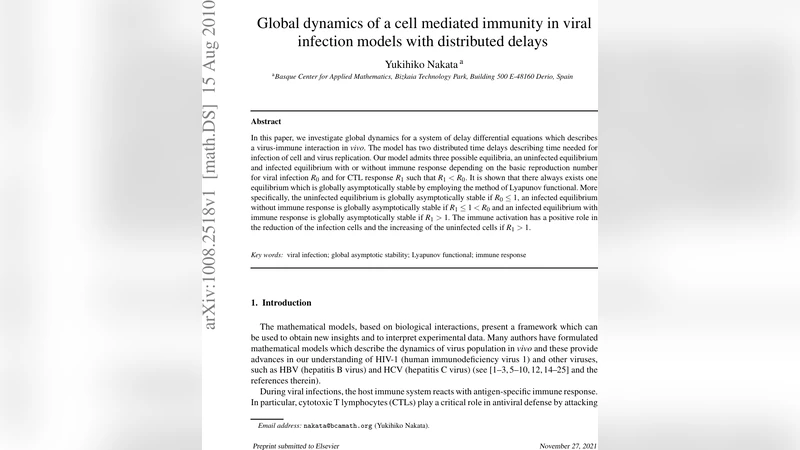
In this paper, we investigate global dynamics for a system of delay differential equations which describes a virus-immune interaction in \textit{vivo}. The model has two distributed time delays describing time needed for infection of cell and virus replication. Our model admits three possible equilibria, an uninfected equilibrium and infected equilibrium with or without immune response depending on the basic reproduction number for viral infection $R_{0}$ and for CTL response $R_{1}$ such that $R_{1}<R_{0}$. It is shown that there always exists one equilibrium which is globally asymptotically stable by employing the method of Lyapunov functional. More specifically, the uninfected equilibrium is globally asymptotically stable if $R_{0}\leq1$, an infected equilibrium without immune response is globally asymptotically stable if $R_{1}\leq1<R_{0}$ and an infected equilibrium with immune response is globally asymptotically stable if $R_{1}>1$. The immune activation has a positive role in the reduction of the infection cells and the increasing of the uninfected cells if $R_{1}>1$.
💡 Research Summary
This paper studies a virus‑immune interaction model formulated as a system of delay differential equations (DDEs) that incorporates two distributed time delays: one representing the latency between a target cell’s infection and the production of new virions, and the other representing the time required for infected cells to generate virus particles. The state variables are the concentrations of uninfected target cells (T), infected cells (I), free virus (V), and cytotoxic T‑lymphocytes (CTL, denoted E). The distributed delays are introduced through convolution integrals with kernel functions f₁(τ) and f₂(τ), which model realistic, possibly non‑exponential, waiting‑time distributions for the biological processes.
Two dimensionless threshold quantities are defined. The basic reproduction number for the virus, R₀, measures the average number of newly infected cells generated by a single infected cell in a completely susceptible environment. The CTL reproduction number, R₁, quantifies the ability of the immune response to expand and suppress the infection. The authors assume R₁ < R₀, reflecting the biological situation where the immune response is activated after the virus has already begun to spread.
Three equilibria are identified:
- Uninfected equilibrium (E₀): (T*, 0, 0, 0), where T* = λ/d is the steady‑state level of healthy cells in the absence of infection.
- Infected equilibrium without immune response (E₁): (T₁, I₁, V₁, 0), existing when the virus can persist (R₀ > 1) but the CTL response is insufficient (R₁ ≤ 1).
- Infected equilibrium with immune response (E₂): (T₂, I₂, V₂, E₂), existing when the immune system is strong enough to mount a sustained response (R₁ > 1).
The core contribution of the paper lies in proving that exactly one of these equilibria is globally asymptotically stable (GAS) for any admissible parameter set, using Lyapunov‑Krasovskii functionals tailored to each equilibrium. For E₀, a functional V₀ is constructed that includes the integral terms arising from the distributed delays; its derivative satisfies (\dot V₀\le0) and equals zero only at E₀ when R₀ ≤ 1, leading to global convergence by LaSalle’s invariance principle. For E₁, a functional V₁ that omits the CTL component is employed; under the condition R₁ ≤ 1 < R₀, (\dot V₁\le0) with equality only at E₁, establishing its GAS property. For E₂, a more intricate functional V₂ incorporates all four variables; when R₁ > 1, (\dot V₂\le0) and the only invariant set is E₂, guaranteeing global stability.
The analysis also discusses the influence of the shape of the delay kernels. Numerical simulations with exponential and uniform kernels illustrate that larger mean delays produce more pronounced transient oscillations, yet the long‑term outcome remains dictated solely by the relative magnitudes of R₀ and R₁. This robustness underscores the biological relevance of the thresholds: regardless of the detailed timing of infection and replication, the infection either clears (R₀ ≤ 1), settles at a virus‑only steady state (R₁ ≤ 1 < R₀), or reaches a controlled chronic state where CTL activity keeps the viral load low (R₁ > 1).
From a biomedical perspective, the results highlight the positive role of CTL activation. When R₁ > 1, the equilibrium E₂ features a markedly reduced infected‑cell population and an elevated count of healthy cells compared with E₁, indicating that a sufficiently strong immune response can substantially mitigate disease severity. The findings suggest that therapeutic strategies aimed at boosting CTL proliferation or enhancing its killing efficiency could shift the system from the undesirable E₁ regime to the more favorable E₂ regime, even in the presence of realistic distributed delays.
In summary, the paper extends classical virus‑immune models by incorporating biologically realistic distributed delays, rigorously establishes global stability results using Lyapunov functionals, and confirms that the fundamental thresholds R₀ and R₁ remain the decisive determinants of infection outcome. The work provides both a solid mathematical framework for future modeling of delayed immune dynamics and actionable insights for designing immunotherapeutic interventions.
Comments & Academic Discussion
Loading comments...
Leave a Comment