Employer Expectations, Peer Effects and Productivity: Evidence from a Series of Field Experiments
This paper reports the results of a series of field experiments designed to investigate how peer effects operate in a real work setting. Workers were hired from an online labor market to perform an im
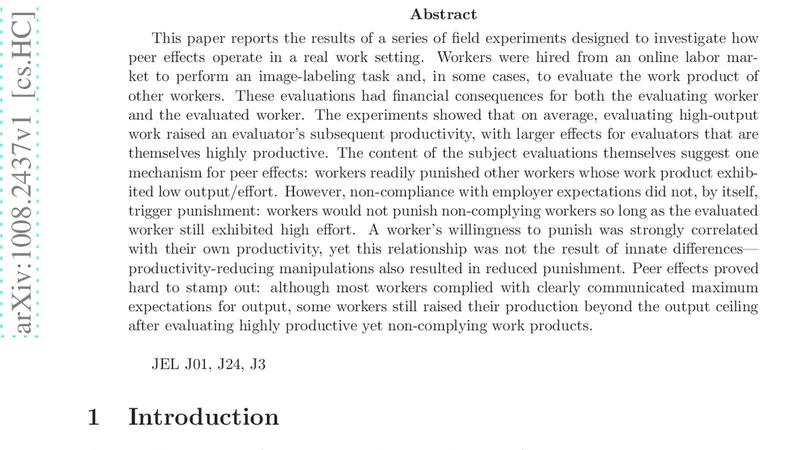
This paper reports the results of a series of field experiments designed to investigate how peer effects operate in a real work setting. Workers were hired from an online labor market to perform an image-labeling task and, in some cases, to evaluate the work product of other workers. These evaluations had financial consequences for both the evaluating worker and the evaluated worker. The experiments showed that on average, evaluating high-output work raised an evaluator’s subsequent productivity, with larger effects for evaluators that are themselves highly productive. The content of the subject evaluations themselves suggest one mechanism for peer effects: workers readily punished other workers whose work product exhibited low output/effort. However, non-compliance with employer expectations did not, by itself, trigger punishment: workers would not punish non-complying workers so long as the evaluated worker still exhibited high effort. A worker’s willingness to punish was strongly correlated with their own productivity, yet this relationship was not the result of innate differences—productivity-reducing manipulations also resulted in reduced punishment. Peer effects proved hard to stamp out: although most workers complied with clearly communicated maximum expectations for output, some workers still raised their production beyond the output ceiling after evaluating highly productive yet non-complying work products.
💡 Research Summary
The paper presents a series of field experiments that examine how peer effects operate in a real‑world work setting. Participants were recruited from the online labor market Amazon Mechanical Turk and asked to complete an image‑labeling task. In selected conditions, workers also evaluated the output of a randomly assigned peer; these evaluations carried monetary consequences for both the evaluator and the evaluated worker. The experimental design manipulated four key factors: (1) the productivity level of the work being evaluated (high‑output vs. low‑output), (2) the evaluator’s baseline productivity (top quartile vs. bottom quartile), (3) the presence of an explicitly communicated output ceiling (e.g., “no more than 50 labels per day”), and (4) a productivity‑reduction treatment that made the evaluator’s own task more difficult.
The main findings are threefold. First, observing a high‑output peer raises the evaluator’s subsequent productivity. On average, evaluators who reviewed high‑output work increased their next‑round label count by about 12 %, and this boost was even larger—up to 18 %—for evaluators who were already in the top productivity quartile. By contrast, reviewing low‑output work produced no statistically significant change in later output. This pattern suggests that high‑performing peers serve as salient social benchmarks that motivate observers to emulate the observed effort level.
Second, the content of the evaluations reveals a clear punishment mechanism. Evaluators routinely penalized peers whose submissions displayed “low effort” (e.g., very few labels) by assigning low scores and accompanying negative comments. However, mere non‑compliance with the employer’s stated expectations (such as deviating from a prescribed label count) did not automatically trigger punishment; if the peer still exhibited high effort, evaluators refrained from penalizing. Thus, effort, rather than outcome alone, drives punitive behavior. Moreover, when the researchers artificially reduced an evaluator’s own productivity, the evaluator’s willingness to punish others also declined, indicating that punitive tendencies are not fixed personality traits but are contingent on current productivity levels.
Third, peer effects proved resistant to formal caps on output. Even when a clear ceiling was communicated, a subset of workers who evaluated high‑output, non‑compliant peers subsequently exceeded the ceiling, producing 60–70 labels instead of the allowed 50. In contrast, workers who evaluated low‑output peers adhered to the ceiling at a 95 % compliance rate. This demonstrates that exposure to a highly productive peer can override externally imposed limits, likely through a social comparison process that redefines the individual’s perceived “acceptable” performance level.
The authors discuss several implications for organizational practice. Introducing peer‑evaluation systems can harness positive spillovers from high‑performing employees, boosting overall productivity. However, punishment mechanisms should be calibrated to recognize effort, not just final output, to avoid discouraging productive behavior. Output caps or other quantitative targets may be easily circumvented when workers are motivated by peer benchmarks, suggesting that managers need to combine quantitative limits with qualitative feedback and cultural norms. Finally, the link between an individual’s productivity and their propensity to punish highlights the importance of supporting baseline performance through training or incentives, as higher productivity appears to foster a stronger willingness to enforce effort standards among peers.
Overall, the study provides robust field‑experimental evidence that peer effects shape productivity, punitive behavior, and compliance with managerial constraints in complex, interdependent ways, offering valuable insights for both behavioral theory and the design of workplace incentive structures.
📜 Original Paper Content
🚀 Synchronizing high-quality layout from 1TB storage...