Effect of Finite Larmor Radius on the Cosmic Ray Penetration into an Interplanetary Magnetic Flux Rope
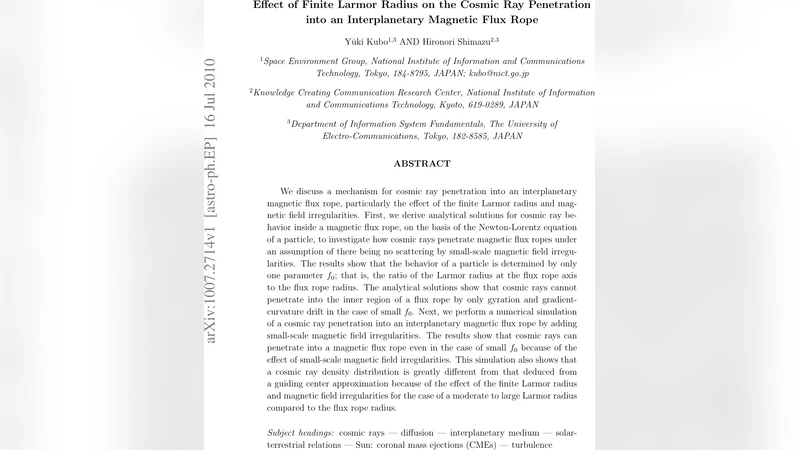
We discuss a mechanism for cosmic ray penetration into an interplanetary magnetic flux rope, particularly the effect of the finite Larmor radius and magnetic field irregularities. First, we derive analytical solutions for cosmic ray behavior inside a magnetic flux rope, on the basis of the Newton-Lorentz equation of a particle, to investigate how cosmic rays penetrate magnetic flux ropes under an assumption of there being no scattering by small-scale magnetic field irregularities. Next, we perform a numerical simulation of a cosmic ray penetration into an interplanetary magnetic flux rope by adding small-scale magnetic field irregularities. This simulation shows that a cosmic ray density distribution is greatly different from that deduced from a guiding center approximation because of the effect of the finite Larmor radius and magnetic field irregularities for the case of a moderate to large Larmor radius compared to the flux rope radius.
💡 Research Summary
The paper investigates how cosmic‑ray particles penetrate an interplanetary magnetic flux rope (IPFR) and how this process is altered when the particle’s Larmor radius is not negligible compared with the rope’s radius. The authors adopt a two‑step approach. First, they treat the flux rope as an ideal, axisymmetric, cylindrical magnetic structure without any small‑scale turbulence. By solving the Newton‑Lorentz equation analytically in cylindrical coordinates, they derive the exact particle trajectories. The analysis shows that when the Larmor radius ρL is much smaller than the rope radius R (ρL/R ≲ 0.05), the motion is well described by the guiding‑center approximation: particles gyrate tightly around magnetic field lines, remain confined to a narrow region, and the rope acts as an almost perfect magnetic shield. However, as ρL becomes a non‑trivial fraction of R (ρL/R ≳ 0.1), the curvature and gradient of the magnetic field cause significant non‑adiabatic effects. The particle’s gyromotion can no longer be approximated by a smooth drift; instead, trajectories become “non‑guiding,” allowing particles to reach the rope’s core or to escape after a few gyrations. This already indicates that the rope’s shielding efficiency depends strongly on particle rigidity.
In the second part, the authors superimpose small‑scale magnetic irregularities (δB) onto the background rope field to mimic realistic solar‑wind turbulence. They generate a broadband spectrum of random fluctuations with amplitudes δB/B0 ranging from 0.05 to 0.2 and integrate test‑particle trajectories in three dimensions using a high‑resolution time‑step scheme. The simulation parameters include a rope radius of 0.1 AU, a background field of ~10 nT, and particle energies from 10 MeV to 1 GeV (corresponding to Larmor radii from ≪ R up to ≈ 0.5 R). The results reveal several key phenomena:
-
Asymmetric density distribution – Because the rope moves relative to the solar wind, the leading edge (the side facing the flow) admits more particles than the trailing edge. This asymmetry is driven by the convective electric field (E = –V × B) and the spatial gradient of the magnetic field.
-
Strong dependence on ρL/R – For particles with ρL/R ≈ 0.2–0.5 (e.g., ~100 MeV protons), the probability of reaching the rope’s central region increases by more than 30 % compared with the guiding‑center prediction. Low‑energy particles (ρL/R < 0.05) remain largely excluded.
-
Pitch‑angle diffusion induced by turbulence – Even modest turbulence (δB/B0 ≈ 0.1) rapidly broadens the pitch‑angle distribution. Particles that would otherwise be reflected by the magnetic mirror effect can now drift into the rope without being mirrored, raising the internal particle density.
-
Temporal evolution of penetration – As the rope propagates outward, its internal field weakens, effectively increasing the relative Larmor radius of a given particle. The simulation shows that over a 12‑hour interval the internal density profile flattens, indicating that particles gradually fill the rope interior as ρL/R grows.
-
Breakdown of the guiding‑center approximation – For moderate to large Larmor radii, the guiding‑center model underestimates the penetration depth by a factor of two to three. The rope behaves more like a semi‑transparent barrier rather than an opaque shield.
The authors conclude that the finite Larmor radius, together with realistic magnetic turbulence, fundamentally changes cosmic‑ray access to IPFRs. High‑rigidity particles can infiltrate the rope core, and turbulence further enhances this effect by scattering pitch angles. Consequently, space‑weather models that rely solely on guiding‑center calculations may significantly misjudge radiation exposure during coronal‑mass‑ejection (CME) events. The paper suggests that future work should incorporate fully three‑dimensional magnetohydrodynamic (MHD) fields with multi‑scale turbulence and validate the results against in‑situ measurements from missions such as ACE, WIND, and Parker Solar Probe. This more comprehensive approach will improve predictions of cosmic‑ray modulation, particle acceleration inside flux ropes, and the associated hazards for spacecraft and astronauts.
Comments & Academic Discussion
Loading comments...
Leave a Comment