SMART: A statistical framework for optimal design matrix generation with application to fMRI
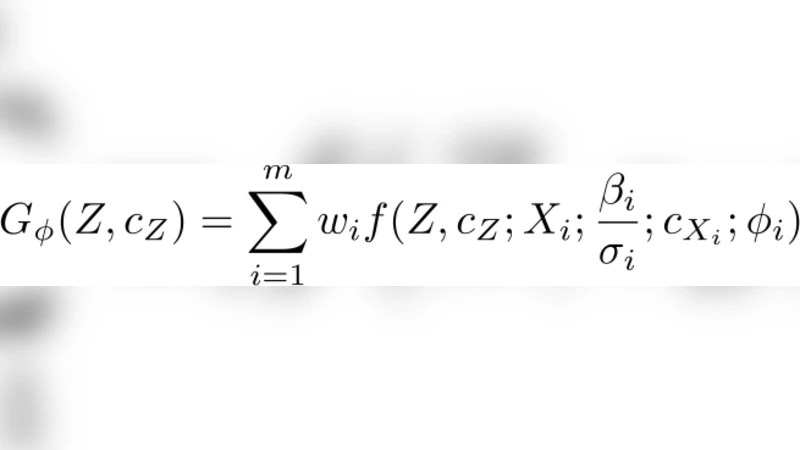
The general linear model (GLM) is a well established tool for analyzing functional magnetic resonance imaging (fMRI) data. Most fMRI analyses via GLM proceed in a massively univariate fashion where the same design matrix is used for analyzing data from each voxel. A major limitation of this approach is the locally varying nature of signals of interest as well as associated confounds. This local variability results in a potentially large bias and uncontrolled increase in variance for the contrast of interest. The main contributions of this paper are two fold (1) We develop a statistical framework called SMART that enables estimation of an optimal design matrix while explicitly controlling the bias variance decomposition over a set of potential design matrices and (2) We develop and validate a numerical algorithm for computing optimal design matrices for general fMRI data sets. The implications of this framework include the ability to match optimally the magnitude of underlying signals to their true magnitudes while also matching the “null” signals to zero size thereby optimizing both the sensitivity and specificity of signal detection. By enabling the capture of multiple profiles of interest using a single contrast (as opposed to an F-test) in a way that optimizes for both bias and variance enables the passing of first level parameter estimates and their variances to the higher level for group analysis which is not possible using F-tests. We demonstrate the application of this approach to in vivo pharmacological fMRI data capturing the acute response to a drug infusion, to task-evoked, block design fMRI and to the estimation of a haemodynamic response function (HRF) response in event-related fMRI. Our framework is quite general and has potentially wide applicability to a variety of disciplines.
💡 Research Summary
The paper addresses a fundamental limitation of the conventional mass‑univariate GLM approach to functional MRI (fMRI) analysis: the use of a single, fixed design matrix for every voxel. Because the amplitude, shape, and temporal profile of task‑related or pharmacological signals, as well as the structure of confounds (motion, physiological noise, drift), vary across brain regions, a one‑size‑fits‑all design matrix can introduce systematic bias when the true signal does not match the assumed regressors, and it can inflate variance when the matrix is overly sensitive to noise. Both effects degrade statistical power and can lead to erroneous inferences.
To overcome this problem the authors introduce SMART (Statistical framework for Optimal design matrix generation for fMRI). SMART treats the choice of a design matrix as an optimization problem that explicitly balances bias and variance over a user‑defined set of plausible design matrices ({X_1,\dots,X_K}). For each candidate matrix the expected value and covariance of the contrast estimator (\hat\beta) are derived, allowing a clean decomposition into a bias term (the mismatch between the true signal and the regressors) and a variance term (the sensitivity of the estimator to noise). The overall objective function is
\
Comments & Academic Discussion
Loading comments...
Leave a Comment