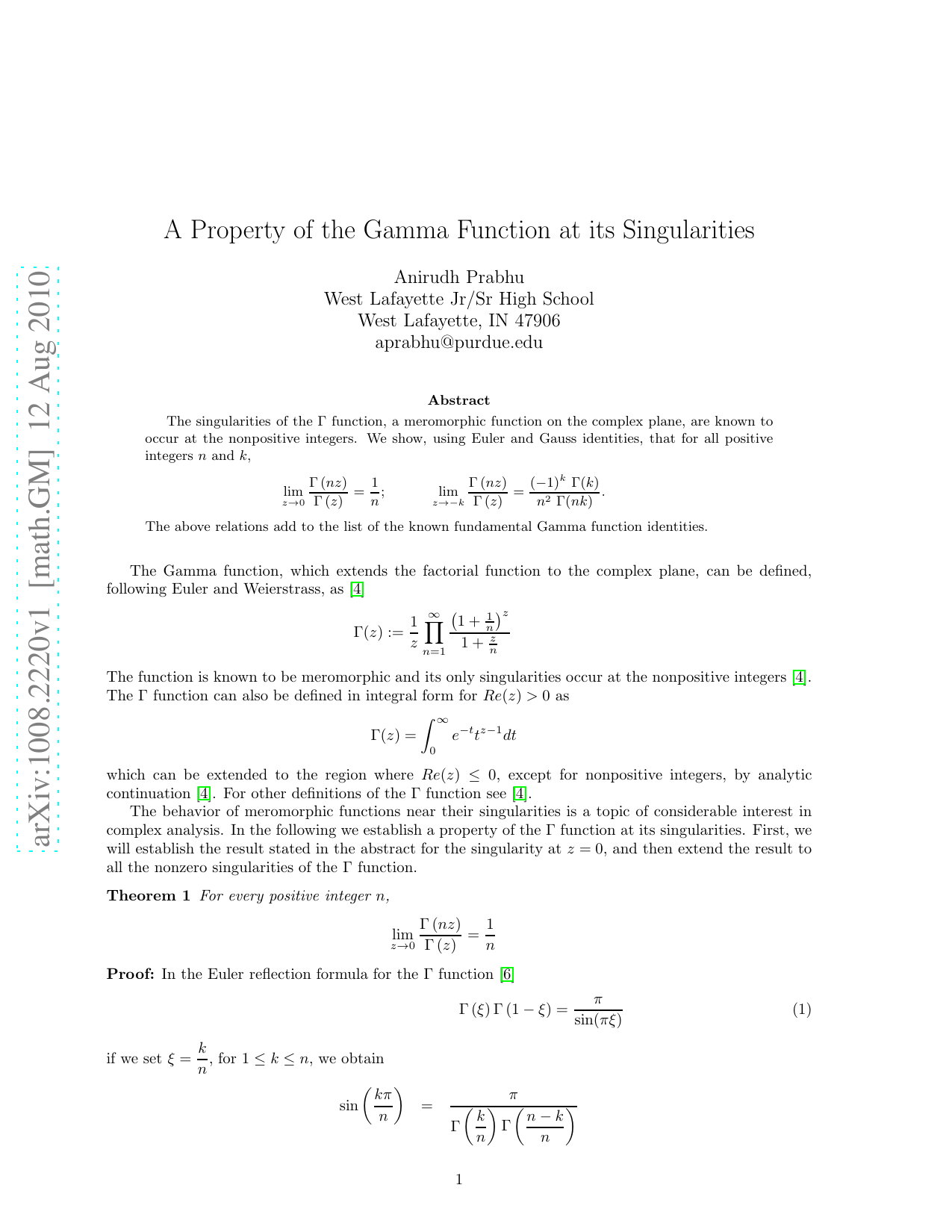
The singularities of the $\Gamma$ function, a meromorphic function on the complex plane, are known to occur at the nonpositive integers. We show, using Euler and Gauss identities, that for all positive integers $n$ and $k$, $$ \lim_{z\rightarrow 0} \frac{\Gamma(nz)}{\Gamma(z)} = \frac 1 n; \hspace{0.4in} \lim_{z\rightarrow -k} \frac{\Gamma(nz)}{\Gamma(z)} = \f{(-1)^{k}\ \Gamma(k)}{n^2\ \Gamma(nk)}.$$ The above relations add to the list of the known fundamental Gamma function identities.
Deep Dive into A Property of the Gamma Function at its Singularities.
The singularities of the $\Gamma$ function, a meromorphic function on the complex plane, are known to occur at the nonpositive integers. We show, using Euler and Gauss identities, that for all positive integers $n$ and $k$,
$$ \lim_{z\rightarrow 0} \frac{\Gamma(nz)}{\Gamma(z)} = \frac 1 n; \hspace{0.4in} \lim_{z\rightarrow -k} \frac{\Gamma(nz)}{\Gamma(z)} = \f{(-1)^{k}\ \Gamma(k)}{n^2\ \Gamma(nk)}.$$
The above relations add to the list of the known fundamental Gamma function identities.
The above relations add to the list of the known fundamental Gamma function identities.
The Gamma function, which extends the factorial function to the complex plane, can be defined, following Euler and Weierstrass, as [4] Γ(z) := 1 z
The function is known to be meromorphic and its only singularities occur at the nonpositive integers [4].
The Γ function can also be defined in integral form for Re(z) > 0 as
which can be extended to the region where Re(z) ≤ 0, except for nonpositive integers, by analytic continuation [4]. For other definitions of the Γ function see [4]. The behavior of meromorphic functions near their singularities is a topic of considerable interest in complex analysis. In the following we establish a property of the Γ function at its singularities. First, we will establish the result stated in the abstract for the singularity at z = 0, and then extend the result to all the nonzero singularities of the Γ function.
Theorem 1 For every positive integer n,
Proof: In the Euler reflection formula for the Γ function [6] Γ
(
The product on the left hand side of ( 2) is related to the product of distances between all pairs of n points that are uniformly distributed on a unit circle [2,3]. The following identity has been established using the Vandermonde determinant in [2] and more directly in [7] for positive integer n
(
An outline of the proof of (3), as reported in [7], is presented in the Appendix. Since sin kπ n = sin (n-k)π n for 1 ≤ k ≤ n, and for even n,
For even n there are two Γ1 2 factors on the left hand side above. One of the them is included in the product while the other appears as Γ 1 2 = √ π. Observing that for odd n, π ⌊n/2⌋ = π n/2 • π -1/2 and using (5) we have
Next, consider the Gauss multiplication formula for the Γ function [1,5] n-
which can be rewritten as
Taking the limit as z → 0 on both sides we get
Using ( 2), ( 4), ( 6) and (9) we have
as claimed
In the following we establish the result stated in the abstract for all the nonzero singularities of the Γ function.
Theorem 2 For all positive integers n and k,
Proof: In the Euler reflection formula (1) we set ξ = -w + r n , for 1 ≤ r ≤ n -1 to obtain
Using Gauss’ multiplication identity (7) and rewriting it as in (8), except using -w instead of z, we get
Observing that w
Multiplying ( 12) and (13), and rearranging we get
Observe that the right hand side of ( 14) is well-defined for positive integer values of w (since the singularities of the Γ function occur only at nonpositive integers). Therefore
Inserting ( 11) into (15), and rewriting the limit in terms of z = -w we get lim As an example, the function Γ(nz) Γ(z) is plotted in Figure 1 to display the limits z → 0 -and z → 0 + , for n = 100. The graphs converge to the predicted value of 0.01.
The following is an outline of the proof of (3) as presented in
(4) The denominator on the right hand side of (2) can be rewritten as ⌊n/2⌋ k=1
This content is AI-processed based on ArXiv data.