Formal completion of a category along a subcategory
Following an idea of Kontsevich, we introduce and study the notion of formal completion of a compactly generated (by a set of objects) enhanced triangulated category along a full thick essentially sma
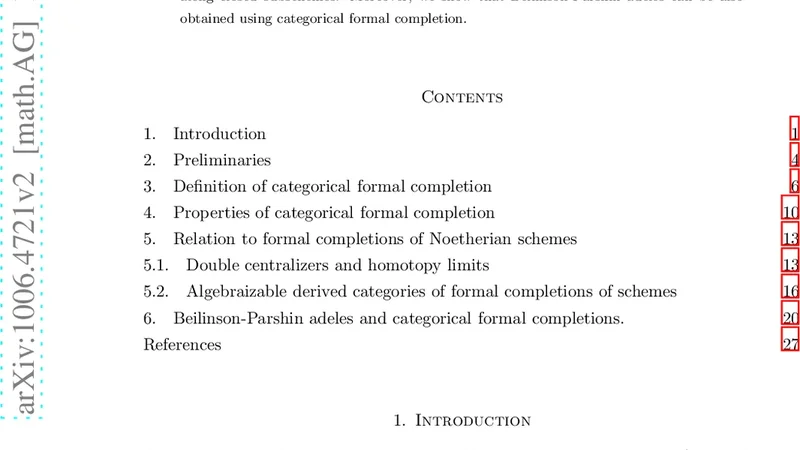
Following an idea of Kontsevich, we introduce and study the notion of formal completion of a compactly generated (by a set of objects) enhanced triangulated category along a full thick essentially small triangulated subcategory. In particular, we prove (answering a question of Kontsevich) that using categorical formal completion, one can obtain ordinary formal completions of Noetherian schemes along closed subschemes. Moreover, we show that Beilinson-Parshin adeles can be also obtained using categorical formal completion.
💡 Research Summary
The paper introduces a categorical notion of formal completion for compactly generated enhanced triangulated categories along a full thick essentially small triangulated subcategory, following an idea of Kontsevich. The authors first set up the necessary background: an enhanced triangulated category is a DG‑ or A∞‑category equipped with a triangulated homotopy category, and “compactly generated” means that a set of compact objects generates the whole category under arbitrary coproducts. A full thick subcategory that is essentially small is closed under shifts, cones, and direct summands, and contains only a set of isomorphism classes of objects.
With these ingredients, the authors define the formal completion (\widehat{\mathcal C}_\mathcal A) of a category (\mathcal C) along a subcategory (\mathcal A). The construction proceeds by regarding objects of (\mathcal A) as modules over (\mathcal C), forming the I‑adic filtration induced by the (\mathcal A)‑support, and then taking limits and colimits in the DG‑module category to obtain a new DG‑category. A key technical result, the “completion preservation theorem,” shows that this process respects the triangulated structure and yields again an enhanced triangulated category.
The second major contribution is a proof that this categorical formal completion recovers the classical formal completion of a Noetherian scheme along a closed subscheme. Let (X) be a Noetherian scheme and (Z\subset X) a closed subscheme. By taking (\mathcal A) to be the full thick subcategory of (\mathrm{D}{\mathrm{qc}}(X)) consisting of complexes with cohomology supported on (Z), the authors show that the completed structure sheaf (\widehat{\mathcal O}{X,Z}) obtained from (\widehat{\mathcal C}_\mathcal A) is canonically isomorphic to the usual (I)-adic completion (\widehat{\mathcal O}_X) where (I) is the ideal defining (Z). The proof hinges on identifying the (\mathcal A)-support filtration with the classical (I)-adic filtration and on the compatibility of limits in the DG‑category with sheaf‑theoretic completions. This answers a question posed by Kontsevich, confirming that the categorical framework indeed subsumes the traditional algebro‑geometric construction.
The third major result demonstrates that Beilinson‑Parshin adeles can be obtained via iterated categorical completions. For a scheme of dimension (d), one considers a chain of closed subschemes (Z_0\subset Z_1\subset\cdots\subset Z_d) corresponding to a flag of points. For each level (i) a full thick subcategory (\mathcal A_i) of complexes supported on (Z_i) is defined. By performing successive completions (\widehat{\mathcal C}{\mathcal A_0}, \widehat{(\widehat{\mathcal C}{\mathcal A_0})}_{\mathcal A_1},\dots) one arrives at a DG‑category whose homotopy category reproduces the adelic complex of Beilinson‑Parshin. This categorical viewpoint simplifies the intricate combinatorial description of adeles, replaces it with a clean sequence of universal constructions, and suggests new ways to generalize adelic methods to non‑commutative or derived settings.
The paper concludes with several technical appendices: proofs of the preservation of compactness under completion, compatibility of the construction with base change, and a discussion of how the formalism interacts with t‑structures and perverse sheaves. Overall, the work provides a robust bridge between derived categorical techniques and classical algebraic geometry, opening avenues for applying categorical formal completions to problems in deformation theory, arithmetic geometry, and derived non‑commutative geometry.
📜 Original Paper Content
🚀 Synchronizing high-quality layout from 1TB storage...