We present a conclusive answer to Bertrand's paradox, a long standing open issue in the basic physical interpretation of probability. The paradox deals with the existence of mutually inconsistent results when looking for the probability that a chord, drawn at random in a circle, is longer than the side of an inscribed equilateral triangle. We obtain a unique solution by substituting chord drawing with the throwing of a straw of finite length L on a circle of radius R, thus providing a satisfactory operative definition of the associated experiment. The obtained probability turns out to be a function of the ratio L/R, as intuitively expected.
Deep Dive into Bertrands paradox: a physical solution.
We present a conclusive answer to Bertrand’s paradox, a long standing open issue in the basic physical interpretation of probability. The paradox deals with the existence of mutually inconsistent results when looking for the probability that a chord, drawn at random in a circle, is longer than the side of an inscribed equilateral triangle. We obtain a unique solution by substituting chord drawing with the throwing of a straw of finite length L on a circle of radius R, thus providing a satisfactory operative definition of the associated experiment. The obtained probability turns out to be a function of the ratio L/R, as intuitively expected.
Bertrand's paradox is a basic example of the intrinsic ambiguity in the concept of randomness. It is associated with the probability that a chord, drawn at random in a circle, is longer than the side of an equilateral triangle inscribed in the circle. The paradoxical nature of the problem was originally stated by Bertrand [1], who showed how different solutions can be obtained based on different assumptions of equal a priori probabilities. Three situations are typically reported in the literature (see, e.g., [2]): 1) to fix one end of the chord on the circle and draw the diameter through the fixed end: all chords lying within ±30 degrees satisfy the length condition; 2) to draw a diameter through the midpoint of the given chord: chords intersecting the diameter between 1/4 and 3/4 of its length will have the required length; 3) to choose a point anywhere within the circle and construct a chord with the chosen point as its midpoint: if the midpoint lies in a circle of radius R/2, the length requirement will be again fulfilled. They lead to the result of uniform probability density p = 1/3, 1/2 , 1/4, respectively. Although these results, as well as many other possible ones, (see, e.g., ref. [3]) are mutually inconsistent, they are all correct. Actually, it is the very statement of the problem that is not satisfactory since the concept of drawing a chord at random is not uniquely defined, the random elements being not quantities but geometrical objects such as points, lines and angles which are assumed to be uniformly distributed [3].
The problem has been restated by Jaynes [4] in a different way, adopting a more physical perspective: a long straw is tossed at random onto a circle and the probability is sought that, given that it falls so to intercept the circle, the resulting chord is longer than the side of the inscribed equilateral triangle. By imposing the requirement of invariant probability density, he was able to show that the only solution compatible with the tossing of a long straw is p = 1/2, corresponding to case 2) above. However, his procedure still exhibits a somewhat limiting feature, i.e., the obviously finite length L of the straw is not explicitly taken into account, the straw only needing to be long. In fact, Jaynes invariant properties imply a common final result, i.e., a probability p independent from the radius R of the circle. As we shall see, this is actually true only if L is much larger than R. In this respect, we underline that in any problem requiring absolute randomness two criteria must be fulfilled : statistical equivalence of all relevant parameters and consideration of involved finite quantities.
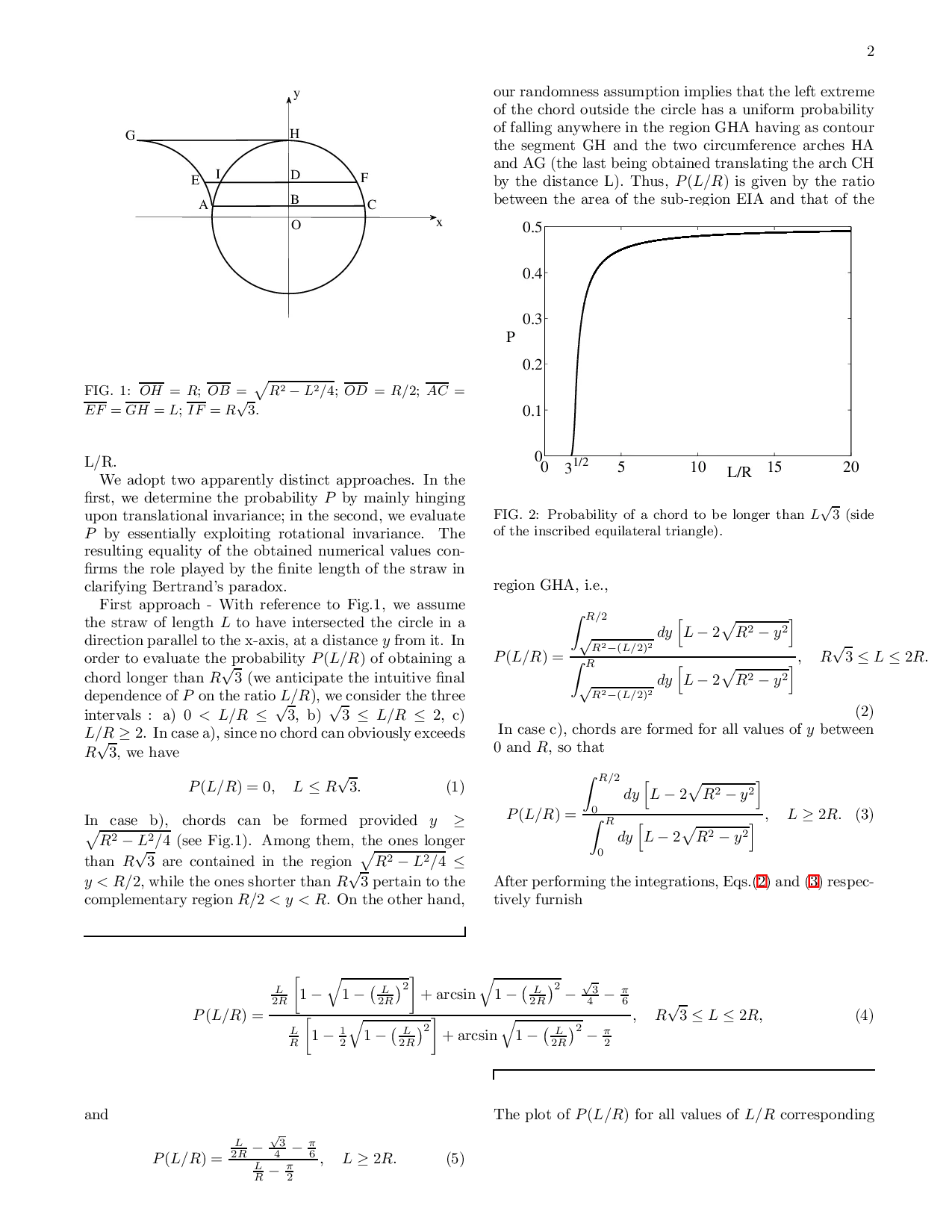
In order to meet the above criteria, in this Letter we deal with a finite straw length, facing the problem in the more complete form: a straw of length L is tossed at random onto a circle of radius R; given that it falls so that it intersects the circle, what is the probability that the chord thus defined is longer than the side of the inscribed equilateral triangle? The relevance of our procedure is two-fold. First, we obtain a well-defined answer more general and physically sound than that of Ref. [4]; second, our solution depends on the ratio L/R as a priori desirable and its limit for L/R ≫ 1 turns out to be 1/2, in agreement with Ref. [4]. We wish to underline the essential role played by the assumption of a finite value of L in devising a physically meaningful experiment in connection with Bertrand’s problem.
Let us consider an horizontal surface S over which we draw a circle of radius R. We have at our disposal a straw of length L and assume, in order to avoid unwanted edge effects, the linear dimensions of S to be much larger than both L and R. The straw is tossed at random onto S. What is the meaning of at random? In this context, the only sensible answer is that all positions and orientations on S are statistically equivalent: given a point of the straw (e.g., an extreme), its probability density of falling somewhere on S, as well as that of the straw orientation, are uniform. Due to the large extension of S, most of times the straw will not intercept the circle: nevertheless, by repeatedly tossing the straw, a chord will eventually be formed a number of times large enough to give meaning to Bertrand’s paradox. Below, we evaluate the associated probability, conditional to the straw intercepting the circle , and express it as a function of
L/R. We adopt two apparently distinct approaches. In the first, we determine the probability P by mainly hinging upon translational invariance; in the second, we evaluate P by essentially exploiting rotational invariance. The resulting equality of the obtained numerical values confirms the role played by the finite length of the straw in clarifying Bertrand’s paradox.
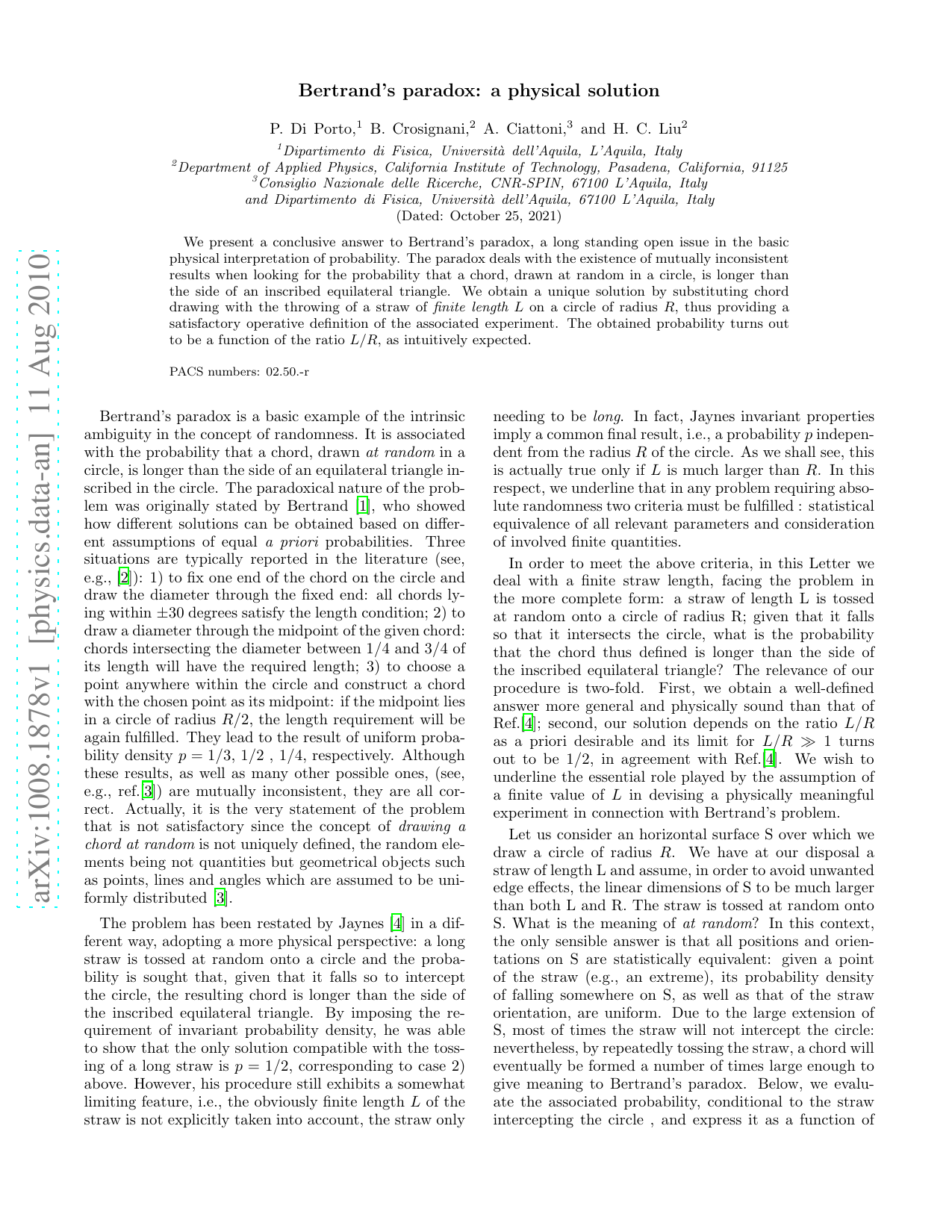
First approach -With reference to Fig. 1, we assume the straw of length L to have intersected the circle in a direction parallel to the x-axis, at a distance y from it. I
…(Full text truncated)…
This content is AI-processed based on ArXiv data.