The luminosity function and the rate of Swifts Gamma Ray Bursts
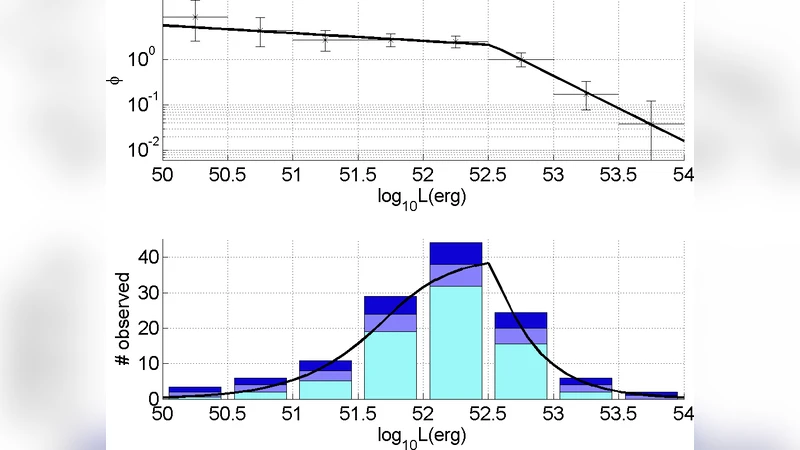
We invert directly the redshift - luminosity distribution of observed long Swift GRBs to obtain their rate and luminosity function. Our best fit rate is described by a broken power law that rises like (1+z)^2.1{+0.5-0.6} for 0<z<3 and decrease like (1+z)^-1.4{+2.4-1.0} for z>3. The local rate is 1.3^{+0.6-0.7} [Gpc^-3 yr^-1]. The luminosity function is well described by a broken power law with a break at L* = 10^52.5{+-0.2}[erg/sec] and with indices alpha = 0.2^{+0.2-0.1} and beta = 1.4^{+0.3-0.6}. The recently detected GRB 090423, with redshift ~8, fits nicely into the model’s prediction, verifying that we are allowed to extend our results to high redshifts. While there is a possible agreement with the star formation rate (SFR) for z<3, the high redshift slope is shallower than the steep decline in the SFR for 4<z. However we cannot rule out a GRB rate that follows one of the recent SFR models.
💡 Research Summary
The paper presents a direct inversion of the observed redshift–luminosity (z–L) distribution of long gamma‑ray bursts (GRBs) detected by the Swift satellite in order to simultaneously determine the cosmic GRB formation rate and the intrinsic luminosity function. Unlike many previous works that imposed external assumptions (e.g., that the GRB rate follows a specific star‑formation‑rate (SFR) model) or that treated the rate and luminosity function independently, the authors exploit the fact that the observed (z, L) sample encodes the product of the comoving rate density, the luminosity function, and the cosmological volume element. By correcting for Swift’s detection efficiency and selection biases, they model the rate as a broken power law in (1 + z) and the luminosity function as a broken power law with a characteristic break luminosity L*.
Using a Bayesian framework with Markov‑Chain Monte Carlo sampling, they find that the GRB formation rate rises as (1 + z)^{2.1^{+0.5}{‑0.6}} for 0 < z < 3 and declines as (1 + z)^{‑1.4^{+2.4}{‑1.0}} for z > 3. The local (z ≈ 0) rate is ρ₀ ≈ 1.3^{+0.6}{‑0.7} Gpc⁻³ yr⁻¹. The luminosity function is best described by a break at L* ≈ 10^{52.5 ± 0.2} erg s⁻¹, with a low‑luminosity slope α ≈ 0.2^{+0.2}{‑0.1} (nearly flat) and a high‑luminosity slope β ≈ 1.4^{+0.3}_{‑0.6} (significantly steeper).
A key validation comes from GRB 090423, whose spectroscopic redshift of ≈ 8 lies precisely on the extrapolation of the fitted model, indicating that the derived rate and luminosity function can be safely extended to very high redshifts. When compared with contemporary SFR measurements, the GRB rate matches the SFR for z < 3 but deviates at higher redshifts: the SFR is observed to fall sharply beyond z ≈ 4, whereas the GRB rate declines only modestly. This suggests that GRBs may not trace the global star‑formation history uniformly; instead, they could be preferentially associated with low‑metallicity, high‑mass star formation that persists longer than the bulk SFR. Nevertheless, the authors caution that the current high‑z GRB sample is sparse, and they cannot definitively rule out a GRB rate that follows any of the recent SFR parametrizations.
The study’s methodological contribution is significant: by inverting the observed z–L distribution without imposing a priori rate model, it provides a self‑consistent determination of both the rate evolution and the luminosity function. The broken‑power‑law form of the rate, with a peak around z ≈ 3, aligns with earlier indications of a “GRB‑enhancement” epoch, while the flat low‑luminosity slope implies a substantial population of faint GRBs that may be missed by current detectors. The derived local rate of ≈ 1 Gpc⁻³ yr⁻¹ is compatible with estimates from other instruments (e.g., BATSE, Fermi) after accounting for differing sensitivities.
In summary, the paper delivers a robust statistical framework for extracting the intrinsic properties of the Swift long‑GRB population, demonstrates consistency with the high‑redshift GRB 090423, and highlights both the agreement and tension with the cosmic star‑formation history. Future observations—particularly of faint, high‑z bursts—will be essential to refine the rate’s high‑redshift slope, test the metallicity‑bias hypothesis, and improve the precision of the luminosity‑function parameters.
Comments & Academic Discussion
Loading comments...
Leave a Comment