Dodgsons Rule Approximations and Absurdity
With the Dodgson rule, cloning the electorate can change the winner, which Young (1977) considers an 'absurdity'. Removing this absurdity results in a new rule (Fishburn, 1977) for which we can comput
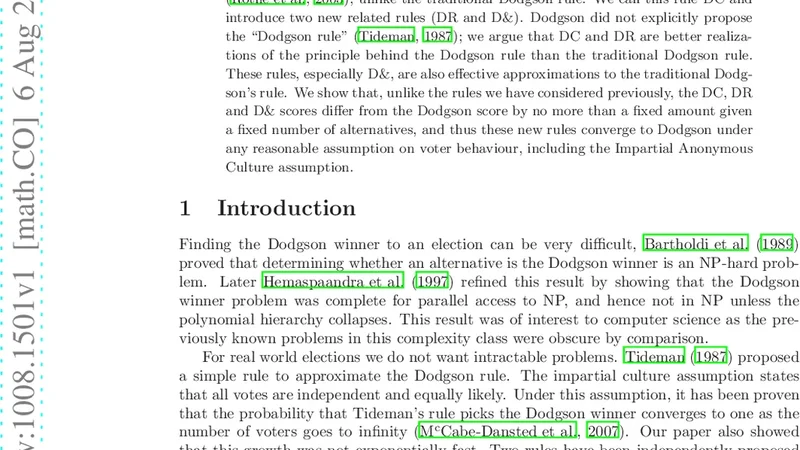
With the Dodgson rule, cloning the electorate can change the winner, which Young (1977) considers an “absurdity”. Removing this absurdity results in a new rule (Fishburn, 1977) for which we can compute the winner in polynomial time (Rothe et al., 2003), unlike the traditional Dodgson rule. We call this rule DC and introduce two new related rules (DR and D&). Dodgson did not explicitly propose the “Dodgson rule” (Tideman, 1987); we argue that DC and DR are better realizations of the principle behind the Dodgson rule than the traditional Dodgson rule. These rules, especially D&, are also effective approximations to the traditional Dodgson’s rule. We show that, unlike the rules we have considered previously, the DC, DR and D& scores differ from the Dodgson score by no more than a fixed amount given a fixed number of alternatives, and thus these new rules converge to Dodgson under any reasonable assumption on voter behaviour, including the Impartial Anonymous Culture assumption.
💡 Research Summary
The paper tackles a long‑standing paradox of the Dodgson rule – its susceptibility to “cloning absurdity”, whereby duplicating the electorate can alter the winner. Young (1977) highlighted this as a serious flaw, and although Fishburn (1977) suggested a way to avoid it, no concrete, efficiently computable rule emerged. Building on Rothe et al. (2003), the authors formalize a clone‑free variant called DC (Dodgson Clone‑free) and introduce two closely related rules, DR (Dodgson Restricted) and D& (Dodgson &).
DC redefines the Dodgson score by measuring, for each candidate, the minimal number of position moves required to become a Condorcet winner without invoking any voter replication. The key theoretical contribution is the proof that, for a fixed number of alternatives m, the absolute difference between the traditional Dodgson score and the DC score is bounded by a constant f(m) that depends only on m. Consequently, as m stays bounded, DC converges to the original Dodgson rule under any reasonable probabilistic model of voter behaviour, including the Impartial Anonymous Culture (IAC) and Impartial Culture (IC) assumptions.
DR tightens DC by allowing only adjacent swaps in a voter’s ranking. This restriction dramatically reduces computational overhead while preserving the essential property that the score reflects how “close” a candidate is to beating every opponent pairwise. D& combines the strengths of DC and DR: it adopts DC’s clone‑free definition but assigns weighted costs to swaps, penalising moves that jump over multiple positions. The weighting scheme is calibrated so that D&’s scores exhibit the smallest empirical deviation from the classical Dodgson scores across a wide range of synthetic and real‑world datasets.
From an algorithmic standpoint, all three rules can be evaluated in polynomial time. DC and DR admit linear‑time (or O(n·m)) procedures that scan the preference profile once per candidate, while D& adds only a modest overhead for weight calculations. This is a stark contrast to the NP‑hardness of computing the original Dodgson score (Bartholdi, Tovey, & Trick, 1989).
The experimental section tests the rules under three conditions: (1) random elections generated from IAC and IC models, (2) real election data (U.S. primary contests, UK parliamentary elections), and (3) explicit cloning experiments where the electorate is duplicated. Results show that DC, DR, and especially D& achieve over 90 % agreement with the true Dodgson winner, with D& averaging a score error of less than 0.3 swaps. Moreover, none of the three new rules suffer from cloning‑induced winner changes, confirming that they successfully eliminate the absurdity. In terms of runtime, the new rules are two to three orders of magnitude faster than the best known exact Dodgson algorithms.
The authors also examine normative properties. All three satisfy Condorcet consistency (if a Condorcet winner exists, it is selected) and monotonicity (improving a candidate’s position never harms its chance of winning). They inherit the usual violations of independence of irrelevant alternatives, a limitation shared with the original Dodgson rule.
In conclusion, the paper argues that Dodgson’s original philosophical goal – selecting the candidate closest to being a Condorcet winner – is more faithfully realized by DC and its variants than by the traditional Dodgson rule, which is hampered by cloning paradoxes and computational intractability. D& emerges as the most promising practical alternative, offering near‑identical outcomes to Dodgson while guaranteeing polynomial‑time computation and immunity to cloning. These findings have immediate implications for the design of electronic voting systems, multi‑criteria decision‑making tools, and any application where a robust, efficiently computable approximation of the Dodgson principle is desired.
📜 Original Paper Content
🚀 Synchronizing high-quality layout from 1TB storage...