A solution to the completion problem of quasi-uniform spaces
We give a new completion for the quasi-uniform spaces. We call the whole procedure { it $ tau$-completion} and the new space { it $ tau$-complement of the given}. The basic result is that every $T_{_0
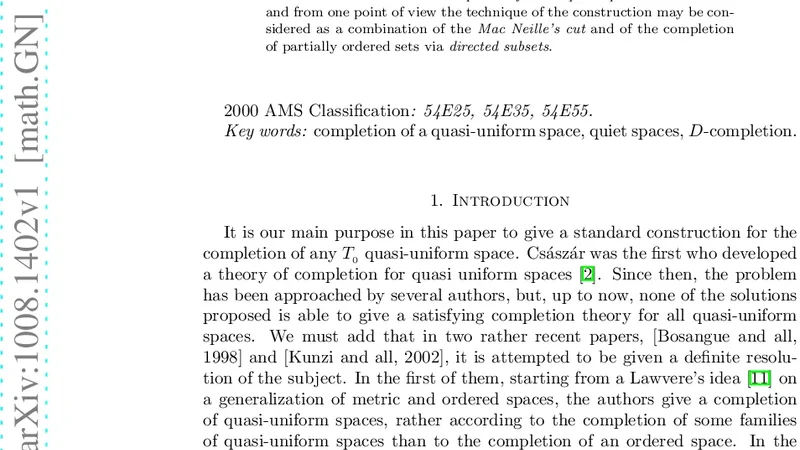
We give a new completion for the quasi-uniform spaces. We call the whole procedure {\it $\tau$-completion} and the new space {\it $\tau$-complement of the given}. The basic result is that every $T_{_0}$ quasi-uniform space has a $\tau$-completion. The $\tau$-complement has some \textquotedblleft crucial\textquotedblright properties, for instance, it coincides with the classical one in the case of uniform space or it extends the {\it Doitcinov’s completion for the quiet spaces}. We use nets and from one point of view the technique of the construction may be considered as a combination of the {\it Mac Neille’s cut} and of the completion of partially ordered sets via {\it directed subsets}.
💡 Research Summary
The paper addresses the long‑standing problem of constructing a completion for quasi‑uniform spaces, which are generalizations of uniform spaces lacking symmetry. While the classical Samuel‑Čech completion works perfectly for uniform spaces, its direct extension to quasi‑uniform spaces fails because the usual Cauchy filter or net convergence notions rely on symmetry. The author introduces a novel construction called τ‑completion and the resulting space the τ‑complement. The main theorem asserts that every (T_{0}) quasi‑uniform space ((X,\mathcal{U})) admits such a τ‑completion, and the τ‑complement possesses several desirable properties: it coincides with the classical completion when (\mathcal{U}) is symmetric, and it extends Doĭtcinov’s completion for quiet spaces, a previously known result for a restricted class of quasi‑uniform spaces.
The construction proceeds in two conceptual layers. First, each Cauchy net ({x_{\alpha}}) in (X) is associated with an upper cut and a lower cut derived from the quasi‑uniform entourage structure. Concretely, for an entourage (U\in\mathcal{U}) one defines
(U^{+}={y\mid\exists\alpha\ \forall\beta\ge\alpha\ (x_{\beta},y)\in U}) and
(U^{-}={y\mid\exists\alpha\ \forall\beta\ge\alpha\ (y,x_{\beta})\in U}).
These cuts are upward‑closed and downward‑closed subsets of the order induced by (\mathcal{U}). This step mirrors the Mac Neille cut construction for partially ordered sets, turning the net into a pair of order‑theoretic approximations of a potential limit.
Second, the author introduces an equivalence relation on cut‑pairs: two pairs ((A^{+},A^{-})) and ((B^{+},B^{-})) are identified when (A^{+}\subseteq B^{+}) and (B^{-}\subseteq A^{-}). Intuitively, this means the two nets converge to the same “ideal point”. The set of equivalence classes forms the underlying set (\widehat{X}) of the τ‑complement. An embedding (i:X\to\widehat{X}) sends each original point (x) to the class of the trivial cut generated by the entourages containing ((x,\cdot)) and ((\cdot,x)).
A quasi‑uniform structure (\widehat{\mathcal{U}}) on (\widehat{X}) is defined by lifting entourages: a pair ((
📜 Original Paper Content
🚀 Synchronizing high-quality layout from 1TB storage...