Scale Invariance of Immune System Response Rates and Times: Perspectives on Immune System Architecture and Implications for Artificial Immune Systems
Most biological rates and times decrease systematically with organism body size. We use an ordinary differential equation (ODE) model of West Nile Virus in birds to show that pathogen replication rate
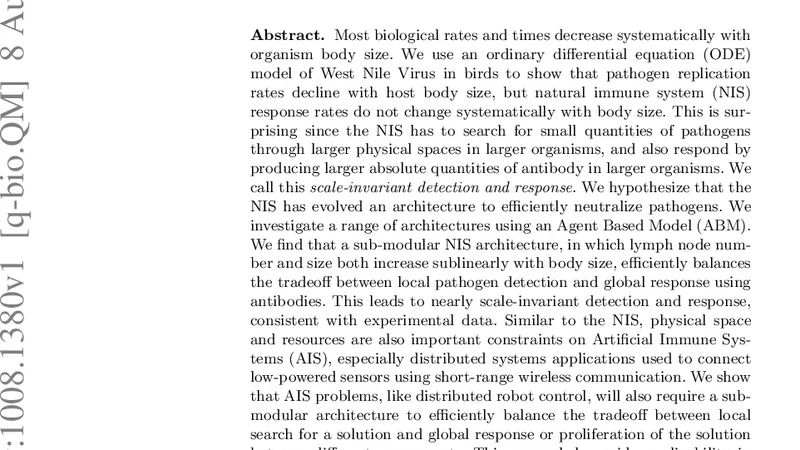
Most biological rates and times decrease systematically with organism body size. We use an ordinary differential equation (ODE) model of West Nile Virus in birds to show that pathogen replication rates decline with host body size, but natural immune system (NIS) response rates do not change systematically with body size. This is surprising since the NIS has to search for small quantities of pathogens through larger physical spaces in larger organisms, and also respond by producing larger absolute quantities of antibody in larger organisms. We call this scale-invariant detection and response. We hypothesize that the NIS has evolved an architecture to efficiently neutralize pathogens. We investigate a range of architectures using an Agent Based Model (ABM). We find that a sub-modular NIS architecture, in which lymph node number and size both increase sublinearly with body size, efficiently balances the tradeoff between local pathogen detection and global response using antibodies. This leads to nearly scale-invariant detection and response, consistent with experimental data. Similar to the NIS, physical space and resources are also important constraints on Artificial Immune Systems (AIS), especially distributed systems applications used to connect low-powered sensors using short-range wireless communication. We show that AIS problems, like distributed robot control, will also require a sub-modular architecture to efficiently balance the tradeoff between local search for a solution and global response or proliferation of the solution between different components. This research has wide applicability in other distributed systems AIS applications.
💡 Research Summary
The paper investigates why many biological rates and times scale with organism size, yet the natural immune system (NIS) appears to defy this rule. Using an ordinary differential equation (ODE) model of West Nile virus (WNV) infection in birds, the authors first demonstrate that viral replication rates decline with host body mass (approximately as M‑¾), consistent with metabolic scaling theory. In contrast, two key immune parameters—time to detect infection (t_det) and the rate of antibody production (k_Ab)—show no systematic dependence on body size. This “scale‑invariant detection and response” is surprising because larger organisms must search a greater physical volume for a limited number of pathogens and must produce a larger absolute quantity of antibodies.
To explain this paradox, the authors examine possible architectures of the lymphatic network. They contrast two extreme designs: (1) a monolithic system where the number of lymph nodes (LNs) is fixed and only node size grows with body mass, and (2) a fully modular system where both LN number and size increase linearly with body mass. The monolithic design yields fast local detection but insufficient global antibody output, whereas the fully modular design provides ample antibody production but suffers from delayed detection because each LN covers a very small tissue region.
The authors then construct an agent‑based model (ABM) that simulates individual LNs, immune cells, and pathogens moving in a three‑dimensional tissue space. By varying how LN number and size scale with body mass, they identify a sub‑modular architecture—where both LN number and size increase sublinearly (approximately as M^0.5)—as optimal. In this configuration, each LN covers a moderate tissue volume, preserving rapid pathogen encounter, while the increased LN size allows each node to host enough immune cells to generate a sufficient systemic antibody response. The ABM reproduces the empirical finding of size‑independent detection and response times across a wide range of bird sizes.
Having uncovered a biologically plausible design principle, the authors extend the analysis to artificial immune systems (AIS), especially distributed applications such as sensor networks and swarm robotics that rely on short‑range wireless communication and limited power. These systems face an analogous trade‑off: local search for a solution versus global dissemination of that solution. The paper argues that a sub‑modular network topology—mirroring the NIS—will balance these competing demands, enabling rapid local problem identification while keeping the communication overhead for global propagation low.
In summary, the study makes three major contributions: (1) it provides quantitative evidence that pathogen replication scales with body size while immune response rates do not; (2) it proposes and validates, via ABM, a sub‑modular lymphatic architecture that yields scale‑invariant immune performance; and (3) it translates this biological insight into design guidelines for AIS, suggesting that distributed systems should adopt sub‑modular structures to achieve efficient local‑global coordination. The work bridges immunology, scaling theory, and distributed computing, offering a unified framework for understanding how complex detection‑response networks can remain robust across orders of magnitude in size.
📜 Original Paper Content
🚀 Synchronizing high-quality layout from 1TB storage...