Evaluating Systematic Dependencies of Type Ia Supernovae: The Influence of Deflagration to Detonation Density
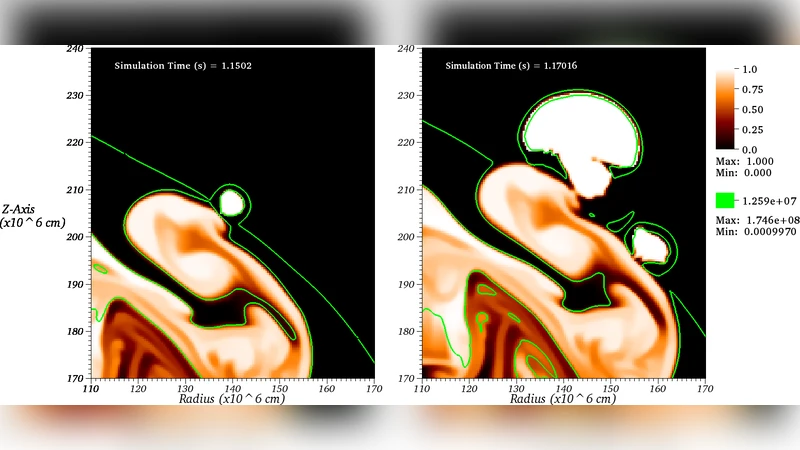
We explore the effects of the deflagration to detonation transition (DDT) density on the production of Ni-56 in thermonuclear supernova explosions (type Ia supernovae). Within the DDT paradigm, the transition density sets the amount of expansion during the deflagration phase of the explosion and therefore the amount of nuclear statistical equilibrium (NSE) material produced. We employ a theoretical framework for a well-controlled statistical study of two-dimensional simulations of thermonuclear supernovae with randomized initial conditions that can, with a particular choice of transition density, produce a similar average and range of Ni-56 masses to those inferred from observations. Within this framework, we utilize a more realistic “simmered” white dwarf progenitor model with a flame model and energetics scheme to calculate the amount of Ni-56 and NSE material synthesized for a suite of simulated explosions in which the transition density is varied in the range 1-3x10^7 g/cc. We find a quadratic dependence of the NSE yield on the log of the transition density, which is determined by the competition between plume rise and stellar expansion. By considering the effect of metallicity on the transition density, we find the NSE yield decreases by 0.055 +/- 0.004 solar masses for a 1 solar metallicity increase evaluated about solar metallicity. For the same change in metallicity, this result translates to a 0.067 +/- 0.004 solar mass decrease in the Ni-56 yield, slightly stronger than that due to the variation in electron fraction from the initial composition. Observations testing the dependence of the yield on metallicity remain somewhat ambiguous, but the dependence we find is comparable to that inferred from some studies.
💡 Research Summary
This paper investigates how the density at which a deflagration transitions to a detonation (the DDT density) controls the synthesis of ^56Ni and the overall amount of material that reaches nuclear statistical equilibrium (NSE) in Type Ia supernova (SN Ia) explosions. Within the DDT paradigm, the transition density determines how much the white dwarf expands during the subsonic deflagration phase; a lower transition density allows the star to expand more before the detonation, reducing the density at which burning proceeds to NSE and consequently lowering the ^56Ni yield. Conversely, a higher transition density keeps the star more compact, leading to a larger NSE mass and a brighter supernova.
To explore this systematically, the authors construct a statistical framework based on two‑dimensional hydrodynamic simulations. They randomize the initial flame geometry for each run, thereby sampling a broad range of plausible ignition conditions. The simulations employ a “simmered” white‑dwarf progenitor model that incorporates the pre‑explosion convective simmering phase, a flame‑capturing scheme, and an energetics prescription calibrated to reproduce realistic burning rates. By varying the DDT density between 1 × 10⁷ g cm⁻³ and 3 × 10⁷ g cm⁻³, they generate a suite of explosions whose average and spread of ^56Ni masses can be matched to the observed distribution (≈0.4–0.8 M☉, mean ≈0.6 M☉).
The key quantitative result is that the NSE mass depends quadratically on the logarithm of the transition density. Physically, this reflects the competition between buoyant plume rise (which tends to lift hot ash and promote expansion) and the global stellar expansion driven by the energy released in the deflagration. At low transition densities, plume rise dominates, the star expands substantially, and the density at detonation falls below the threshold for efficient NSE synthesis. At high transition densities, the detonation ignites earlier, before expansion can dilute the fuel, so a larger fraction of the star burns to NSE.
In addition to the pure density effect, the authors examine how metallicity (Z) influences the transition density and, through it, the ^56Ni yield. Metallicity affects the electron fraction (Yₑ) and the opacity of the progenitor, which in turn shift the conditions for DDT. By adopting a linear scaling of transition density with metallicity, they find that an increase of 1 Z☉ (evaluated about solar metallicity) reduces the NSE mass by 0.055 ± 0.004 M☉. Translating this into ^56Ni, the same metallicity change yields a decrease of 0.067 ± 0.004 M☉, a slightly larger effect than the direct reduction caused by the change in Yₑ alone. This metallicity‑dependent yield suppression is comparable in magnitude to the trends inferred from some observational studies that report fainter SNe Ia in metal‑rich host galaxies.
The paper discusses several caveats. First, the simulations are two‑dimensional; true three‑dimensional turbulence, flame wrinkling, and vortex dynamics could modify the plume‑rise versus expansion balance. Second, the adopted flame model and the prescription for the DDT criterion are simplified representations of a complex physical process that likely depends on local turbulence intensity, composition gradients, and magnetic fields. Third, the linear metallicity‑density relation is a first‑order approximation; more sophisticated progenitor evolution models might reveal non‑linear behavior.
Despite these limitations, the study provides the first statistically robust link between DDT density, metallicity, and the observable ^56Ni yield in SNe Ia. It demonstrates that modest changes in the transition density—whether driven by intrinsic variations in the ignition conditions or by systematic metallicity trends—can produce the range of ^56Ni masses seen in nature. The authors argue that future work should extend the analysis to fully three‑dimensional simulations, explore a broader metallicity range, and directly compare synthetic light curves and spectra with observations of SNe Ia in hosts spanning a wide range of chemical enrichment. Such efforts will sharpen the use of SNe Ia as precision distance indicators and improve our understanding of how stellar evolution and explosion physics conspire to set the brightness of these cosmological beacons.
Comments & Academic Discussion
Loading comments...
Leave a Comment