Multiphase modeling of tumor growth with matrix remodeling and fibrosis
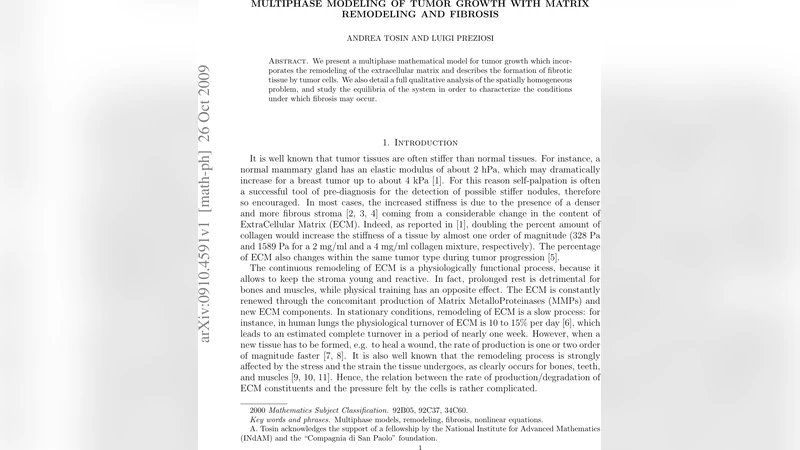
We present a multiphase mathematical model for tumor growth which incorporates the remodeling of the extracellular matrix and describes the formation of fibrotic tissue by tumor cells. We also detail a full qualitative analysis of the spatially homogeneous problem, and study the equilibria of the system in order to characterize the conditions under which fibrosis may occur.
💡 Research Summary
The paper introduces a multiphase continuum model that captures the interplay between tumor cells, the extracellular matrix (ECM), and interstitial fluid during tumor progression. By treating each component as a distinct phase—tumor cell volume fraction (φ_T), matrix volume fraction (φ_E), and fluid volume fraction (φ_F)—the authors derive a coupled system of partial differential equations that incorporates mass conservation, momentum balance, Darcy‑type fluid flow, and mechanochemical interactions such as pressure‑driven migration, friction between phases, and biochemical reactions (cell proliferation, apoptosis, matrix synthesis, and degradation). The total volume is constrained by φ_T+φ_E+φ_F=1, ensuring incompressibility of the mixture.
To make the problem analytically tractable, the authors first consider the spatially homogeneous case, reducing the PDEs to a three‑dimensional ordinary differential equation (ODE) system:
dφ_T/dt = g(φ_T,φ_E)·φ_T – d(φ_T,φ_E)·φ_T,
dφ_E/dt = α(φ_T)·φ_T – β(φ_E)·φ_E,
φ_F = 1 – φ_T – φ_E.
Here g and d are growth and death rates that depend on both cell density and matrix density, α represents matrix production by tumor cells, and β is the matrix degradation rate. The functional forms are chosen to reflect logistic growth, ECM‑mediated inhibition, and enzyme‑driven breakdown, respectively.
A comprehensive qualitative analysis follows. The authors identify all biologically relevant equilibria: (i) a tumor‑free, matrix‑free state; (ii) a proliferative tumor state with low matrix; and (iii) a fibrotic state where matrix accumulation is sustained (φ_E*>0). Existence conditions are derived by solving g(φ_T*,φ_E*)=d(φ_T*,φ_E*) and α(φ_T*)·φ_T* = β(φ_E*)·φ_E*. Linear stability is examined by computing the Jacobian at each equilibrium and analyzing eigenvalues. A critical growth parameter γ_c emerges: when the intrinsic tumor proliferation strength γ exceeds γ_c, the tumor‑free equilibrium loses stability, leading to uncontrolled cell expansion. Simultaneously, if the matrix degradation parameter β is sufficiently small, the system undergoes a pitchfork bifurcation that creates a new stable fibrotic equilibrium.
Beyond linear analysis, the paper explores nonlinear bifurcations using Lyapunov–Schmidt reduction and numerical continuation. A subcritical bifurcation is detected for certain ranges of the matrix production coefficient α and degradation coefficient β, implying the coexistence of two stable steady states (fibrotic vs. normal) and a hysteresis loop. This bistability suggests that therapeutic interventions must be sufficiently strong to push the system across the unstable branch; otherwise, the tumor may revert to a fibrotic phenotype after treatment cessation.
Parameter sensitivity studies reveal that simultaneous reduction of γ (e.g., by cytotoxic drugs) and increase of β (e.g., by matrix‑degrading enzymes) yields a synergistic effect: both φ_T and φ_E decay rapidly, and the system converges to the healthy equilibrium. Conversely, targeting only one pathway leads to partial remission, with either residual tumor cells or persistent matrix deposition. The authors illustrate these scenarios with time‑course simulations, highlighting the importance of combined anti‑tumor and anti‑fibrotic strategies.
The discussion acknowledges several limitations. Spatial heterogeneity, such as nutrient gradients and hypoxic cores, is omitted; the model assumes uniform concentrations throughout the tumor mass. Cellular heterogeneity (cancer stem cells, differentiated cells) and immune‑mediated interactions are not represented. Moreover, angiogenesis, a key driver of both tumor growth and matrix remodeling, is absent. The authors propose extending the framework to include additional phases (vascular endothelial cells, immune cells) and to couple the multiphase equations with reaction‑diffusion equations for oxygen, growth factors, and cytokines.
In summary, the paper delivers a rigorous mathematical framework that links tumor proliferation, ECM remodeling, and fibrosis. By performing a full qualitative analysis of the homogeneous system, it pinpoints the parameter regimes that trigger fibrotic tissue formation and clarifies the stability landscape of the tumor‑matrix ecosystem. These insights provide a theoretical basis for designing combination therapies that simultaneously curb tumor cell expansion and prevent pathological matrix deposition, thereby addressing a major obstacle in cancer treatment.
Comments & Academic Discussion
Loading comments...
Leave a Comment