The C*-algebras qAotimes K and S^2Aotimes K are asymptotically equivalent
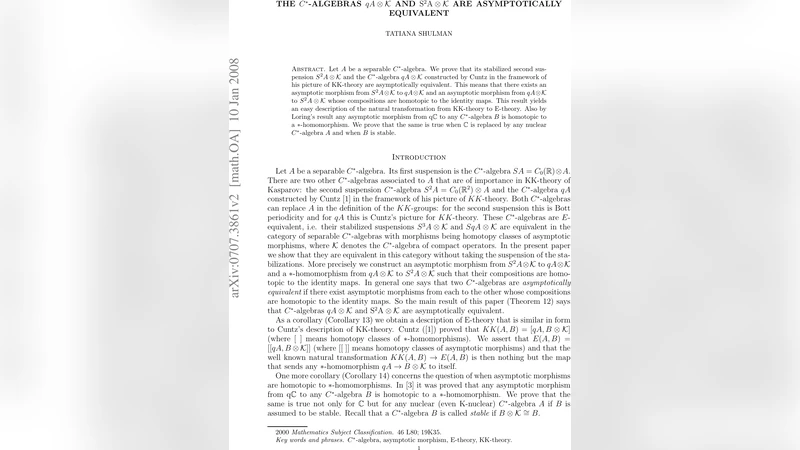
Let $A$ be a separable $C^$-algebra. We prove that its stabilized second suspension $S^2A\otimes \mathcal K$ and the $C^$-algebra $qA\otimes \mathcal K$ constructed by Cuntz in the framework of his picture of KK-theory are asymptotically equivalent. This means that there exist asymptotic morphisms from each to the other whose compositions are homotopic to the identity maps. This result yields an easy description of the natural transformation from KK-theory to E-theory. One more corollary is the following. T. Loring ([3]) proved that any asymptotic morphism from $\qC$ to any $C^$-algebra $B$ is homotopic to a $\ast$-homomorphism. We prove that the same is true when $\C$ is replaced by any nuclear $C^$-algebra $A$ and when $B$ is stable.
💡 Research Summary
The paper establishes that for any separable C*‑algebra (A) the stabilized second suspension (S^{2}A\otimes\mathcal K) and Cuntz’s algebra (qA\otimes\mathcal K) are asymptotically equivalent. The authors begin by recalling the constructions of the second suspension and of the Cuntz algebra (qA). The second suspension (S^{2}A) is obtained by applying the suspension functor twice; after tensoring with the compact operators (\mathcal K) the resulting algebra is stable and retains the K‑theoretic information of (A). The algebra (qA) is defined as the quotient of the free C*‑algebra generated by (A) by the ideal generated by the canonical inclusion of (A); it plays a central role in Cuntz’s picture of KK‑theory, where one has the canonical identification (KK(A,B)\cong
Comments & Academic Discussion
Loading comments...
Leave a Comment