On the Stickelberger splitting map in the $K$--theory of number fields
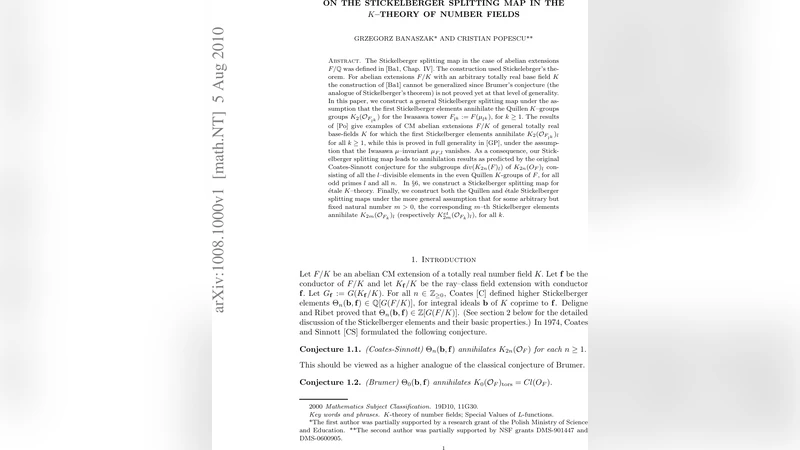
The Stickelberger splitting map in the case of abelian extensions $F / \Q$ was defined in [Ba1, Chap. IV]. The construction used Stickelebrger’s theorem. For abelian extensions $F / K$ with an arbitrary totally real base field $K$ the construction of \cite{Ba1} cannot be generalized since Brumer’s conjecture (the analogue of Stickelberger’s theorem) is not proved yet at that level of generality. In this paper, we construct a general Stickelberger splitting map under the assumption that the first Stickelberger elements annihilate the Quillen $K$–groups groups $K_2 ({\mathcal O}{F{l^k}})$ for the Iwasawa tower $F_{l^k} := F(\mu_{l^k})$, for $k \geq 1.$ The results of [Po] give examples of CM abelian extensions $F/K$ of general totally real base-fields $K$ for which the first Stickelberger elements annihilate $K_2 ({\mathcal O}{F{l^k}})l$ for all $k \geq 1$, while this is proved in full generality in [GP], under the assumption that the Iwasawa $\mu$–invariant $\mu{F,l}$ vanishes. As a consequence, our Stickelberger splitting map leads to annihilation results as predicted by the original Coates-Sinnott conjecture for the subgroups $div(K_{2n}(F)l)$ of $K{2n}(O_F)l$ consisting of all the $l$–divisible elements in the even Quillen $K$-groups of $F$, for all odd primes $l$ and all $n$. } In \S6, we construct a Stickelberger splitting map for 'etale $K$–theory. Finally, we construct both the Quillen and 'etale Stickelberger splitting maps under the more general assumption that for some arbitrary but fixed natural number $m>0$, the corresponding $m$–th Stickelberger elements annihilate $K{2m} ({\mathcal O}{F_k})l$ (respectively $K^{et}{2m} ({\mathcal O}{F_k})_l$), for all $k$
💡 Research Summary
The paper develops a general construction of the Stickelberger splitting map in algebraic K‑theory for abelian extensions (F/K) where the base field (K) is an arbitrary totally real number field. In the classical setting of abelian extensions over (\mathbb{Q}), Ba1 (Chapter IV) used Stickelberger’s theorem to define such a map. However, for a general totally real base field the analogue of Stickelberger’s theorem—Brumer’s conjecture—is not known, preventing a direct generalisation.
To overcome this obstacle the authors assume that the first Stickelberger elements annihilate the Quillen (K)-groups (K_{2}(\mathcal{O}{F{l^{k}}})) for the Iwasawa tower (F_{l^{k}}:=F(\mu_{l^{k}})) (with (k\ge 1) and (l) an odd prime). This hypothesis is satisfied in two important families of examples: (i) the CM abelian extensions considered by Popescu, where the annihilation holds for all (k); and (ii) the work of Greither–Popescu, which proves the same statement for all abelian extensions provided the Iwasawa (\mu)-invariant (\mu_{F,l}) vanishes.
Under this hypothesis the authors construct a concrete Stickelberger splitting map on the Quillen (K)-theory groups (K_{2}(\mathcal{O}{F{l^{k}}})_{l}). The map is Galois‑equivariant and respects the natural projective system coming from the Iwasawa tower. Using it they obtain annihilation results for the (l)-divisible subgroup \
Comments & Academic Discussion
Loading comments...
Leave a Comment