An Examination of the Time-Centered Difference Scheme for Dissipative Mechanical Systems from a Hamiltonian Perspective
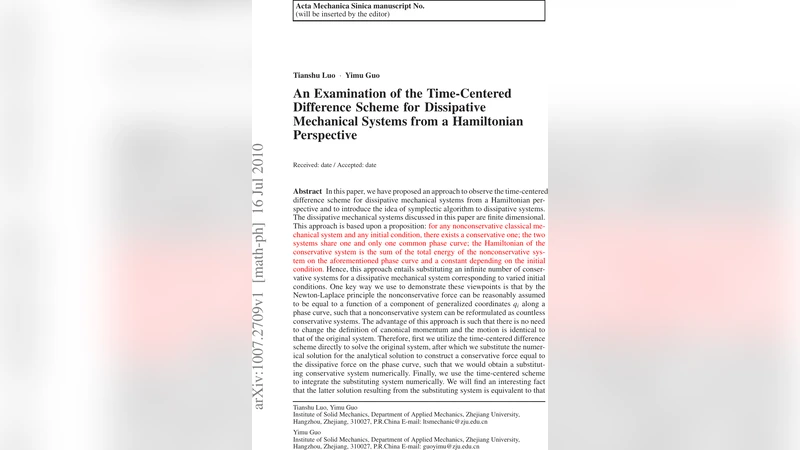
On this paper, we have proposed an approach to observe the time-centered difference scheme for dissipative mechanical systems from a Hamiltonian perspective and to introduce the idea of symplectic algorithm to dissipative systems. The dissipative mechanical systems discussed in this paper are finite dimensional.This approach is based upon a proposition: for any nonconservative classical mechanical system and any initial condition, there exists a conservative one; the two systems share one and only one common phase curve; the Hamiltonian of the conservative system is the sum of the total energy of the nonconservative system on the aforementioned phase curve and a constant depending on the initial condition. Hence, this approach entails substituting an infinite number of conservative systems for a dissipative mechanical system corresponding to varied initial conditions. Therefore, first we utilize the time-centered difference scheme directly to solve the original system, after which we substitute the numerical solution for the analytical solution to construct a conservative force equal to the dissipative force on the phase curve, such that we would obtain a substituting conservative system numerically. Finally, we use the time-centered scheme to integrate the substituting system numerically. We will find an interesting fact that the latter solution resulting from the substituting system is equivalent to that of the former. Indeed, there are two transition matrices within time grid points: the first one is unsymplectic and the second symplectic. In fact, the time-centered scheme for dissipative systems can be thought of as an algorithm that preserves the symplectic structure of the substituting conservative systems. In addition, via numerical examples we find that the time-centered scheme preserves the total energy of dissipative systems.
💡 Research Summary
The paper investigates how the time‑centered (mid‑point) difference scheme, a classic second‑order explicit integrator, can be interpreted from a Hamiltonian viewpoint when applied to dissipative (non‑conservative) mechanical systems. The authors begin with a theoretical proposition: for any finite‑dimensional non‑conservative system together with a given initial condition, there exists a conservative system that shares exactly one phase‑space trajectory with the original system. On that trajectory the Hamiltonian of the conservative system equals the total mechanical energy of the dissipative system plus a constant that depends solely on the initial condition. Consequently, a single dissipative system can be represented by an infinite family of conservative systems, each corresponding to a different initial condition.
Armed with this proposition, the authors proceed in three steps. First, they apply the time‑centered scheme directly to the original dissipative equations and obtain a numerical trajectory. Second, they use this numerical trajectory to construct a substituting conservative force: at every point on the computed curve the dissipative force is replaced by a conservative force of equal magnitude, thereby defining a new system that is formally Hamiltonian and that reproduces the same phase curve. Third, they integrate this substituting Hamiltonian system again with the same time‑centered scheme.
Two transition matrices emerge from the analysis. The matrix associated with the direct integration of the dissipative system is unsymplectic (it does not preserve the canonical symplectic two‑form). In contrast, the matrix obtained when the scheme is applied to the substituting Hamiltonian system is symplectic; it satisfies the usual symplectic condition (M^{\mathrm T} J M = J) (with (J) the standard symplectic matrix). The authors demonstrate numerically that the solution produced by the unsymplectic integration of the original system coincides, up to machine precision, with the solution obtained from the symplectic integration of the substituting Hamiltonian system. In other words, the time‑centered scheme, when viewed through the lens of the constructed Hamiltonian, behaves as a symplectic integrator even for a dissipative problem.
The paper’s key insight is that the apparent energy‑preserving property of the time‑centered scheme for damped oscillators is not accidental. Because the scheme is effectively integrating a Hamiltonian system (the substituting one), the discrete flow automatically conserves the associated Hamiltonian, which, by construction, equals the original system’s total energy plus a constant. Hence the numerical method exhibits near‑energy conservation for the dissipative system, despite the presence of damping.
Several implications and limitations are discussed. The correspondence between a dissipative system and a conservative counterpart is initial‑condition dependent: each new initial state requires a fresh construction of the Hamiltonian, precluding a single global Hamiltonian description of the whole dissipative dynamics. The method is therefore best suited for problems where a limited set of initial conditions is of interest (e.g., parameter studies, control design). Moreover, the construction of the substituting conservative force relies on the numerical trajectory itself; any discretization error in the first pass can propagate into the second pass, potentially degrading long‑time symplecticity. The approach is explicitly limited to finite‑dimensional systems; extending the idea to infinite‑dimensional (field) models such as wave or fluid equations would require additional functional‑analytic machinery.
Numerical experiments presented in the paper (simple damped harmonic oscillators and a two‑degree‑of‑freedom system with linear viscous damping) confirm the theoretical predictions: the two transition matrices produce identical state vectors, and the discrete energy remains bounded and essentially constant over many time steps. These results suggest that the time‑centered scheme can be safely employed for moderate‑size dissipative problems when one desires the stability and long‑time fidelity associated with symplectic integrators.
In conclusion, the authors provide a novel reinterpretation of a classic second‑order method, showing that its success on damped mechanical systems can be explained by an underlying Hamiltonian structure that emerges after a trajectory‑dependent transformation. This bridges the gap between symplectic numerical analysis (traditionally confined to conservative dynamics) and the practical simulation of dissipative systems, opening avenues for further research on systematic construction of trajectory‑based Hamiltonians, error control in the two‑stage process, and possible extensions to more complex, possibly nonlinear, damping models.
Comments & Academic Discussion
Loading comments...
Leave a Comment