Transits of Transparent Planets - Atmospheric Lensing Effects
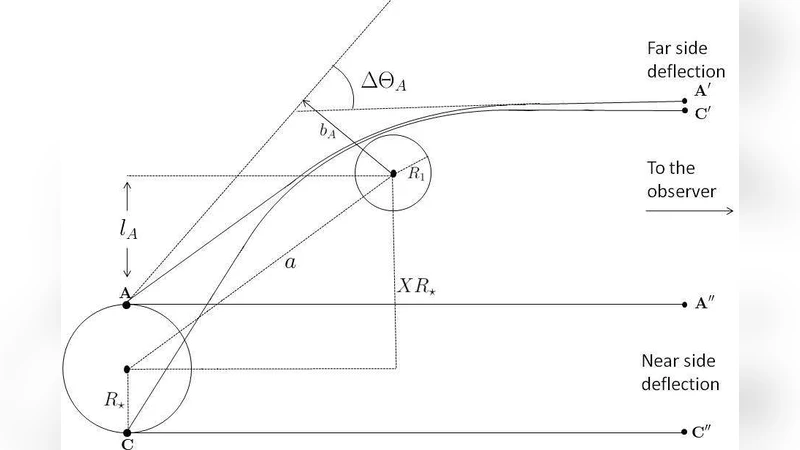
Light refracted by the planet’s atmosphere is usually ignored in analysis of planetary transits. Here we show that refraction can add shoulders to the transit light curve, i.e., an increase in the observed flux, mostly just before and after transit. During transit, light may be refracted away from the observer. Therefore, even completely transparent planets will display a very similar signal to that of a standard transit, i.e., that of an opaque planet. We provide analytical expression for the amount of additional light deflected towards the observer before the transit, and show that the effect may be as large as $10^{-4}$ of the stellar light and therefore measurable by current instruments. By observing this effect we can directly measure the scale height of the planet’s atmosphere. We also consider the attenuation of starlight in the planetary atmosphere due to Rayleigh scattering and discuss the conditions under which the atmospheric lensing effect is most prominent. We show that, for planets on orbital periods larger than about 70 days, the size of the transit is determined by refraction effects, and not by absorption within the planet.
💡 Research Summary
The paper investigates a previously neglected physical process in exoplanet transit observations: the refraction of starlight by a planet’s atmosphere. While most transit analyses assume that only the opaque planetary disk blocks stellar photons, the authors demonstrate that even a completely transparent planet can produce a characteristic light‑curve signature due to atmospheric lensing. Their main findings are as follows.
First, atmospheric refraction bends incoming stellar rays toward the observer before the planet’s geometric ingress and after egress, creating “shoulders” – modest increases in observed flux that flank the main transit dip. By modeling the atmosphere as a spherically symmetric, exponentially decreasing density profile, they derive an analytical expression for the additional flux. The magnitude of the effect scales with the atmospheric scale height H, the planetary radius R, and inversely with the square of the star‑planet separation a. For typical gas‑giant parameters and orbital periods longer than ~70 days, the predicted flux excess can reach ∼10⁻⁴ of the stellar brightness, well within the detection limits of current space‑based photometers (e.g., TESS, CHEOPS, JWST).
Second, during the actual transit the same refraction can divert some of the starlight away from the line of sight, effectively enlarging the apparent occulting area. Consequently, a perfectly transparent planet will still produce a transit depth comparable to that of an opaque body, making the traditional radius measurement ambiguous unless refraction is accounted for.
The authors also incorporate Rayleigh scattering and molecular absorption into a combined attenuation model. Rayleigh scattering follows a λ⁻⁴ dependence, so the shoulder amplitude is larger at blue wavelengths, while absorption by H₂, He, and trace molecules further modulates the signal. Their calculations show that, depending on atmospheric temperature, composition, and mean molecular weight, the net refractive‑plus‑scattering signal can vary between 10⁻⁴ and 10⁻³ of the stellar flux.
A key practical outcome is that the shape and amplitude of the pre‑ and post‑transit shoulders provide a direct measurement of the atmospheric scale height H, without requiring detailed spectral retrievals. By measuring the temporal width of the shoulder (Δt) and its peak flux increase (ΔF/F), and knowing the orbital velocity (from the period and stellar mass), one can solve for H analytically. This offers a novel, model‑independent probe of atmospheric temperature and mean molecular weight, especially valuable for planets with clear, cloud‑free upper atmospheres.
The paper evaluates observational feasibility. Current photometric missions achieve sub‑10⁻⁴ precision over transit timescales, and JWST’s NIR instruments can simultaneously record high‑resolution spectra and precise light curves, enabling simultaneous constraints on refraction and scattering. However, the authors caution that stellar variability, instrumental systematics, and orbital inclination uncertainties must be carefully mitigated. Long‑period planets (P > 70 days) have fewer transits per observing campaign, demanding extended monitoring and robust detrending techniques.
In summary, this work adds atmospheric refraction to the toolbox of exoplanet characterization. It shows that even “transparent” planets imprint a measurable lensing signature on their light curves, that this signature can be used to infer atmospheric scale height, and that for planets on wider orbits the apparent transit size may be dominated by refraction rather than absorption. The results open a new observational window on exoplanet atmospheres and suggest that future transit surveys should incorporate refractive modeling into their data analysis pipelines.
Comments & Academic Discussion
Loading comments...
Leave a Comment