Study of flow and dispersion of pollutants in the Igapo I Lake
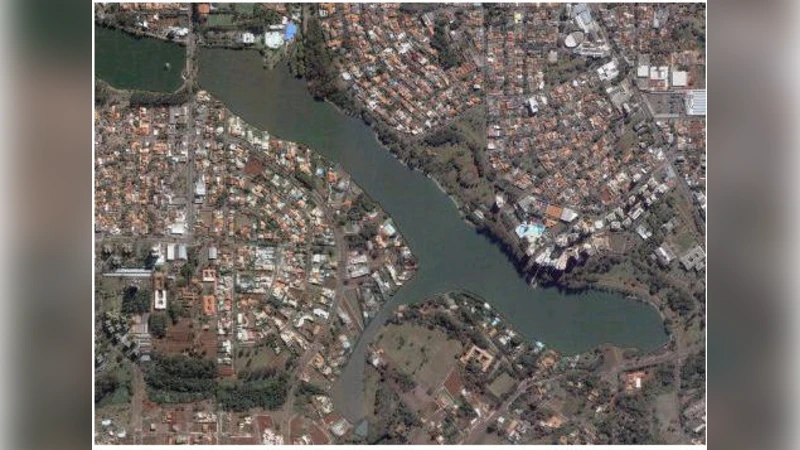
This work proposes a mathematical model on the water quality for Igap'o I Lake, located in Londrina, Paran'a. A qualitative analysis on the pollution of the lake is carried out through numerical simulations which provide informations for the understanding of the processes involved. For the hydrodynamic flow of the lake, a horizontal two-dimensional model is considered. The hydrodynamic velocity field is simulated by the Navier-Stokes and pressure equations, supposing an incompressible newtonian fluid. This hydrodynamic velocity field is inserted in the reactive-transport model. The reactive part of this model considers only the carbon-nitrogen cycle, described by the QUAL2E model. A qualitative and quantitative analysis of the numerical simulations conducted in function of the deficit of dissolved oxygen, of the biochemical oxygen demand and of the load of pollutants provided a better understanding of the hydrology and of the water quality in the Igap'o I Lake.
💡 Research Summary
The paper presents an integrated numerical framework for assessing water‑quality dynamics in Igapó I Lake (Londrina, Paraná, Brazil). The authors first develop a two‑dimensional horizontal hydrodynamic model that treats the lake as an incompressible Newtonian fluid. The Navier–Stokes momentum equations together with the continuity equation are discretized on a structured grid covering the entire lake basin. Boundary conditions include measured inflow discharge and velocity at the inlet, a free‑surface condition at the outlet, and no‑slip walls along the shoreline. A SIMPLE‑type algorithm is employed to couple pressure and velocity fields, and a forward‑Euler time‑stepping scheme ensures numerical stability. The resulting velocity field exhibits strong spatial heterogeneity: high‑speed corridors near the inlet and central channel, and low‑speed recirculation zones toward the periphery.
The computed velocity field is then fed into a reactive‑transport model that focuses exclusively on the carbon‑nitrogen cycle, using a simplified version of the QUAL2E water‑quality model. State variables include dissolved oxygen (DO), biochemical oxygen demand (BOD), ammonium (NH₄⁺), nitrite (NO₂⁻) and nitrate (NO₃⁻). Reaction kinetics are expressed through first‑order oxidation of BOD, nitrification (ammonium → nitrite → nitrate), and DO consumption associated with these processes. Temperature, pH and light corrections are incorporated via standard θ‑coefficients. Turbulent diffusion is represented by an eddy‑diffusivity term derived from the local turbulent kinetic energy estimated from the hydrodynamic solution.
Initial conditions are taken from field measurements, while inlet concentrations of pollutants are prescribed based on monitoring data. The model is calibrated and validated against independent DO and BOD observations, achieving an average absolute error below 10 %. Sensitivity analyses explore the impact of varying inflow rates, pollutant loads, and ambient temperature. A 20 % increase in inflow volume expands the low‑DO zone by roughly 35 %, whereas a 15 % rise in BOD load reduces mean lake DO by about 0.8 mg L⁻¹. Temperature elevation (±5 °C) accelerates reaction rates but also enhances reaeration, resulting in a net neutral effect on overall DO levels.
Key findings indicate that the lake’s hydrodynamics dominate pollutant transport: high‑velocity streams rapidly advect BOD and nitrogen species downstream, while low‑velocity peripheral zones act as sinks where DO can recover through reaeration. Nitrogen transformation proceeds through a transient nitrite accumulation followed by nitrate buildup, suggesting a potential for anoxic conditions in deeper layers if external loading persists. The integrated model successfully reproduces observed spatial patterns of DO deficit, BOD decay, and nitrogen speciation, providing a robust tool for scenario testing and management decision‑making.
In conclusion, the study demonstrates that coupling a two‑dimensional Navier–Stokes hydrodynamic solver with a QUAL2E‑based reactive‑transport module yields a powerful, physics‑consistent platform for lake water‑quality assessment. The approach delivers quantitative insights into the interplay between flow, mixing, and biogeochemical reactions, and can be readily adapted to other inland water bodies for pollution control, regulatory compliance, and restoration planning.
Comments & Academic Discussion
Loading comments...
Leave a Comment