Quantum Logic in Dagger Kernel Categories
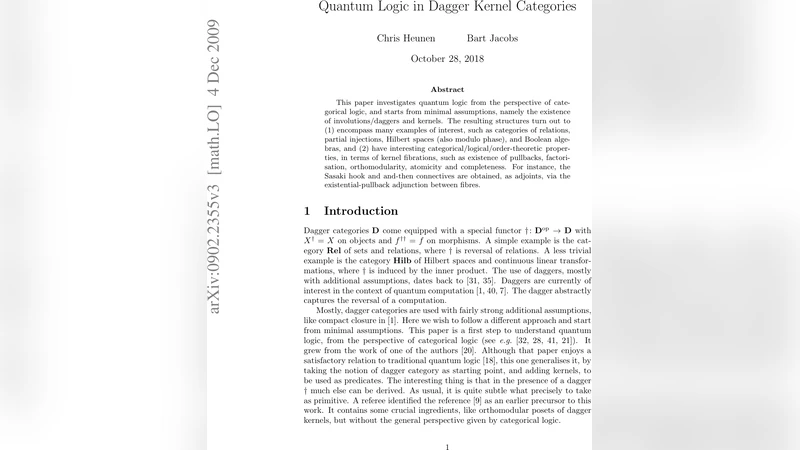
This paper investigates quantum logic from the perspective of categorical logic, and starts from minimal assumptions, namely the existence of involutions/daggers and kernels. The resulting structures turn out to (1) encompass many examples of interest, such as categories of relations, partial injections, Hilbert spaces (also modulo phase), and Boolean algebras, and (2) have interesting categorical/logical properties, in terms of kernel fibrations, such as existence of pullbacks, factorisation, and orthomodularity. For instance, the Sasaki hook and and-then connectives are obtained, as adjoints, via the existential-pullback adjunction between fibres.
💡 Research Summary
The paper introduces a novel categorical framework for quantum logic that rests on the minimal assumptions of a dagger (an involutive, contravariant functor) and the existence of kernels for every morphism. This structure, termed a “dagger kernel category,” is shown to be sufficiently rich to capture the essential logical features of quantum theory while encompassing a wide variety of concrete examples, including the category of relations (Rel), the category of partial injections (PInj), the category of Hilbert spaces (Hilb) modulo global phase, and Boolean algebras.
The authors begin by formalising the notion of a dagger kernel category. A dagger provides, for each morphism f : X→Y, an adjoint f† : Y→X satisfying (f†)† = f and (g∘f)† = f†∘g†. Kernels are defined in the usual categorical sense: for any f there exists a monomorphism ker f : K→X such that f∘ker f = 0 and any morphism h with f∘h = 0 factors uniquely through ker f. No further structure (e.g., biproducts, monoidal tensor) is required.
From these primitives the authors construct a kernel fibration: for each object X, the fibre consists of all subobjects of X given by kernels, ordered by inclusion. This fibre forms a complete lattice. Crucially, for any morphism f : X→Y there are two associated fibre maps: the pullback f* : Sub(Y) → Sub(X) sending a subobject S↪Y to its pre‑image under f, and the existential direct image ∃f : Sub(X) → Sub(Y) defined via the image factorisation of f∘s. The authors prove that ∃f ⊣ f* holds, i.e., ∃f is left adjoint to the pullback. This adjunction is the categorical source of logical connectives.
Using the adjunction, the paper derives the Sasaki hook (→S) and the “and‑then” connective (⊗S). The Sasaki hook is defined for subobjects a, b of X by a →S b = (a⊥ ∨ (a ∧ b)), where a⊥ denotes the orthogonal complement obtained via the dagger. The and‑then connective is a ⊗S b = a ∧ (a⊥ ∨ b). Both operations arise as right and left adjoints of the pullback functor, respectively, mirroring the familiar adjointness of implication and conjunction in intuitionistic logic but now adapted to the orthomodular setting.
The authors then verify that a wide range of familiar categories satisfy the dagger‑kernel axioms. In Rel, the dagger is relational converse, and kernels correspond to relational pre‑images; in PInj, the dagger is functional inverse on partial injections, and kernels are ordinary subsets. In Hilb, the dagger is the adjoint of a bounded linear operator, and kernels are closed subspaces; quotienting by the global phase eliminates the irrelevant scalar factor, yielding a genuinely projective structure. Boolean algebras appear as degenerate dagger‑kernel categories where the dagger is identity and kernels are set‑theoretic complements. In each case the subobject lattice is orthomodular, confirming that orthomodularity is a robust consequence of the dagger‑kernel axioms rather than an extra assumption.
Beyond examples, the paper establishes several categorical properties. Pullbacks always exist in the kernel fibration, ensuring that the logical operations are well‑behaved under substitution. Every morphism admits a factorisation into an epimorphism followed by a monomorphism (the image factorisation), and the image of a kernel is again a kernel, which underlies the orthomodular law. The authors also show that the kernel fibration is a regular fibration, providing a sound categorical semantics for a quantum propositional logic that includes both implication (via the Sasaki hook) and a sequential conjunction (via and‑then).
In the concluding discussion the authors argue that dagger‑kernel categories provide a unifying, minimalistic foundation for quantum logic. Because the framework requires only a dagger and kernels, it can be instantiated in many settings of interest to quantum information and computation, such as categorical models of quantum programming languages, diagrammatic calculi for quantum processes, and abstract treatments of quantum measurement. The adjoint‑based derivation of logical connectives suggests a deep link between categorical dualities (dagger, adjunction) and the non‑classical logical structure of quantum theory, opening avenues for further research into categorical semantics of quantum protocols, resource theories, and the development of new logical systems that respect the orthomodular nature of quantum propositions.
Comments & Academic Discussion
Loading comments...
Leave a Comment