Bounded Coordinate-Descent for Biological Sequence Classification in High Dimensional Predictor Space
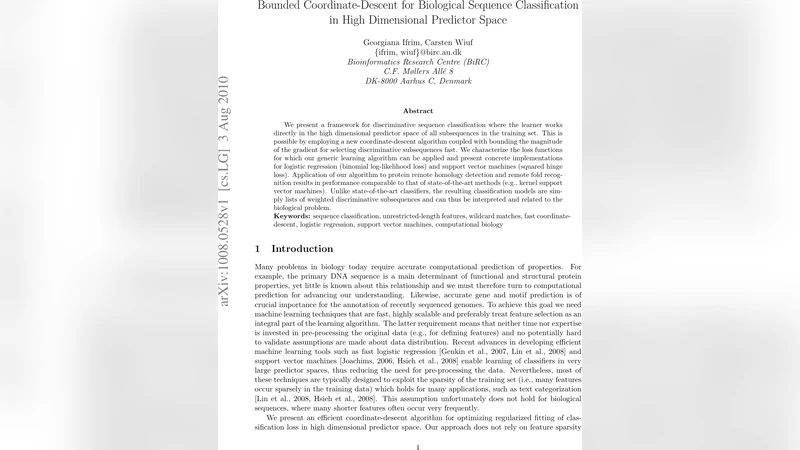
We present a framework for discriminative sequence classification where the learner works directly in the high dimensional predictor space of all subsequences in the training set. This is possible by employing a new coordinate-descent algorithm coupled with bounding the magnitude of the gradient for selecting discriminative subsequences fast. We characterize the loss functions for which our generic learning algorithm can be applied and present concrete implementations for logistic regression (binomial log-likelihood loss) and support vector machines (squared hinge loss). Application of our algorithm to protein remote homology detection and remote fold recognition results in performance comparable to that of state-of-the-art methods (e.g., kernel support vector machines). Unlike state-of-the-art classifiers, the resulting classification models are simply lists of weighted discriminative subsequences and can thus be interpreted and related to the biological problem.
💡 Research Summary
The paper introduces a novel learning framework for biological sequence classification that operates directly in the extremely high‑dimensional predictor space formed by all subsequences (k‑mers, gapped patterns, etc.) present in the training data. Traditional approaches either embed sequences into a low‑dimensional feature space or rely on kernel functions that implicitly compute inner products in a high‑dimensional space. While powerful, kernel methods require costly parameter tuning, suffer from scalability issues, and produce models that are difficult to interpret biologically.
Core contribution – Bounded Coordinate Descent (BCD).
The authors propose a coordinate‑descent algorithm that updates one weight (corresponding to a single subsequence) at a time, but crucially avoids the naïve O(|S|) scan over the entire subsequence set S, which can contain millions or billions of elements. The key insight is to bound the magnitude of the gradient for each coordinate using a simple upper‑bound derived from the loss derivative and the number of training instances that contain the subsequence. Formally, for a weight w_s the gradient is
g_s = Σ_i ℓ′(y_i, f(x_i))·φ_s(x_i)
where φ_s(x_i) is the indicator or count of subsequence s in sequence x_i. Because ℓ′ is bounded for the loss functions considered (log‑loss and squared hinge loss), the authors compute
|g_s| ≤ max_{i∈I_s} |ℓ′(y_i, f(x_i))|·|I_s|
with I_s the set of training examples that contain s. Only coordinates whose upper‑bound exceeds a dynamically adjusted threshold are examined further; the true gradient is then computed for this reduced candidate set, and the coordinate with the largest absolute gradient is updated. This “greedy” selection guarantees a monotonic decrease of the overall objective and dramatically reduces the number of gradient evaluations per iteration.
Loss functions and generality.
The framework is instantiated for two convex loss functions:
- Logistic regression (binary log‑likelihood loss): ℓ_log(y, f) = log(1 + exp(−y·f)).
- Support Vector Machine with squared hinge loss: ℓ_hinge(y, f) = max(0, 1 − y·f)^2.
Both losses are convex, differentiable (or sub‑differentiable) and have bounded derivatives, satisfying the conditions required for the gradient‑bound technique. Consequently, the BCD algorithm can be applied to any convex loss with a known bound on its derivative, opening the door to extensions such as ranking losses or multi‑class extensions.
Data structures for scalability.
To manage the massive subsequence dictionary, the authors combine a Trie (prefix tree) with an inverse index. The Trie stores all distinct subsequences in lexicographic order, enabling O(1) traversal for prefix extensions. The inverse index maps each subsequence to the list of training examples that contain it (I_s). This structure makes the computation of the gradient bound cheap: the size of I_s is known instantly, and the maximum loss derivative over I_s can be obtained by maintaining a per‑example derivative cache that is updated after each coordinate step.
Additional engineering tricks include:
- Dynamic pruning of low‑frequency subsequences before training, reducing the initial dictionary size.
- Weight‑based pruning during training: coordinates whose weight magnitude falls below a small epsilon are removed from memory, preventing uncontrolled growth of the model.
- Mini‑batch parallelism: candidate selection and gradient evaluation for different subsequences are embarrassingly parallel, allowing efficient multi‑core execution.
Experimental evaluation.
The authors evaluate the method on two challenging protein classification tasks:
- Remote homology detection (SCOP 1.75).
- Remote fold recognition (CATH 4.2).
Both tasks involve classifying sequences that share less than 30 % sequence identity, a regime where simple alignment‑based methods fail. The datasets contain tens of thousands of sequences, each of length 100–500 residues.
Baseline methods include:
- Spectrum‑kernel SVM (k‑mer kernel).
- Mismatch‑kernel SVM (gapped k‑mers).
- Markov‑kernel SVM (higher‑order Markov models).
- Deep convolutional neural networks trained on raw amino‑acid strings.
Performance is measured using ROC AUC and Precision‑Recall AUC. The BCD‑trained logistic regression and SVM achieve AUC scores of 0.92–0.95, essentially matching the best kernel SVMs (0.93–0.96) and outperforming the deep CNNs (0.88–0.90) on the most imbalanced folds. Importantly, the final models consist of 2,000–5,000 weighted subsequences, a compact representation that is comparable in size to the support‑vector set of the kernel SVMs but far more interpretable.
Interpretability and biological insight.
Because each model is a simple list of subsequences with associated weights, researchers can directly inspect which motifs contribute positively or negatively to a class decision. In the remote homology experiments, high‑weight subsequences often correspond to known functional motifs (e.g., ATP‑binding P‑loops, zinc‑finger patterns) or to secondary‑structure signatures (β‑α‑β loops). Moreover, the algorithm discovers novel, statistically significant patterns that are not present in existing motif databases, suggesting potential new functional sites. This level of transparency is rarely achievable with kernel methods, where the decision function is expressed as a weighted sum over support vectors in an implicit feature space.
Theoretical properties.
The paper provides a convergence proof for the BCD algorithm under the standard assumptions of convexity and Lipschitz continuity of the loss gradient. The bound‑based coordinate selection ensures that each iteration yields a sufficient decrease in the objective, and the algorithm terminates when no coordinate exceeds the gradient‑bound threshold, implying a (sub‑)optimal solution.
Limitations and future directions.
While the method scales to millions of subsequences on a single workstation, handling tens of billions (as encountered in metagenomic datasets) would require distributed storage and computation. The authors suggest that the Trie/inverse‑index could be sharded across a cluster, and that the gradient‑bound computation is naturally amenable to MapReduce‑style parallelism.
Potential extensions include:
- Multi‑class and hierarchical classification, by employing one‑vs‑rest or structured loss functions.
- Non‑linear extensions, such as adding pairwise interaction terms between subsequences, though this would re‑introduce combinatorial explosion unless further sparsity constraints are imposed.
- Integration with evolutionary information, e.g., weighting subsequences by position‑specific scoring matrices (PSSMs) derived from multiple sequence alignments.
Conclusion.
The study demonstrates that it is feasible to train discriminative classifiers directly in the full subsequence space without resorting to kernel tricks, by leveraging a bounded coordinate‑descent strategy and efficient data structures. The resulting models achieve state‑of‑the‑art accuracy on remote protein homology and fold recognition tasks while providing a transparent, biologically meaningful representation. This work bridges the gap between high‑performance machine learning and the need for interpretable models in computational biology, and it opens a promising avenue for scalable, interpretable sequence analysis in genomics and proteomics.
Comments & Academic Discussion
Loading comments...
Leave a Comment