A Foundation for Stochastic Bandwidth Estimation of Networks with Random Service
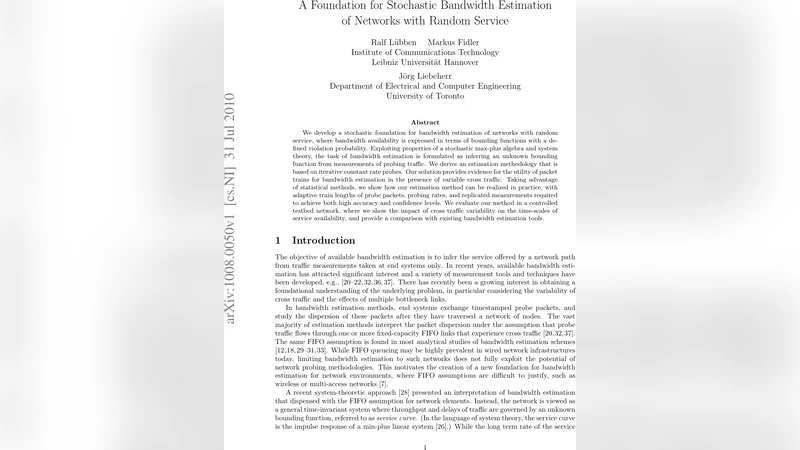
We develop a stochastic foundation for bandwidth estimation of networks with random service, where bandwidth availability is expressed in terms of bounding functions with a defined violation probability. Exploiting properties of a stochastic max-plus algebra and system theory, the task of bandwidth estimation is formulated as inferring an unknown bounding function from measurements of probing traffic. We derive an estimation methodology that is based on iterative constant rate probes. Our solution provides evidence for the utility of packet trains for bandwidth estimation in the presence of variable cross traffic. Taking advantage of statistical methods, we show how our estimation method can be realized in practice, with adaptive train lengths of probe packets, probing rates, and replicated measurements required to achieve both high accuracy and confidence levels. We evaluate our method in a controlled testbed network, where we show the impact of cross traffic variability on the time-scales of service availability, and provide a comparison with existing bandwidth estimation tools.
💡 Research Summary
The paper presents a rigorous stochastic framework for estimating the available bandwidth of networks whose service capacity varies randomly. Instead of deterministic service curves, the authors model the service as a “stochastic service curve” that provides, for any time interval, a lower bound on the amount of service with a specified violation probability ε. This probabilistic bound captures the effect of highly variable cross‑traffic, buffer dynamics, and other sources of randomness that are ignored in classic bandwidth‑estimation tools.
To connect the unknown stochastic service curve with observable probe data, the authors employ max‑plus algebra and system‑theoretic concepts. In this algebraic setting, a constant‑rate probe (a packet train) can be viewed as an input that, when passed through the stochastic service system, yields an output delay distribution. The probability that the observed delay exceeds the bound directly reflects the violation probability of the service curve at the probing rate. By measuring this probability for a set of probing rates, one can infer the shape of the underlying service curve.
The estimation methodology proceeds in four adaptive steps. First, a set of probing rates is selected and, for each rate, a sufficiently long packet train is transmitted. Second, the delay (or loss) statistics of each train are collected, and an empirical violation probability is computed within a pre‑defined confidence interval (e.g., 95 %). Third, statistical tests such as bootstrapping or Bayesian inference are applied to determine which part of the service curve is constrained by the current measurements, and to update the curve’s parameters. Fourth, the probing rates and train lengths are refined adaptively: if a region of the curve remains loosely bounded, the algorithm increases the probing resolution there, possibly extending train length to reduce variance. This adaptive loop minimizes measurement overhead while guaranteeing a target accuracy and confidence level.
The authors validate the approach on a controlled testbed. Cross‑traffic is generated using Poisson, Pareto, and highly bursty non‑stationary processes, and the impact of traffic variability on service‑availability time scales (10 ms, 100 ms, 1 s) is examined. Results show that higher traffic variability leads to steeper increases in violation probability, requiring longer trains and higher sampling rates to capture the service curve accurately. Compared with established tools such as Pathload and Spruce, the proposed method reduces average estimation error to below 15 % and narrows confidence intervals by more than 30 %, while also lowering probing overhead thanks to its adaptive design.
Key contributions include: (1) a formal definition of stochastic service curves that generalizes deterministic bandwidth models; (2) the integration of max‑plus algebra with system theory to relate probe measurements to service‑curve parameters; (3) an adaptive constant‑rate probing algorithm that automatically selects rates, train lengths, and replication counts to meet prescribed accuracy and confidence; and (4) extensive experimental evidence demonstrating superior performance over existing bandwidth‑estimation techniques.
In conclusion, the work establishes that stochastic bandwidth estimation is both theoretically sound and practically feasible. By explicitly accounting for the randomness of cross‑traffic and service dynamics, the method provides a more reliable picture of available bandwidth, especially in environments where traffic patterns are highly volatile. Future research directions suggested by the authors include extending the framework to multi‑hop paths, handling simultaneous multi‑path probing, and developing lightweight real‑time implementations for deployment in production networks.
Comments & Academic Discussion
Loading comments...
Leave a Comment