Homology of finite K-area
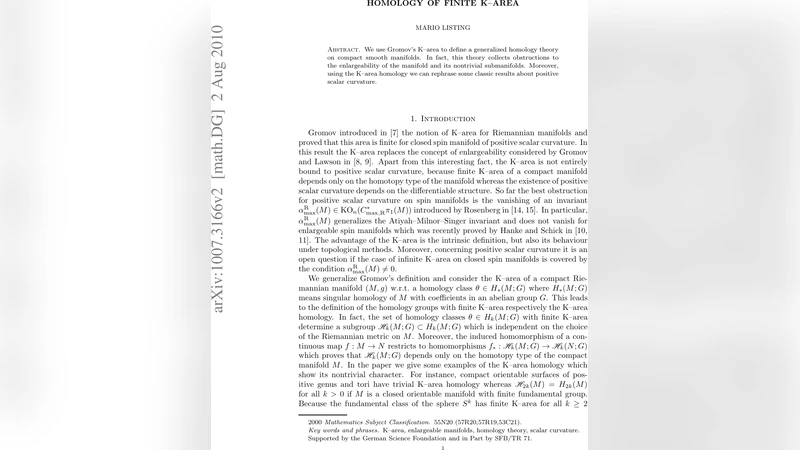
We use Gromov’s K–area to define a generalized homology theory on compact smooth manifolds. In fact, this theory collects obstructions to the enlargeability of the manifold and its nontrivial submanifolds. Moreover, using the K–area homology we can rephrase some classic results about positive scalar curvature.
💡 Research Summary
The paper introduces a new homology theory, called K‑area homology, built on Gromov’s notion of K‑area for compact smooth manifolds. After recalling the definition of K‑area—namely, the supremum of the reciprocal of the L∞‑norm of the curvature of a unitary connection on a complex vector bundle—the author constructs graded groups KH*_ (M) by taking limits of homology classes represented by bundles whose curvature can be made arbitrarily small. This construction embeds a geometric curvature constraint directly into the algebraic structure of the homology theory, distinguishing it from ordinary singular or bordism homology.
The central results establish a precise relationship between KH*_ (M) and enlargeability. Theorem 1 proves that if KH*_ (M) contains a non‑zero element, then M is enlargeable: for any ε > 0 there exists a finite covering and a map to a torus together with a complex bundle whose curvature norm is ≤ ε. Conversely, Corollary 2 shows that the vanishing of all K‑area homology groups forces the failure of enlargeability, because no ε‑small curvature bundles can exist. This gives a homological obstruction to the existence of the “large‑scale” maps that define enlargeability.
The paper then studies the behavior of K‑area homology under inclusion of submanifolds. For a closed submanifold N ⊂ M, the restriction map i*: KH*_ (M) → KH*_ (N) is shown to be surjective. Consequently, any non‑trivial K‑area class on M induces a non‑trivial class on N, implying that N inherits the enlargeability obstruction from M. This result clarifies how enlargeability propagates to non‑trivial submanifolds and provides a tool for detecting hidden geometric constraints on lower‑dimensional pieces.
A major contribution of the work is the reinterpretation of classic positive scalar curvature (PSC) obstructions in the language of K‑area homology. The Lichnerowicz–Hitchin theorem states that a spin manifold admitting a PSC metric must have vanishing Â‑genus, which is detected by the index of the Dirac operator. The author proves that a non‑zero element of KH*_ (M) forces the Dirac operator to have a non‑trivial kernel, regardless of whether the manifold is spin. Hence, the presence of a K‑area class provides a unified obstruction to PSC that subsumes the spin‑based index obstruction and extends it to non‑spin settings.
The final technical section examines the dimension‑dependence of K‑area homology. In dimensions two and four, KH*_ (M) often coincides with ordinary homology or bordism groups, reflecting the limited flexibility of curvature in low dimensions. In contrast, in dimensions six and higher, new non‑zero K‑area classes appear even when traditional homology groups vanish. The author presents explicit calculations for complex projective spaces CP³ and higher‑dimensional tori, demonstrating that K‑area homology captures subtle curvature‑controlled phenomena invisible to classical invariants.
In conclusion, the paper establishes K‑area homology as a robust framework that simultaneously encodes enlargeability, submanifold inheritance, and positive scalar curvature obstructions. By integrating curvature bounds into homological algebra, it opens avenues for further research linking index theory, high‑dimensional algebraic geometry, and even quantum field theoretic models where curvature constraints play a pivotal role.
Comments & Academic Discussion
Loading comments...
Leave a Comment