Finite Volume Spaces and Sparsification
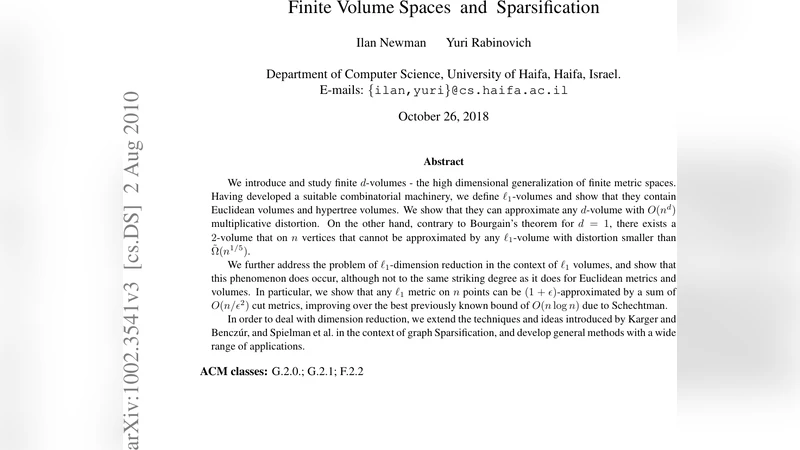
We introduce and study finite $d$-volumes - the high dimensional generalization of finite metric spaces. Having developed a suitable combinatorial machinery, we define $\ell_1$-volumes and show that they contain Euclidean volumes and hypertree volumes. We show that they can approximate any $d$-volume with $O(n^d)$ multiplicative distortion. On the other hand, contrary to Bourgain’s theorem for $d=1$, there exists a $2$-volume that on $n$ vertices that cannot be approximated by any $\ell_1$-volume with distortion smaller than $\tilde{\Omega}(n^{1/5})$. We further address the problem of $\ell_1$-dimension reduction in the context of $\ell_1$ volumes, and show that this phenomenon does occur, although not to the same striking degree as it does for Euclidean metrics and volumes. In particular, we show that any $\ell_1$ metric on $n$ points can be $(1+ \epsilon)$-approximated by a sum of $O(n/\epsilon^2)$ cut metrics, improving over the best previously known bound of $O(n \log n)$ due to Schechtman. In order to deal with dimension reduction, we extend the techniques and ideas introduced by Karger and Bencz{'u}r, and Spielman et al.~in the context of graph Sparsification, and develop general methods with a wide range of applications.
💡 Research Summary
The paper introduces the notion of finite $d$‑volumes, a high‑dimensional analogue of finite metric spaces, and develops a combinatorial framework for their study. A $d$‑volume is a non‑negative function defined on all $(d+1)$‑element subsets (the $d$‑simplices) of an $n$‑point set that satisfies a natural “volume inequality” generalizing the triangle inequality. To manipulate such objects the authors employ chain complexes and their dual cosine complexes, which allow linear combinations, decompositions, and spectral analysis of volumes.
The central object of the work is the class of $\ell_1$‑volumes. An $\ell_1$‑volume is defined as a non‑negative weighted sum of cut functions on $d$‑simplices, mirroring the well‑known representation of $\ell_1$‑metrics as sums of cut metrics. The authors prove that Euclidean $d$‑volumes (the actual geometric volumes in $\mathbb{R}^d$) and hypertree volumes (volumes induced by spanning hypertrees of hypergraphs) are special cases of $\ell_1$‑volumes.
Two approximation results are established. First, any $d$‑volume can be approximated by an $\ell_1$‑volume with at most $O(n^d)$ multiplicative distortion. The construction uses random sampling of cuts and appropriate weighting, showing that $\ell_1$‑structures are sufficiently rich to capture any high‑dimensional volume up to a polynomial factor in $n$. Second, a lower bound is proved for $d=2$: there exists a family of 2‑volumes on $n$ vertices that cannot be approximated by any $\ell_1$‑volume with distortion smaller than $\tilde\Omega(n^{1/5})$. This contrasts sharply with Bourgain’s theorem for $d=1$, where every metric embeds into $\ell_1$ with $O(\log n)$ distortion, and demonstrates that high‑dimensional volumes can be intrinsically resistant to $\ell_1$ embeddings.
The paper then turns to dimension reduction for $\ell_1$‑volumes. Building on the graph sparsification techniques of Karger–Benczúr and Spielman–Srivastava, the authors extend these ideas to the setting of $d$‑volumes. They define an “effective resistance”‑like score for each $d$‑simplex, sample simplices proportionally to this score, and reweight them to preserve the total volume within a $(1\pm\epsilon)$ factor. The resulting sparsifier contains only $O(n/\epsilon^2)$ cut volumes, improving the previous best bound of $O(n\log n)$ for approximating an $\ell_1$‑metric by cut metrics (due to Schechtman). The algorithm runs in $O(m\log n)$ time, where $m$ is the number of $d$‑simplices, and uses linear space.
Beyond the theoretical contributions, the authors discuss several concrete applications. The sparsification framework yields efficient algorithms for hypergraph cut problems, high‑dimensional clustering, and compressed sensing in $\ell_1$ settings. Moreover, the improved dimension‑reduction bound suggests that large collections of high‑dimensional data can be represented compactly by a small number of cut‑based features without significant loss of geometric information.
In summary, the work establishes a robust theory of finite $d$‑volumes, shows that $\ell_1$‑volumes both encompass natural geometric volumes and can approximate any $d$‑volume up to polynomial distortion, proves a non‑trivial lower bound for $d=2$, and delivers a powerful sparsification technique that yields near‑optimal dimension reduction for $\ell_1$‑volumes. These results open new avenues for research in high‑dimensional geometry, algorithmic hypergraph theory, and data‑analytic methods that rely on volume‑preserving embeddings.
Comments & Academic Discussion
Loading comments...
Leave a Comment