Known Algorithms on Graphs of Bounded Treewidth are Probably Optimal
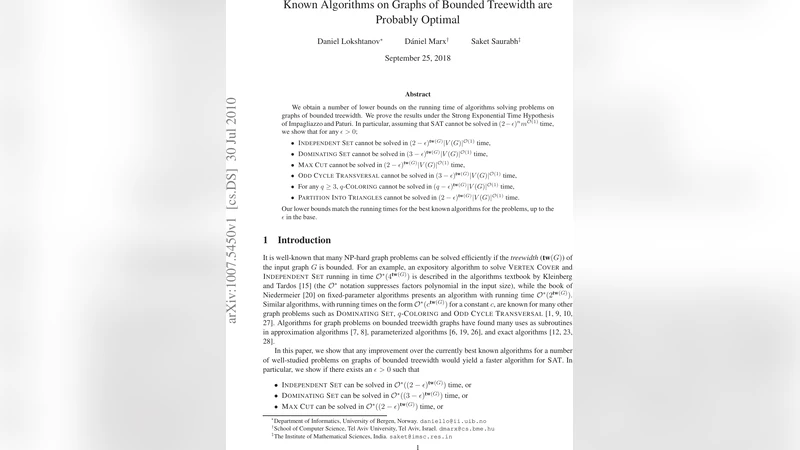
We obtain a number of lower bounds on the running time of algorithms solving problems on graphs of bounded treewidth. We prove the results under the Strong Exponential Time Hypothesis of Impagliazzo and Paturi. In particular, assuming that SAT cannot be solved in (2-\epsilon)^{n}m^{O(1)} time, we show that for any e > 0; {\sc Independent Set} cannot be solved in (2-e)^{tw(G)}|V(G)|^{O(1)} time, {\sc Dominating Set} cannot be solved in (3-e)^{tw(G)}|V(G)|^{O(1)} time, {\sc Max Cut} cannot be solved in (2-e)^{tw(G)}|V(G)|^{O(1)} time, {\sc Odd Cycle Transversal} cannot be solved in (3-e)^{tw(G)}|V(G)|^{O(1)} time, For any $q \geq 3$, $q$-{\sc Coloring} cannot be solved in (q-e)^{tw(G)}|V(G)|^{O(1)} time, {\sc Partition Into Triangles} cannot be solved in (2-e)^{tw(G)}|V(G)|^{O(1)} time. Our lower bounds match the running times for the best known algorithms for the problems, up to the e in the base.
💡 Research Summary
The paper establishes tight conditional lower bounds on the running times of a suite of classic NP‑hard problems when the input graphs have bounded treewidth. All results are proved under the Strong Exponential Time Hypothesis (SETH), which posits that for every ε>0 there exists a k such that k‑SAT cannot be solved in time (2‑ε)ⁿ·poly(m). By reducing SAT instances to instances of the target graph problems while preserving a small treewidth, the authors show that any algorithm that beats the known “c‑exponential” dependence on the treewidth would violate SETH.
The technical core consists of a generic reduction framework that maps a SAT formula with n variables and m clauses to a graph G whose treewidth tw(G) = O(n). The mapping uses carefully designed gadgets that encode variable assignments, clause satisfaction, and problem‑specific constraints. For each problem, the authors tailor these gadgets:
- Independent Set – variable gadgets allow the selection of a literal; clause gadgets enforce that at least one literal per clause is chosen, otherwise the independent set size falls below a threshold.
- Dominating Set – domination gadgets ensure that a small dominating set corresponds to a satisfying assignment.
- Maximum Cut – cut‑selection gadgets translate clause satisfaction into a cut of weight exceeding a prescribed bound.
- Odd Cycle Transversal – gadgets force the removal of vertices that break all odd cycles precisely when the underlying assignment satisfies the formula.
- q‑Coloring (q≥3) – color‑assignment gadgets encode literals as colors; clause gadgets prohibit monochromatic configurations that would represent unsatisfied clauses.
- Partition Into Triangles – triangle‑packing gadgets make a perfect triangle partition possible only if the SAT instance is satisfiable.
All reductions run in polynomial time and produce graphs whose size is polynomial in n+m, while the treewidth remains linear in n. Consequently, if any of the target problems could be solved in time (c‑ε)^{tw(G)}·|V(G)|^{O(1)} for the respective constant c (c=2 for Independent Set, Max‑Cut, and Triangle Partition; c=3 for Dominating Set and Odd Cycle Transversal; c=q for q‑Coloring), then SAT could be solved in (2‑ε)ⁿ·poly(m), contradicting SETH.
The lower bounds match the best known exact algorithms for each problem up to the ε term. For example, the classic dynamic‑programming algorithm for Independent Set on treewidth‑t graphs runs in O(2^{t}·n) time, and the paper shows that improving the base 2 to any smaller constant is impossible under SETH. Similarly, the optimal known algorithms for Dominating Set and Odd Cycle Transversal run in O(3^{t}·n) time, and the authors prove that the factor 3 cannot be reduced. For q‑Coloring, the current best algorithm runs in O(q^{t}·n) time, and the paper’s lower bound rules out any base smaller than q.
Beyond the specific results, the work contributes a methodological template for SETH‑based lower bounds in the realm of treewidth‑parameterized problems. The key insight is that treewidth can be kept low while encoding the full combinatorial complexity of SAT, by using gadgets that are themselves of constant treewidth and that connect in a tree‑like fashion. This approach is likely extensible to other problems where the solution space can be expressed through local constraints.
The authors also discuss the practical implications. Graphs of bounded treewidth appear in many domains—network design, database query optimization, phylogenetics, and more. The paper’s findings suggest that, for exact solutions, algorithm designers should not expect asymptotically faster exponential‑in‑treewidth algorithms than those already known; instead, effort should be directed toward improving polynomial‑factor overhead, developing parameter‑independent heuristics, or exploring approximation and fixed‑parameter algorithms with respect to alternative parameters.
In summary, the paper delivers a comprehensive set of SETH‑based conditional lower bounds that align perfectly with existing upper bounds, thereby establishing the optimality (up to the ε term) of the current best exact algorithms for Independent Set, Dominating Set, Max‑Cut, Odd Cycle Transversal, q‑Coloring, and Partition Into Triangles on graphs of bounded treewidth. This solidifies the theoretical understanding of the limits of treewidth‑parameterized computation and provides a robust foundation for future research on both lower bounds and algorithmic innovations in this area.
Comments & Academic Discussion
Loading comments...
Leave a Comment