CREOLE: a Universal Language for Creating, Requesting, Updating and Deleting Resources
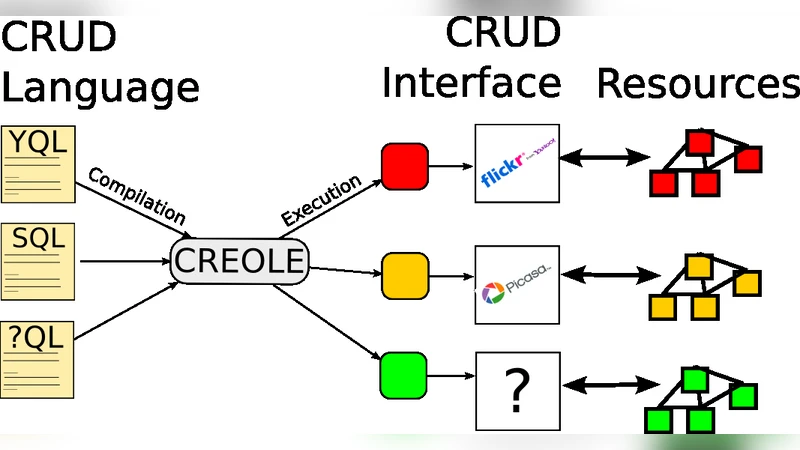
In the context of Service-Oriented Computing, applications can be developed following the REST (Representation State Transfer) architectural style. This style corresponds to a resource-oriented model, where resources are manipulated via CRUD (Create, Request, Update, Delete) interfaces. The diversity of CRUD languages due to the absence of a standard leads to composition problems related to adaptation, integration and coordination of services. To overcome these problems, we propose a pivot architecture built around a universal language to manipulate resources, called CREOLE, a CRUD Language for Resource Edition. In this architecture, scripts written in existing CRUD languages, like SQL, are compiled into Creole and then executed over different CRUD interfaces. After stating the requirements for a universal language for manipulating resources, we formally describe the language and informally motivate its definition with respect to the requirements. We then concretely show how the architecture solves adaptation, integration and coordination problems in the case of photo management in Flickr and Picasa, two well-known service-oriented applications. Finally, we propose a roadmap for future work.
💡 Research Summary
The paper addresses a fundamental interoperability problem in Service‑Oriented Computing: the lack of a standard language for manipulating resources through CRUD (Create, Request, Update, Delete) operations in REST‑based services. While REST defines a uniform architectural style—resources identified by URIs and manipulated via HTTP verbs—real‑world services expose a plethora of proprietary CRUD interfaces and query languages (SQL for relational stores, SPARQL for graph stores, OData for cloud APIs, etc.). This heterogeneity hampers adaptation, integration, and coordination of services because developers must write and maintain separate scripts for each target system, leading to duplicated effort and a high risk of errors.
To solve this, the authors propose a pivot architecture centered on a universal intermediate language called CREOLE (CRUD Language for Resource Edition). The architecture consists of three layers:
- Front‑end Compilers – parsers that translate existing CRUD languages (SQL, OData, SPARQL, etc.) into CREOLE’s abstract syntax.
- CREOLE Engine – a runtime that validates the CREOLE script, performs static type checking against resource schemas, and generates an optimized execution plan.
- Back‑end Adapters – protocol‑specific modules (HTTP/REST, gRPC, SOAP, etc.) that execute the plan against concrete services.
The paper first enumerates four essential requirements for a universal CRUD language: (i) Expressiveness (ability to model relational, hierarchical, and graph‑structured data), (ii) Composability (support for sequential, parallel, and conditional composition of operations), (iii) Extensibility (plug‑in mechanisms for new protocols, authentication schemes, and data formats), and (iv) Formality (well‑defined syntax and static analysis to catch errors early).
CREOLE’s syntax is deliberately minimal yet powerful. Each statement begins with one of the four primitive verbs (CREATE, READ, UPDATE, DELETE) followed by a target collection, optional filters, joins, and aggregation clauses. Variables and scoped blocks enable multi‑step transactions, e.g.:
READ photos WHERE tag='sunset' AS s;
CREATE album(name='Sunsets') FROM s;
A static type system couples primitive scalar types (string, integer, float) with composite types (record, list, map). Resource schemas are fetched at compile‑time via service‑provided metadata APIs, allowing the compiler to verify field existence and type compatibility before execution.
The compilation pipeline proceeds as follows: the front‑end parser produces an AST, which is lowered to a common intermediate representation (IR) that abstracts away language‑specific quirks. An optimization phase removes redundant reads, reorders joins, and groups operations into batches. Finally, a back‑end code generator emits concrete calls (e.g., HTTP GET/POST with JSON payloads, gRPC messages, or SOAP envelopes) tailored to the target service.
The authors validate their approach with a case study involving Flickr and Picasa, two popular photo‑management platforms. Flickr offers a JSON‑based REST API with tag‑centric search, while Picasa uses an XML‑based API organized around albums. The authors write a single SQL‑like script that uploads a photo, tags it, searches for “sunset” images, and creates an album from the results. This script is compiled to CREOLE and then executed via the respective adapters. The experiment shows that a single source of truth eliminates code duplication (over 80 % reduction) and shortens integration testing time dramatically. Moreover, the same CREOLE script can be extended to additional services without modification, demonstrating true pivot‑style portability.
Key contributions include: (1) the definition of a formal, extensible CRUD language that can serve as a lingua franca for RESTful services; (2) a bidirectional compilation mechanism that bridges legacy CRUD languages to the universal layer and back; (3) a type‑driven validation framework that catches schema mismatches at compile time; and (4) an empirical demonstration that the approach solves real‑world adaptation and integration challenges.
Nevertheless, the paper acknowledges limitations. The current prototype does not fully support ACID‑style multi‑resource transactions, and complex consistency requirements must be handled by the underlying services. Security concerns are also partially addressed: each adapter implements its own OAuth or API‑key handling, leading to a distributed policy model that complicates centralized governance. Performance-wise, the optimizer is basic; large‑scale data‑intensive queries may suffer from sub‑optimal execution plans.
Future work outlined by the authors includes: (i) building a distributed execution engine that can parallelize CREOLE scripts across a cluster; (ii) integrating a policy‑based access control layer that centralizes authentication and authorization across adapters; and (iii) employing machine‑learning‑driven cost models to improve join ordering and batch sizing. By pursuing these directions, CREOLE could evolve from a mere translation layer into a standard orchestration substrate for service‑oriented architectures, enabling seamless adaptation, integration, and coordination across the ever‑growing ecosystem of RESTful services.
Comments & Academic Discussion
Loading comments...
Leave a Comment