Information Ranking and Power Laws on Trees
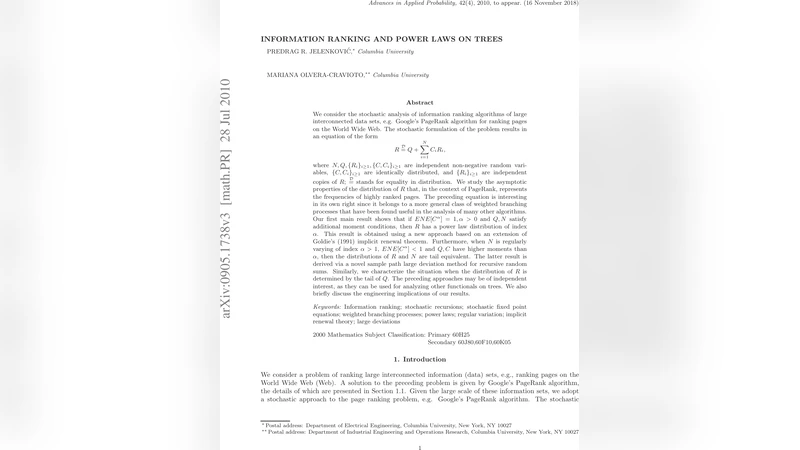
We study the situations when the solution to a weighted stochastic recursion has a power law tail. To this end, we develop two complementary approaches, the first one extends Goldie’s (1991) implicit renewal theorem to cover recursions on trees; and the second one is based on a direct sample path large deviations analysis of weighted recursive random sums. We believe that these methods may be of independent interest in the analysis of more general weighted branching processes as well as in the analysis of algorithms.
💡 Research Summary
The paper investigates when the solution of a weighted stochastic recursion exhibits a power‑law tail. The authors consider a recursive distributional equation of the form
(R \stackrel{d}{=} \sum_{i=1}^{N} C_i R_i + Q)
where (N) is a random number of offspring, (C_i>0) are random weights, (Q) is an external shock, and the (R_i) are i.i.d. copies of (R) attached to the children. While classical results such as Kesten (1973) and Goldie (1991) treat this equation on a single line (or a single root), the present work lifts the setting to an infinite rooted tree: each node carries its own independent copy of ((N, C_i, Q)) and the value at the root is the sum of weighted values of all descendants.
Two complementary approaches are developed.
1. Tree‑based extension of Goldie’s implicit renewal theorem.
The authors define the moment function (M(s)=\mathbb{E}\big
Comments & Academic Discussion
Loading comments...
Leave a Comment