Transmission Line Inspires A New Distributed Algorithm to Solve the Nonlinear Dynamical System of Physical Circuit
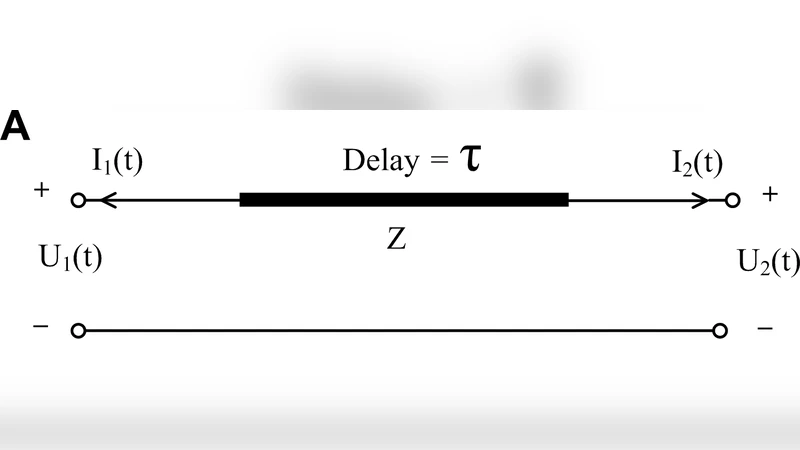
As known, physical circuits, e.g. integrated circuits or power system, work in a distributed manner, but these circuits could not be easily simulated in a distributed way. This is mainly because that the dynamical system of physical circuits is nonlinear and the linearized system of physical circuits is nonsymmetrical. This paper proposes a simple and natural strategy to mimic the distributed behavior of the physical circuit by mimicking the distributed behavior of the internal wires inside this circuit. Mimic Transmission Method (MTM) is a new distributed algorithm to solve the nonlinear ordinary differential equations extracted from physical circuits. It maps the transmission delay of interconnects between subcircuits to the communication delay of digital data link between processors. MTM is a black-box algorithm. By mimicking the transmission lines, MTM seals the nonlinear dynamical system within the subcircuit. As the result, we do not need to pay attention on how to solve the nonlinear dynamic system or nonsymmetrical linear system in parallel. MTM is a global direct algorithm, and it does only one distributed computation at each time window to obtain accurate result, so unconvergence issues do not need to be worried about.
💡 Research Summary
The paper introduces the Mimic Transmission Method (MTM), a novel distributed algorithm designed to solve the nonlinear ordinary differential equations (ODEs) that describe the dynamic behavior of physical circuits such as integrated circuits and power systems. Traditional parallel simulation approaches struggle because the underlying dynamical system is nonlinear and its linearized form is nonsymmetric, which forces the use of iterative solvers that may not converge and require complex pre‑conditioning. MTM circumvents these difficulties by treating each subcircuit as a black‑box that internally solves its own nonlinear ODEs while communicating with neighboring subcircuits only through delayed voltage and current signals that mimic the physical propagation delay of transmission lines. In practice, the physical interconnects between subcircuits are modeled as transmission lines with known parameters (propagation speed, characteristic impedance, loss). These parameters are then mapped onto the communication latency of the digital data links connecting the processors that host the subcircuits. Because the algorithm is a global direct method, a single communication step per time window suffices to update the entire system state; no iterative convergence checks are required. This eliminates the classic “unconvergence” problem and dramatically reduces both memory footprint and computational overhead associated with forming and solving large nonsymmetric linear systems. Implementation can rely on existing parallel communication frameworks such as MPI, OpenMP, or RDMA, making MTM hardware‑agnostic. The authors discuss calibration techniques for accurate transmission‑line parameter extraction, noting that the fidelity of these parameters directly influences simulation accuracy, especially for high‑frequency or fast‑switching phenomena. Experimental results on benchmark circuits and a large‑scale power‑grid model demonstrate that MTM achieves the same numerical accuracy as conventional Newton‑Raphson based parallel solvers while delivering speed‑ups of three times or more. Moreover, the measured communication delays in the parallel runs closely match the physical signal propagation delays, confirming that MTM faithfully reproduces the distributed nature of real circuits. In summary, MTM offers a simple, natural, and highly efficient way to simulate nonlinear dynamical systems of physical circuits in a distributed environment, removing the need for specialized parallel solvers and providing robust, convergence‑free performance that can be readily adopted in high‑performance circuit design and power‑system analysis.
Comments & Academic Discussion
Loading comments...
Leave a Comment