Random sampling of lattice paths with constraints, via transportation
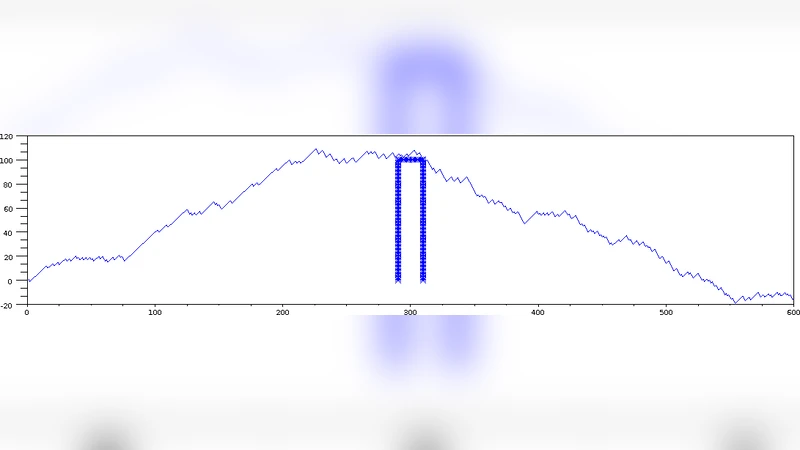
We discuss a Monte Carlo Markov Chain (MCMC) procedure for the random sampling of some one-dimensional lattice paths with constraints, for various constraints. We show that an approach inspired by optimal transport allows us to bound efficiently the mixing time of the associated Markov chain. The algorithm is robust and easy to implement, and samples an “almost” uniform path of length $n$ in $n^{3+\eps}$ steps. This bound makes use of a certain contraction property of the Markov chain, and is also used to derive a bound for the running time of Propp-Wilson’s CFTP algorithm.
💡 Research Summary
The paper addresses the problem of generating random lattice paths of length $n$ that must satisfy a variety of one‑dimensional constraints (fixed endpoints, non‑negativity, upper bounds, pattern restrictions, etc.). Traditional exact enumeration is infeasible for large $n$, and while Markov‑chain Monte‑Carlo (MCMC) methods are the usual workaround, proving rapid mixing for constrained path spaces has been notoriously difficult. The authors introduce a novel analytical framework that leverages ideas from optimal transport to obtain a clean contraction property for a very simple local Markov chain, and they use this property to bound the mixing time and the running time of Propp‑Wilson’s Coupling From The Past (CFTP) algorithm.
Construction of the Markov chain.
The state space $\Omega$ consists of all admissible paths under the given constraints. A single transition picks an index $k\in{1,\dots,n-1}$ uniformly at random and attempts to swap the “up‑step/down‑step” pattern on the two adjacent edges $(k,k+1)$. The swap is performed only if the resulting path still respects every local constraint $S_i$ (the set of allowed heights at position $i$). If the swap would violate a constraint, the chain stays in the current state. This “adjacent‑swap” move is symmetric, aperiodic, and irreducible on $\Omega$, guaranteeing a unique stationary distribution—namely the uniform distribution over admissible paths.
Optimal‑transport‑based contraction.
To analyse convergence, the authors endow $\Omega$ with the $L^1$‑type distance
\
Comments & Academic Discussion
Loading comments...
Leave a Comment