Critical points between varieties generated by subspace lattices of vector spaces
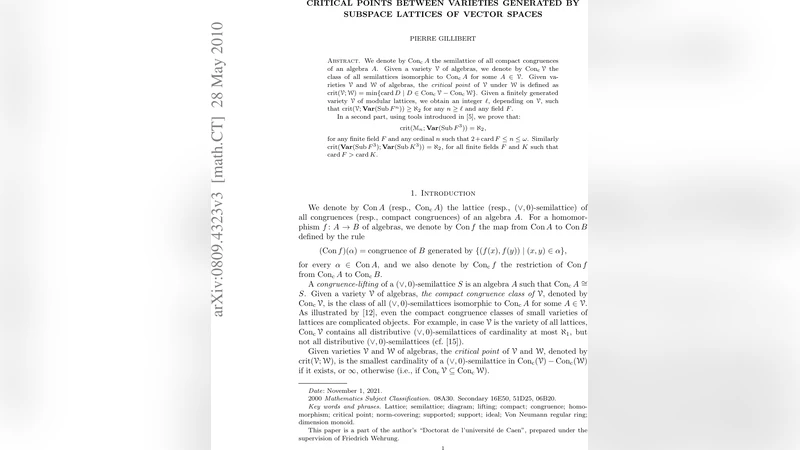
We denote by Conc(A) the semilattice of compact congruences of an algebra A. Given a variety V of algebras, we denote by Conc(V) the class of all semilattices isomorphic to Conc(A) for some A in V. Given varieties V1 and V2 varieties of algebras, the critical point of V1 under V2, denote by crit(V1;V2) is the smalest cardinality of a semilattice in Conc(V1) but not in Conc(V2). Given a finitely generated variety V of modular lattices, we obtain an integer l, depending of V, such that crit(V;Var(Sub F^n)) is at least aleph_2 for any n > 1 and any field F. In a second part, we prove that crit(Var(Mn);Var(Sub F^3))=aleph_2, for any finite field F and any integer n such that 1+card F< n. Similarly crit(Var(Sub F^3);Var(Sub K^3))=aleph_2, for all finite fields F and K such that card F>card K.
💡 Research Summary
The paper investigates a quantitative measure of how “complex” one algebraic variety can be compared to another, using the notion of compact congruences. For any algebra A, Conc(A) denotes the semilattice of its compact congruences; for a variety V, Conc(V) is the class of all semilattices isomorphic to Conc(A) for some A∈V. Given two varieties V₁ and V₂, the critical point crit(V₁;V₂) is defined as the smallest cardinal κ such that there exists a semilattice of size κ belonging to Conc(V₁) but not to Conc(V₂). This concept captures the first cardinal at which V₁ exhibits a structural feature that V₂ cannot realize.
The first major result concerns any finitely generated variety V of modular lattices. The author shows that there exists an integer ℓ(V), depending only on the generators of V, with the property that for every integer n>1 and every field F, the critical point crit(V;Var(Sub Fⁿ)) is at least ℵ₂. The proof proceeds in two stages. First, using known finite representation theorems for modular lattices, it is shown that Conc(V) contains semilattices of every size up to ℵ₁. Second, the variety Var(Sub Fⁿ) – generated by the lattice of subspaces of the n‑dimensional vector space Fⁿ – is examined. Because subspace lattices are modular and have finite height when n>1, their compact congruences cannot produce semilattices of size ℵ₁; any such semilattice would require a richer congruence structure than the subspace lattice can provide. Consequently, ℵ₂ becomes the smallest cardinal that can separate the two varieties, establishing the lower bound.
The second part of the paper pinpoints the exact critical point ℵ₂ for two families of concrete variety pairs.
-
Var(Mₙ) versus Var(Sub F³).
Here Mₙ denotes the simple lattice consisting of n atoms below a single top element, and Var(Mₙ) is the variety generated by Mₙ. Assuming a finite field F and an integer n satisfying 1+|F|<n, the author constructs a compact‑congruence semilattice of size ℵ₂ inside Var(Mₙ) but proves that no such semilattice exists in Var(Sub F³). The key observation is that the three‑dimensional subspace lattice of F³ corresponds to a projective plane over F; its number of subspaces is tightly controlled by |F|, limiting the possible congruence configurations. In contrast, when n exceeds 1+|F|, the lattice Mₙ can encode arbitrarily large independent congruence relations, allowing the realization of an ℵ₂‑sized semilattice. Hence crit(Var(Mₙ);Var(Sub F³))=ℵ₂. -
Var(Sub F³) versus Var(Sub K³) for finite fields F and K with |F|>|K|.
Both varieties are generated by three‑dimensional subspace lattices, but the underlying fields differ in size. The larger field F yields many more one‑ and two‑dimensional subspaces, which translates into a richer lattice of compact congruences. The author demonstrates that Conc(Sub F³) contains a semilattice of cardinality ℵ₂, while Conc(Sub K³) cannot accommodate such a semilattice because the smaller field K imposes stricter combinatorial limits. Therefore, the critical point between these two varieties is again ℵ₂.
Methodologically, the paper blends several sophisticated tools: finite representation theorems for modular lattices, combinatorial properties of projective geometries over finite fields, and cardinal arithmetic concerning ℵ₀, ℵ₁, and ℵ₂. The notion of “lifting” a compact‑congruence semilattice from a free extension of an algebra plays a central role in establishing both existence and non‑existence results.
The significance of the work lies in identifying ℵ₂ as the first infinite cardinal that can separate a broad class of modular‑lattice varieties from those generated by subspace lattices. Prior research had focused on separations at ℵ₀ or ℵ₁; this paper pushes the boundary to the next level, revealing a deeper interaction between algebraic structure and set‑theoretic size. Moreover, the explicit dependence on field size and dimension highlights how combinatorial parameters of vector spaces influence the landscape of congruence semilattices.
Future directions suggested by the author include extending the analysis to higher dimensions (n>3), to infinite fields, and to other algebraic structures such as non‑modular lattices, groups, or rings. Understanding whether larger cardinals (e.g., ℵ₃) can arise as critical points in more exotic settings remains an open and intriguing question.
Comments & Academic Discussion
Loading comments...
Leave a Comment