A review of wildland fire spread modelling, 1990-present 2: Empirical and quasi-empirical models
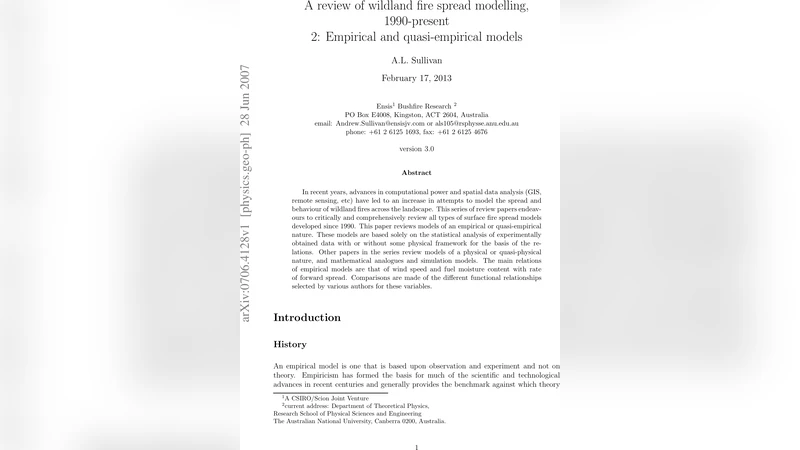
In recent years, advances in computational power and spatial data analysis (GIS, remote sensing, etc) have led to an increase in attempts to model the spread and behaviour of wildland fires across the landscape. This series of review papers endeavours to critically and comprehensively review all types of surface fire spread models developed since 1990. This paper reviews models of an empirical or quasi-empirical nature. These models are based solely on the statistical analysis of experimentally obtained data with or without some physical framework for the basis of the relations. Other papers in the series review models of a physical or quasi-physical nature, and mathematical analogues and simulation models. The main relations of empirical models are that of wind speed and fuel moisture content with rate of forward spread. Comparisons are made of the different functional relationships selected by various authors for these variables.
💡 Research Summary
The paper provides a comprehensive review of empirical and quasi‑empirical surface fire‑spread models that have been developed from 1990 to the present. It begins by contextualising the surge in fire‑spread modelling within the broader advances in computational capacity, geographic information systems (GIS), and remote‑sensing technologies, noting that these tools have enabled researchers to collect and analyse large, spatially explicit datasets on fire behaviour. The authors define empirical models as those that rely primarily on statistical relationships derived from experimental or field data, with or without a limited physical rationale, and contrast them with physical, quasi‑physical, mathematical analogue, and simulation models addressed in other papers of the series.
The core of the review is organised around the two dominant predictor variables identified in the literature: wind speed and fuel moisture content (FMC). For wind speed, the authors catalogue the functional forms most frequently employed—exponential, logarithmic, power‑law, and more recently, non‑linear regression or machine‑learning‑derived curves. They discuss how classic formulations such as the Rothermel (1972) equation have been adapted, calibrated, or replaced, and they highlight the sensitivity of rate‑of‑spread (ROS) predictions to the choice of wind‑function, especially under high‑wind conditions where non‑linearity becomes pronounced.
Fuel moisture is treated similarly. The majority of studies model ROS as an exponentially decaying function of FMC, but the decay coefficient varies widely with fuel type (needleleaf, hardwood, grass, slash), particle size, and packing density. The review points out that many authors have moved beyond simple exponential decay to incorporate interaction terms (e.g., wind × moisture) or to employ multi‑parameter regression that captures the combined influence of FMC, wind, slope, and fuel load.
Data acquisition methods are examined in depth. Early work relied on controlled laboratory flame‑spread tests and small‑scale field burns, whereas recent investigations exploit unmanned aerial vehicles (UAVs), satellite thermal imagery, and high‑resolution LiDAR to capture real‑world fire dynamics over heterogeneous landscapes. The authors stress that differences in spatial and temporal resolution, measurement error, and the scale at which variables are sampled can introduce significant uncertainty into model coefficients. Consequently, they advocate for rigorous cross‑validation, the use of independent test datasets, and transparent reporting of uncertainty bounds.
A substantial portion of the paper is devoted to the integration of empirical models with GIS and remote‑sensing products. By overlaying wind fields, fuel‑type maps, topographic slope, and FMC layers, researchers can generate spatially explicit ROS predictions that are useful for operational fire‑management agencies. The review cites several case studies where such GIS‑based implementations have improved prediction accuracy in complex terrain, but it also notes that the underlying empirical relationships may not hold when extrapolated beyond the conditions under which they were derived (e.g., novel fuel mixes, extreme climate events).
The authors conclude by acknowledging the practical value of empirical and quasi‑empirical models for rapid fire‑behavior assessment and initial incident response, while simultaneously highlighting their inherent limitations. They call for continued collection of high‑quality, standardized fire‑experiment datasets, periodic re‑calibration of model parameters, and the development of hybrid frameworks that embed physical fire‑physics insights within statistically robust structures. Finally, they recommend the establishment of open, international data repositories and collaborative validation exercises to enhance model generalisability and to foster a shared scientific foundation for wildfire risk mitigation worldwide.
Comments & Academic Discussion
Loading comments...
Leave a Comment