A Hybrid Model for Disease Spread and an Application to the SARS Pandemic
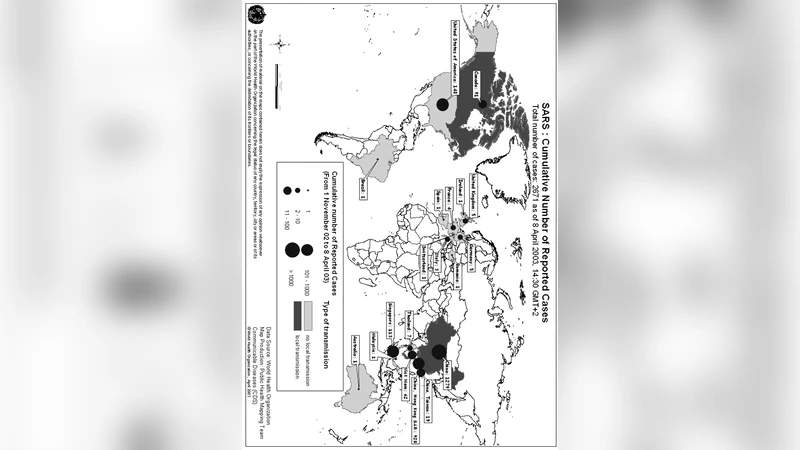
Pandemics can cause immense disruption and damage to communities and societies. Thus far, modeling of pandemics has focused on either large-scale difference equation models like the SIR and the SEIR models, or detailed micro-level simulations, which are harder to apply at a global scale. This paper introduces a hybrid model for pandemics considering both global and local spread of infections. We hypothesize that the spread of an infectious disease between regions is significantly influenced by global traffic patterns and the spread within a region is influenced by local conditions. Thus we model the spread of pandemics considering the connections between regions for the global spread of infection and population density based on the SEIR model for the local spread of infection. We validate our hybrid model by carrying out a simulation study for the spread of SARS pandemic of 2002-2003 using available data on population, population density, and traffic networks between different regions. While it is well-known that international relationships and global traffic patterns significantly influence the spread of pandemics, our results show that integrating these factors into relatively simple models can greatly improve the results of modeling disease spread.
💡 Research Summary
The paper presents a hybrid epidemiological model that simultaneously captures the global spread of an infectious disease through international traffic flows and the local dynamics within each region using a density‑adjusted SEIR framework. The authors begin by reviewing two dominant strands of pandemic modeling: compartmental differential‑equation models (e.g., SIR, SEIR) that are computationally light but ignore heterogeneity between regions, and detailed agent‑based or network simulations that can reproduce fine‑grained transmission pathways but are costly to scale globally. To bridge this gap, they construct a graph where each node represents a country or sub‑national region and edges are weighted by measured passenger and cargo volumes from airline and maritime data. The edge weight (T_{ij}) is interpreted as the probability that an infected individual travels from node (i) to node (j) in a given time step.
Within each node, the classic SEIR equations are retained, but the transmission rate (\beta) is multiplied by the local population density (\rho_i). This modification reflects the empirical observation that densely populated areas experience faster person‑to‑person spread. The resulting system can be written as:
- Global transmission:
\
Comments & Academic Discussion
Loading comments...
Leave a Comment