Limit distribution of degrees in random family trees
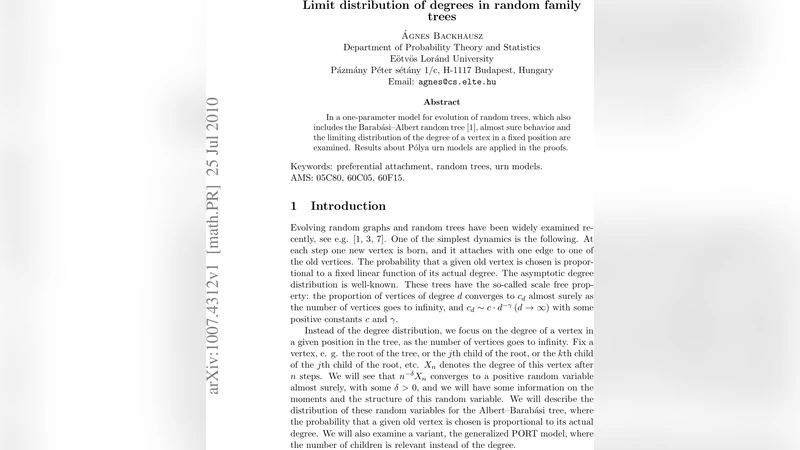
In a one-parameter model for evolution of random trees, which also includes the Barabasi-Albert random tree, almost sure behavior and the limiting distribution of the degree of a vertex in a fixed position are examined. Results about Polya urn models are applied in the proofs.
💡 Research Summary
The paper studies a one‑parameter family of random tree growth processes that interpolates between uniform attachment (α = 0) and preferential attachment (α = 1), the latter being the classic Barabási‑Albert model. Starting from a single root, at each discrete time step a new vertex is added and linked to an existing vertex v with probability
P(v) = (1 − α)·1/(n − 1) + α·deg(v)/(2·(n − 1)),
where n is the current number of vertices and deg(v) is the degree of v. The parameter α∈
Comments & Academic Discussion
Loading comments...
Leave a Comment