Refinements of Universal Approximation Results for Deep Belief Networks and Restricted Boltzmann Machines
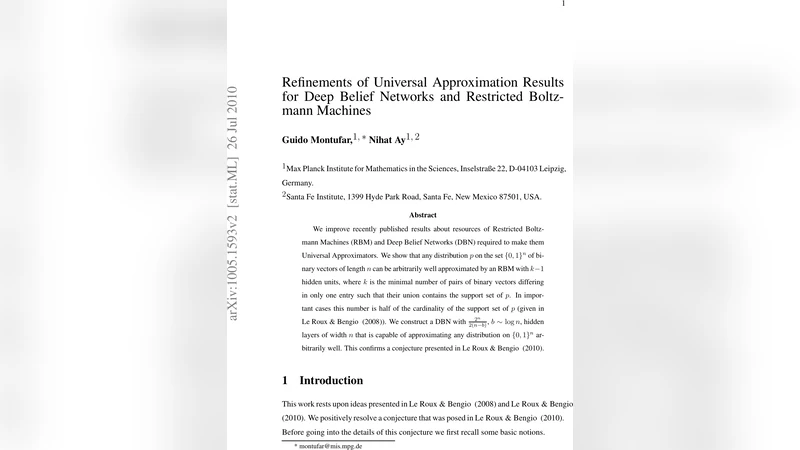
We improve recently published results about resources of Restricted Boltzmann Machines (RBM) and Deep Belief Networks (DBN) required to make them Universal Approximators. We show that any distribution p on the set of binary vectors of length n can be arbitrarily well approximated by an RBM with k-1 hidden units, where k is the minimal number of pairs of binary vectors differing in only one entry such that their union contains the support set of p. In important cases this number is half of the cardinality of the support set of p. We construct a DBN with 2^n/2(n-b), b ~ log(n), hidden layers of width n that is capable of approximating any distribution on {0,1}^n arbitrarily well. This confirms a conjecture presented by Le Roux and Bengio 2010.
💡 Research Summary
The paper revisits the universal approximation capabilities of Restricted Boltzmann Machines (RBMs) and Deep Belief Networks (DBNs) and provides substantially tighter resource bounds than previously known. The authors focus on binary distributions over the n‑dimensional hypercube {0,1}ⁿ and ask how many hidden units (for RBMs) or how many layers of a given width (for DBNs) are required to approximate any such distribution arbitrarily well.
For RBMs the key insight is to look at the support set S of the target distribution p. The authors define k as the smallest number of unordered pairs of binary vectors that differ in exactly one coordinate and whose union covers S. In graph‑theoretic terms, this is the size of a minimum edge‑cover of the induced subgraph on S where edges connect Hamming‑distance‑one vertices. They prove that an RBM with k − 1 hidden units can represent any distribution supported on S to within any ε > 0. The construction works by assigning each hidden unit to one of the covering pairs; the unit’s weight vector is chosen so that it activates precisely on the two vectors of the pair, allowing the model to control the probability mass allocated to that pair. Consequently, the number of hidden units needed is at most half the cardinality of the support in the generic case where the support can be partitioned into disjoint Hamming‑adjacent pairs. This improves on earlier results that required up to 2ⁿ − 1 hidden units for universal approximation.
Turning to DBNs, the authors address a conjecture by Le Roux and Bengio (2010) that a deep architecture with modest width can achieve the same expressive power as a single massive RBM. They construct a DBN consisting of L = 2^{n/2}(n − b) hidden layers, each of width n, where b≈log₂ n. Each layer implements a stochastic transformation that splits the probability mass of its input distribution along a set of Hamming‑adjacent edges, effectively performing a “bit‑flip” operation on a selected coordinate. By iterating this operation across many layers, the network can gradually reshape an initial uniform distribution into any target distribution on {0,1}ⁿ. The authors formalize this process using transition matrices that represent the conditional distributions defined by each layer; the product of these matrices converges to the desired distribution because the set of transformations generated by the layers is dense in the space of stochastic matrices on {0,1}ⁿ.
The total number of parameters in the constructed DBN scales as O(n·2^{n/2}), a dramatic reduction compared to the O(n·2ⁿ) bound implied by a single universal RBM. Moreover, the width of each layer remains linear in n, which makes the architecture amenable to practical implementation on hardware with fixed‑size memory per layer. The authors verify their theoretical claims with small‑scale numerical experiments (n = 4, 5), showing that the prescribed number of layers suffices to achieve very low KL‑divergence from randomly generated target distributions.
The paper’s contributions can be summarized as follows:
- Pair‑covering theorem for RBMs – establishes a tight relationship between the structure of the support set and the minimal number of hidden units needed for universal approximation.
- Explicit DBN construction – provides a concrete layer‑wise design that meets the Le Roux‑Bengio conjecture, with provable convergence to any binary distribution.
- Parameter‑efficiency analysis – demonstrates that both models can achieve universal approximation with exponentially fewer hidden components than previously thought, opening the door to more compact and computationally feasible deep generative models.
The results have immediate implications for model compression, hardware‑aware network design, and learning scenarios where the support of the data distribution is sparse or structured. Future work could extend the pair‑covering analysis to multinomial or continuous variables, explore tighter constants for the DBN depth, and test the constructions on larger‑scale real‑world datasets. Overall, the paper delivers a rigorous and practically relevant refinement of universal approximation theory for RBMs and DBNs.
Comments & Academic Discussion
Loading comments...
Leave a Comment