Equivariant T-Duality of Locally Compact Abelian Groups
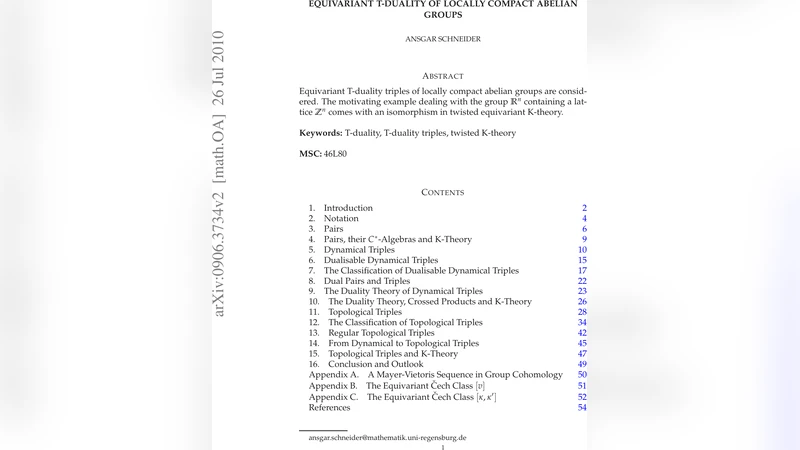
Equivariant T-duality triples of locally compact abelian groups are considered. The motivating example dealing with the group $\R^n$ containing a lattice $\Z^n$ comes with an isomorphism in twisted equivariant K-theory.
💡 Research Summary
The paper develops a comprehensive framework for equivariant T‑duality on locally compact abelian (LCA) groups, extending the classical torus‑lattice picture to a much broader class of groups. After reviewing Pontryagin duality and the basic topology of LCA groups, the author introduces the notion of an equivariant T‑duality triple ((E,\widehat{E},\tau)). Here (E) is a principal (U(1))‑bundle equipped with a continuous (G)‑action, (\widehat{E}) is a principal (U(1))‑bundle with a continuous (\widehat{G})‑action, and (\tau) is a gerbe (or 2‑cocycle) that couples the two bundles in an equivariant way. The triple must satisfy three compatibility conditions: (i) the actions are free and transitive on the fibres, (ii) the gerbe class is represented by a pair of 2‑cocycles (\omega\in Z^{2}(G,U(1))) and (\widehat{\omega}\in Z^{2}(\widehat{G},U(1))) that are dual under Pontryagin duality, and (iii) there exists a Fourier–Mukai type transform intertwining the twisted K‑theories of the two bundles.
Using Kasparov’s KK‑theory, the author constructs a natural isomorphism
\
Comments & Academic Discussion
Loading comments...
Leave a Comment