Characterizations of Morita equivalent inverse semigroups
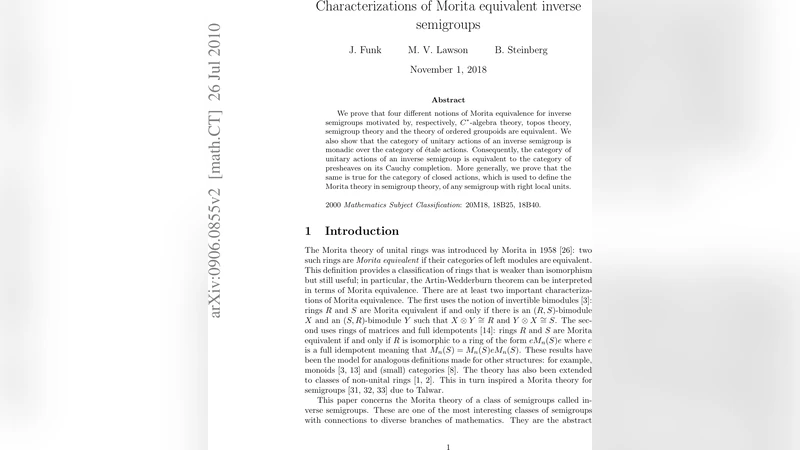
We prove that four different notions of Morita equivalence for inverse semigroups motivated by, respectively, $C^{\ast}$-algebra theory, topos theory, semigroup theory and the theory of ordered groupoids are equivalent. We also show that the category of unitary actions of an inverse semigroup is monadic over the category of 'etale actions. Consequently, the category of unitary actions of an inverse semigroup is equivalent to the category of presheaves on its Cauchy completion. More generally, we prove that the same is true for the category of closed actions, which is used to define the Morita theory in semigroup theory, of any semigroup with right local units.
💡 Research Summary
The paper establishes the equivalence of four independently motivated notions of Morita equivalence for inverse semigroups, thereby unifying perspectives that arise from operator‑algebraic, topos‑theoretic, semigroup‑theoretic, and ordered‑groupoid frameworks. The first notion, derived from C∗‑algebra theory, regards two inverse semigroups as Morita equivalent when the C∗‑algebras generated by their associated étale groupoids are strongly Morita equivalent, i.e., their categories of Hilbert modules are equivalent. The second notion, motivated by topos theory, declares two inverse semigroups Morita equivalent if the étale toposes they generate are equivalent as Grothendieck toposes. The third notion, rooted in classical semigroup theory, uses the concept of closed actions: two inverse semigroups are Morita equivalent when the categories of closed (or “closed‑action”) modules are equivalent. The fourth notion, coming from the theory of ordered groupoids, identifies Morita equivalence with equivalence of the underlying ordered groupoids obtained from the inverse semigroups.
A central technical achievement of the work is the construction of a monadic adjunction between the category of unitary actions of an inverse semigroup and the category of its étale actions. The authors prove that the unitary‑action category is monadic over the étale‑action category; the associated monad’s algebras are precisely the closed actions. Consequently, the category of unitary actions is equivalent to the category of presheaves on the Cauchy completion (Karoubi envelope) of the inverse semigroup. This result provides a concrete categorical description of unitary actions in terms of a well‑understood presheaf construction.
The paper proceeds to show that each of the four Morita notions can be expressed in terms of the equivalence of the corresponding categories of actions (unitary, étale, or closed). By exploiting the monadic relationship, the authors demonstrate that the equivalence of any one of these categories forces the equivalence of the others, thereby proving that all four notions coincide.
Beyond inverse semigroups, the authors extend the monadic framework to arbitrary semigroups possessing right local units. They prove that for such semigroups the category of unitary actions remains monadic over the category of étale actions, and that the resulting monad’s algebras again correspond to closed actions. Hence the same equivalence between unitary actions and presheaves on the Cauchy completion holds in this broader context.
The paper is organized as follows. Section 1 reviews the necessary background on inverse semigroups, their actions, and the four Morita equivalence concepts. Section 2 develops the monadic adjunction between unitary and étale actions, establishing the free‑forgetful relationship and identifying the monad. Section 3 introduces the Cauchy completion of a semigroup and proves the equivalence between unitary actions and presheaves on this completion. Section 4 contains the core equivalence proofs, showing that the four Morita notions are mutually equivalent. Section 5 generalizes the construction to semigroups with right local units, demonstrating that the same categorical picture persists.
In conclusion, the work provides a comprehensive and unified Morita theory for inverse semigroups, linking operator‑algebraic, topos‑theoretic, semigroup‑theoretic, and ordered‑groupoid viewpoints through a single categorical mechanism. The monadic description of unitary actions and its identification with presheaves on the Cauchy completion not only clarifies the structure of Morita equivalence but also opens avenues for applying these ideas to non‑commutative geometry, representation theory of C∗‑algebras associated with inverse semigroups, and the classification of étale groupoids. The extension to semigroups with right local units further indicates that the underlying categorical principles are robust and applicable beyond the narrow class of inverse semigroups.
Comments & Academic Discussion
Loading comments...
Leave a Comment