Breaking Symmetries
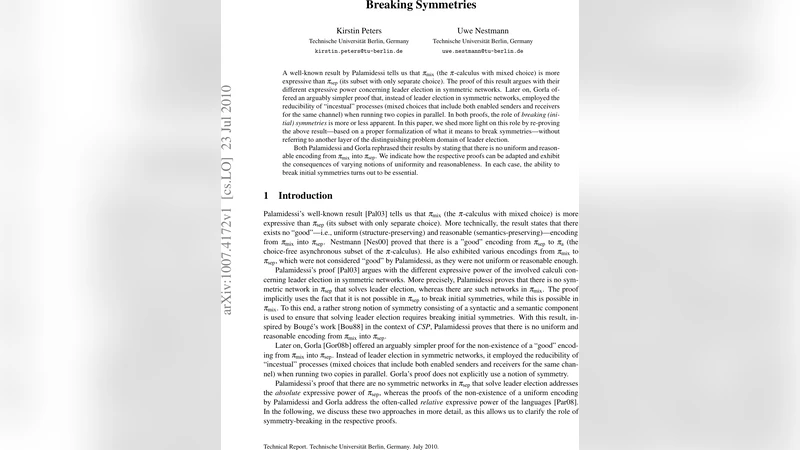
A well-known result by Palamidessi tells us that {\pi}mix (the {\pi}-calculus with mixed choice) is more expressive than {\pi}sep (its subset with only separate choice). The proof of this result argues with their different expressive power concerning leader election in symmetric networks. Later on, Gorla of- fered an arguably simpler proof that, instead of leader election in symmetric networks, employed the reducibility of “incestual” processes (mixed choices that include both enabled senders and receivers for the same channel) when running two copies in parallel. In both proofs, the role of breaking (ini- tial) symmetries is more or less apparent. In this paper, we shed more light on this role by re-proving the above result-based on a proper formalization of what it means to break symmetries-without referring to another layer of the distinguishing problem domain of leader election. Both Palamidessi and Gorla rephrased their results by stating that there is no uniform and reason- able encoding from {\pi}mix into {\pi}sep . We indicate how the respective proofs can be adapted and exhibit the consequences of varying notions of uniformity and reasonableness. In each case, the ability to break initial symmetries turns out to be essential.
💡 Research Summary
The paper revisits the classic separation result between two variants of the π‑calculus: π‑mix, which allows mixed guarded choice (both input and output guards in the same choice construct), and π‑sep, which restricts each choice to either only inputs or only outputs. The original proof by Palamidessi (2003) showed that π‑mix can solve leader election in symmetric networks while π‑sep cannot, thereby establishing that π‑mix is strictly more expressive. Gorla (2008) later gave a simpler argument based on the reducibility of “incestual” processes—processes that contain both an enabled input and an enabled output on the same channel—when two copies are run in parallel. Both proofs hinge on the ability (or inability) to break initial symmetries, but they rely on the specific problem domain of leader election.
The authors of this paper propose to lift “symmetry breaking” from an auxiliary proof technique to a problem of its own. They formalize what it means for a network to be symmetric and what it means to break that symmetry, without referring to any external problem such as leader election. Their definition of symmetry is weaker than Palamidessi’s: a network (ν x̃)(P₁ | … | Pₖ) is symmetric with respect to a permutation σ of free names if, after applying σ, each component process is α‑equivalent to the corresponding original component. No special treatment of a distinguished “out” channel is required. This “initial symmetry” captures the intuitive idea that all processes start from an identical, renamable configuration.
Using this notion, the authors construct a canonical “incestual” process P = a·P₁ + ā·P₂ and consider the parallel composition (ν a)(P | P). In π‑mix, the mixed choice permits one copy to perform the output ā while the other performs the input a, yielding a τ‑transition to (ν a)(P₁ | P₂). The resulting network is no longer symmetric under σ, i.e., the initial symmetry has been broken. By iterating this construction, any π‑mix system can be forced to leave the symmetric state. In contrast, π‑sep forbids a single choice to contain both an input and an output on the same channel; consequently, the parallel composition of two identical π‑sep processes can only evolve through transitions that preserve the symmetry. Thus π‑sep is incapable of breaking the initial symmetry at all.
Having established a concrete behavioural property that distinguishes the two calculi, the paper turns to encodability. An encoding from π‑mix into π‑sep is said to be uniform if it preserves the syntactic structure (e.g., parallel composition, restriction) and respects name permutations; it is reasonable if it preserves observable behaviour, typically the set of visible actions (outputs on free channels). The authors examine several variants of these criteria, ranging from strict compositionality to weaker, more permissive notions. In every case, they show that a uniform and reasonable encoding would have to map a π‑mix process that can break symmetry into a π‑sep process that also breaks symmetry—a contradiction, because π‑sep cannot break symmetry. Hence no such encoding exists under any of the considered definitions.
The paper also discusses how its absolute separation result (π‑mix is strictly more expressive than π‑sep) can be used to derive a family of translational separation results. By varying the definition of “reasonable” (e.g., preserving divergence, success predicates, or barbs), each variant becomes a corollary of the core impossibility of symmetry breaking in π‑sep. This approach yields stronger separation theorems than those previously known, because it does not rely on any auxiliary problem domain and works with a minimal notion of symmetry.
Finally, the authors reflect on the broader implications. The ability to break initial symmetries appears to be a fundamental discriminant among concurrent calculi. The same methodology could be applied to CSP, the asynchronous π‑calculus, or other process algebras where the presence or absence of mixed choice determines whether symmetric configurations can evolve into asymmetric ones. By treating symmetry breaking as an intrinsic computational capability, the paper provides a clean, problem‑independent lens for comparing expressive power across a wide range of models.
In summary, the paper delivers three main contributions: (1) a clean, unconditional separation proof between π‑mix and π‑sep based solely on symmetry breaking; (2) a systematic analysis of how different uniformity and reasonableness conditions affect encodability, showing that none can bridge the gap; and (3) a demonstration that symmetry breaking is a robust, model‑independent criterion for expressive power, opening avenues for future comparative studies in process calculi.
Comments & Academic Discussion
Loading comments...
Leave a Comment