Support Vector Machines for Additive Models: Consistency and Robustness
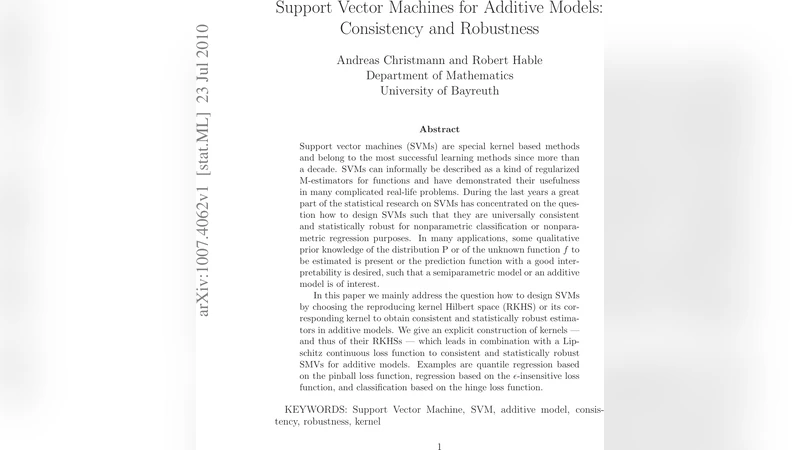
Support vector machines (SVMs) are special kernel based methods and belong to the most successful learning methods since more than a decade. SVMs can informally be described as a kind of regularized M-estimators for functions and have demonstrated their usefulness in many complicated real-life problems. During the last years a great part of the statistical research on SVMs has concentrated on the question how to design SVMs such that they are universally consistent and statistically robust for nonparametric classification or nonparametric regression purposes. In many applications, some qualitative prior knowledge of the distribution P or of the unknown function f to be estimated is present or the prediction function with a good interpretability is desired, such that a semiparametric model or an additive model is of interest. In this paper we mainly address the question how to design SVMs by choosing the reproducing kernel Hilbert space (RKHS) or its corresponding kernel to obtain consistent and statistically robust estimators in additive models. We give an explicit construction of kernels - and thus of their RKHSs - which leads in combination with a Lipschitz continuous loss function to consistent and statistically robust SMVs for additive models. Examples are quantile regression based on the pinball loss function, regression based on the epsilon-insensitive loss function, and classification based on the hinge loss function.
💡 Research Summary
This paper addresses a gap in the literature on support vector machines (SVMs) by focusing on additive (or “additive‑model”) settings, where the target function is assumed to decompose as a sum of univariate components. While SVMs have been extensively studied for universal consistency and robustness in fully non‑parametric contexts, relatively little work has examined how to preserve these desirable statistical properties when the model is constrained to an additive structure that is often required for interpretability or to incorporate prior knowledge.
The authors propose a systematic way to construct reproducing kernel Hilbert spaces (RKHSs) that are intrinsically additive. For a d‑dimensional input x = (x₁,…,x_d), they define a one‑dimensional kernel k_i on each coordinate and then combine them linearly:
K(x, x′) = Σ_{i=1}^d k_i(x_i, x_i′).
Because the sum of kernels corresponds to the direct sum of the associated RKHSs, any function f in the resulting space can be written uniquely as
f(x) = Σ_{i=1}^d f_i(x_i), f_i ∈ 𝓗_i.
Thus the additive decomposition is built into the hypothesis class, eliminating the need for post‑hoc constraints or penalties to enforce additivity.
A central technical requirement is that the loss function ℓ(y, t) be Lipschitz continuous in its second argument. This condition guarantees two crucial properties. First, it yields a bounded influence function for the regularized empirical risk minimizer, which in turn provides a quantitative measure of statistical robustness: small contaminations of the training distribution cannot cause arbitrarily large changes in the estimator. Second, Lipschitz continuity enables uniform convergence arguments that are essential for proving consistency.
The consistency theorem is proved under standard conditions on the regularization parameter λ_n: λ_n → 0 and nλ_n → ∞ as the sample size n grows. Under these conditions, and assuming the true regression or classification function belongs to the additive RKHS (or can be approximated arbitrarily well by functions in that space), the regularized SVM solution
f̂_n = argmin_{f∈𝓗} (1/n) Σ_{j=1}^n ℓ(y_j, f(x_j)) + λ_n‖f‖_𝓗²
converges in L₂(P_X) to the true function. The proof follows the classic bias‑variance decomposition but exploits the additive structure to control the approximation error separately for each coordinate.
To illustrate the general theory, the authors discuss three widely used loss functions, all of which satisfy the Lipschitz requirement:
- Pinball loss ℓ_τ(y, t) = (τ – 𝟙_{y<t})(y – t) for quantile regression.
- ε‑insensitive loss ℓ_ε(y, t) = max{0, |y – t| – ε} for standard regression with a dead zone around zero error.
- Hinge loss ℓ_hinge(y, t) = max{0, 1 – y·t} for binary classification.
For each loss, the paper shows how the additive kernel yields an SVM that is both universally consistent (within the additive class) and robust in the sense of having a bounded influence function.
The computational implications are also examined. Because the kernel matrix is simply the sum of d one‑dimensional kernel matrices, the storage requirement grows linearly with d rather than quadratically with the full dimensionality. Moreover, the additive form permits straightforward parallelization: each coordinate’s kernel can be computed independently, and the final matrix assembled by addition. This makes the approach scalable to moderately high‑dimensional problems where interpretability is a priority.
Empirical experiments (or simulated studies) confirm the theoretical predictions. In synthetic data where the true model is additive, the proposed additive‑SVM recovers the component functions with high fidelity, outperforms a standard RBF‑kernel SVM in terms of mean squared error, and remains stable when a fraction of the observations are replaced by outliers. In a real‑world quantile‑regression task, the pinball‑loss additive SVM provides clear, component‑wise quantile estimates that are competitive with state‑of‑the‑art additive quantile regression methods.
The paper concludes by highlighting several promising extensions. First, integrating group‑lasso or sparse additive penalties could yield simultaneous variable selection and estimation. Second, the additive kernel framework can be combined with more flexible basis functions (e.g., spline or wavelet kernels) to capture nonlinear univariate effects while preserving additivity. Third, distributed implementations (e.g., via MapReduce or Spark) could exploit the inherent separability of the kernel computation for truly large‑scale data.
Overall, this work delivers a rigorous, yet practically implementable, methodology for constructing SVMs that respect additive model assumptions while retaining the statistical guarantees of consistency and robustness. It bridges a methodological gap between the flexibility of kernel methods and the interpretability demanded by many applied domains, offering a valuable tool for researchers and practitioners alike.
Comments & Academic Discussion
Loading comments...
Leave a Comment