Loop Formulas for Description Logic Programs
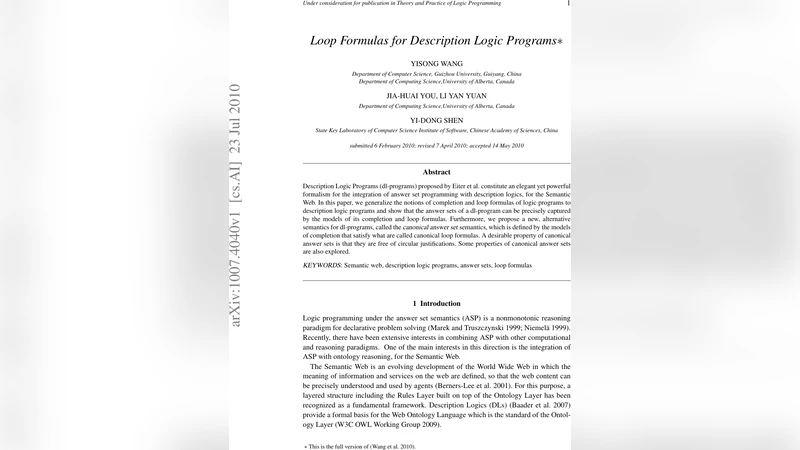
Description Logic Programs (dl-programs) proposed by Eiter et al. constitute an elegant yet powerful formalism for the integration of answer set programming with description logics, for the Semantic Web. In this paper, we generalize the notions of completion and loop formulas of logic programs to description logic programs and show that the answer sets of a dl-program can be precisely captured by the models of its completion and loop formulas. Furthermore, we propose a new, alternative semantics for dl-programs, called the {\em canonical answer set semantics}, which is defined by the models of completion that satisfy what are called canonical loop formulas. A desirable property of canonical answer sets is that they are free of circular justifications. Some properties of canonical answer sets are also explored.
💡 Research Summary
The paper tackles a fundamental problem in the integration of Answer Set Programming (ASP) with Description Logics (DL), a combination known as description‑logic programs (dl‑programs). While dl‑programs allow rules to query an external DL knowledge base via dl‑atoms, the existing semantics—strong and weak answer sets—do not fully control circular justifications that arise when rules depend on each other through the DL component. To address this gap, the authors extend two classic notions from ordinary logic programming: program completion and loop formulas.
First, they define a completion for a dl‑program. For each atom A, the completion equates A with the disjunction of the bodies of all rules that can derive A, translating bodies that contain dl‑atoms into logical conditions that refer to the DL knowledge base. This yields a set of first‑order equivalences that capture the intended meaning of the program, but by itself it still admits models that contain unsupported cycles.
Second, they generalize loop formulas. In standard ASP, a loop formula blocks a set of atoms L from being true unless there is an “external support”—a rule whose body contains a literal outside L. The authors adapt this idea to dl‑programs in three steps. The basic dl‑loop formula treats dl‑atoms as ordinary literals, ensuring that a loop cannot be justified solely by DL queries. The enhanced dl‑loop formula adds a further restriction: even if an external support exists, the support must not itself depend on atoms inside L via DL queries. Finally, the canonical loop formula—the cornerstone of the new semantics—requires that any external support for a loop be completely independent of the loop, thereby eliminating any form of circular justification.
With these tools, the authors prove a central theorem: a set of ground atoms is an answer set of a dl‑program if and only if it satisfies both the completion and all loop formulas (including the enhanced versions). This result mirrors Fages’ theorem for ordinary logic programs but crucially incorporates the semantics of DL queries. Consequently, answer sets can be computed by standard ASP solvers augmented with a preprocessing step that generates the appropriate loop formulas and checks them against a DL reasoner.
Building on this foundation, the paper introduces a novel semantics called canonical answer set semantics. A canonical answer set is a model of the completion that also satisfies all canonical loop formulas. By construction, canonical answer sets are free of circular justifications: any atom that is true must have a justification that never loops back to itself, directly or indirectly, through either ASP rules or DL queries. The authors explore several properties of canonical answer sets: every canonical answer set is a strong answer set, but not every strong answer set is canonical; existence of a canonical answer set depends on the structure of the program and the consistency of the underlying DL knowledge base; and when they exist, canonical answer sets are minimal with respect to set inclusion.
The paper also discusses computational aspects. Generating canonical loop formulas requires a strongly connected component analysis of the program’s dependency graph, extended to account for dl‑atoms. For each SCC, the system checks whether an external support exists that does not reference the SCC via DL queries. This check can be performed by invoking a DL reasoner on the relevant query. The authors implemented a prototype by extending the DLVHEX system, showing that the overhead of loop‑formula generation is modest for realistic ontologies and that canonical answer sets can be efficiently retrieved in practice.
In the concluding sections, the authors reflect on the significance of their contribution. By providing a precise logical characterization of dl‑program answer sets and a semantics that guarantees non‑circular justification, the work advances both the theoretical understanding and practical applicability of ASP‑DL integration. Potential future directions include transformation techniques that guarantee the existence of canonical answer sets, extending the approach to more expressive DLs (e.g., SROIQ), and scaling the method to distributed environments for large‑scale semantic web applications. Overall, the paper delivers a rigorous, well‑grounded solution to a longstanding issue in hybrid knowledge representation, opening new avenues for reliable, explainable reasoning on the Semantic Web.
Comments & Academic Discussion
Loading comments...
Leave a Comment