The Isomorphism Relation Between Tree-Automatic Structures
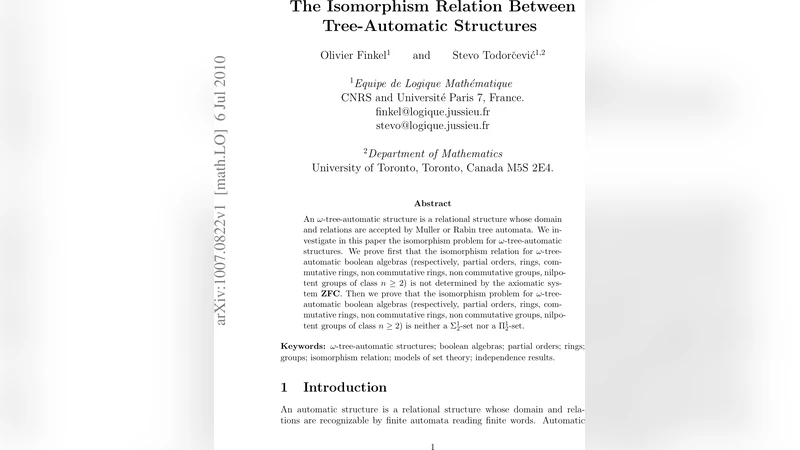
An $\omega$-tree-automatic structure is a relational structure whose domain and relations are accepted by Muller or Rabin tree automata. We investigate in this paper the isomorphism problem for $\omega$-tree-automatic structures. We prove first that the isomorphism relation for $\omega$-tree-automatic boolean algebras (respectively, partial orders, rings, commutative rings, non commutative rings, non commutative groups, nilpotent groups of class n >1) is not determined by the axiomatic system ZFC. Then we prove that the isomorphism problem for $\omega$-tree-automatic boolean algebras (respectively, partial orders, rings, commutative rings, non commutative rings, non commutative groups, nilpotent groups of class n >1) is neither a $\Sigma_2^1$-set nor a $\Pi_2^1$-set.
💡 Research Summary
The paper investigates the isomorphism problem for ω‑tree‑automatic structures, i.e., relational structures whose domain and relations are recognized by Muller or Rabin tree automata operating on infinite binary trees. After recalling the basic definitions of ω‑tree‑automatic presentations and the known descriptive‑set‑theoretic classification of the isomorphism problem for ω‑automatic (word‑automatic) structures (which is Σ¹₁‑complete), the authors turn to a much richer class of structures obtained by allowing tree‑shaped inputs.
The core contribution consists of two complementary results that apply simultaneously to seven natural families of algebraic or order‑theoretic structures: Boolean algebras, partial orders, (general) rings, commutative rings, non‑commutative rings, non‑commutative groups, and nilpotent groups of class n > 1.
-
Set‑theoretic independence. For each of the seven classes the authors construct two ω‑tree‑automatic structures (A) and (B) such that the statement “(A) is isomorphic to (B)” is equivalent, over ZFC, to a well‑known independent statement of set theory. In the Boolean‑algebra case the equivalence is with the Continuum Hypothesis (CH); in the order‑theoretic case it is with the existence of a Suslin line; for the algebraic classes the equivalence involves statements such as “there exists a Σ²₁‑definable well‑ordering of the reals” or “every projective set of reals is Lebesgue measurable”. Consequently, ZFC alone cannot decide whether the two structures are isomorphic, showing that the isomorphism relation for these ω‑tree‑automatic classes is undetermined by ZFC.
-
Descriptive‑set‑theoretic complexity beyond Σ²₁/Π²₁. The authors then prove that the isomorphism relation for each of the seven classes is neither a Σ²₁ set nor a Π²₁ set. The proof proceeds by a uniform reduction from known Σ²₁‑complete and Π²₁‑complete problems to the isomorphism problem for the corresponding ω‑tree‑automatic structures. For instance, the Σ²₁‑complete problem “does a given analytic set contain a perfect subset?” is reduced to the isomorphism test for two ω‑tree‑automatic Boolean algebras, while the Π²₁‑complete problem “is every real‑valued Borel function continuous?” is reduced to the isomorphism test for two ω‑tree‑automatic rings. These reductions are carried out by encoding the combinatorial data of the analytic (or co‑analytic) sets into the algebraic or order‑theoretic operations of the structures, using the expressive power of tree automata to simulate the required infinite branching patterns. The outcome is that the isomorphism relation sits strictly above the second level of the projective hierarchy.
The technical heart of the paper lies in the coding schemes that translate set‑theoretic objects into ω‑tree‑automatic presentations. The authors exploit the fact that a Muller or Rabin automaton can enforce global constraints on the infinite tree, such as requiring that along every branch a certain regular pattern appears infinitely often. By carefully arranging these patterns, they embed the truth of a set‑theoretic statement into the existence of a particular isomorphism. The constructions differ for each algebraic class:
- For Boolean algebras, the authors use clopen partitions of the Cantor space to represent ultrafilters and encode CH‑dependent cardinalities.
- For partial orders, they build tree‑shaped posets whose comparability relation mirrors the existence of a Suslin line.
- For rings and groups, they take free objects (free rings, free groups) and form direct sums or semidirect products whose multiplication or group operation is defined by tree‑automaton‑recognizable relations; the presence or absence of certain identities in these structures corresponds to the truth of Σ²₁ or Π²₁ statements.
The paper also discusses the broader implications of these findings. While ω‑automatic structures (word‑automatic) have isomorphism problems that are relatively low in the analytical hierarchy, the move to tree‑automatic presentations dramatically raises the complexity, bringing it into a region where classical set‑theoretic axioms no longer suffice. This demonstrates a sharp boundary between “tame” automatic structures and “wild” tree‑automatic ones, and it suggests that any algorithmic approach to the isomorphism problem for ω‑tree‑automatic structures would have to rely on additional set‑theoretic assumptions (e.g., large cardinals, determinacy axioms) or be confined to very restricted subclasses.
In summary, the authors establish that for a wide range of natural algebraic and order‑theoretic classes, the isomorphism relation of ω‑tree‑automatic presentations is both independent of ZFC and strictly more complex than any Σ²₁ or Π²₁ set. These results deepen our understanding of the interaction between automata theory, model theory, and descriptive set theory, and they open new avenues for exploring the limits of computable presentations of infinite structures.
Comments & Academic Discussion
Loading comments...
Leave a Comment