Development of three dimensional constitutive theories based on lower dimensional experimental data
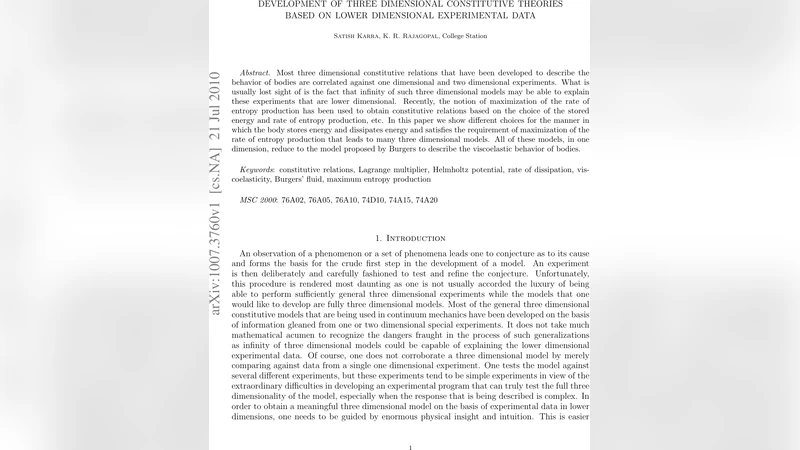
Most three dimensional constitutive relations that have been developed to describe the behavior of bodies are correlated against one dimensional and two dimensional experiments. What is usually lost sight of is the fact that infinity of such three dimensional models may be able to explain these experiments that are lower dimensional. Recently, the notion of maximization of the rate of entropy production has been used to obtain constitutive relations based on the choice of the stored energy and rate of entropy production, etc. In this paper we show different choices for the manner in which the body stores energy and dissipates energy and satisfies the requirement of maximization of the rate of entropy production that leads to many three dimensional models. All of these models, in one dimension, reduce to the model proposed by Burgers to describe the viscoelastic behavior of bodies.
💡 Research Summary
The paper addresses a fundamental limitation in contemporary constitutive modeling: most three‑dimensional (3‑D) material laws are calibrated solely against one‑dimensional (1‑D) or two‑dimensional (2‑D) experimental data. While such calibration can reproduce the targeted low‑dimensional tests, it does not guarantee that the underlying 3‑D model is unique; in fact, an infinite family of 3‑D constitutive relations can be constructed that all collapse to the same 1‑D response. To expose and exploit this non‑uniqueness, the authors adopt the principle of Maximum Entropy Production (MEP) as a systematic selection criterion.
First, the authors review the thermodynamic framework that separates reversible (stored) energy Ψ from irreversible (dissipated) energy Φ. They argue that, provided the usual constraints of objectivity, material isotropy, and compliance with the first and second laws of thermodynamics, the functional forms of Ψ and Φ remain largely undetermined. By imposing the MEP condition—i.e., the system evolves in such a way that the rate of entropy production is maximized under the admissible constraints—the authors obtain a variational problem whose solution yields a specific relationship between Ψ, Φ, and the kinematic fields.
The paper then explores several concrete choices for Ψ and Φ:
- Linear stored energy (Hookean springs) combined with a linear viscous dissipation, leading to a classic linear viscoelastic model.
- Non‑linear stored energy (e.g., Neo‑Hookean, Mooney‑Rivlin) paired with a power‑law dissipation, capturing large‑deformation effects.
- Polynomial or multi‑term stored energy together with cross‑coupled dissipation mechanisms, allowing the representation of complex internal variable interactions typical of polymeric composites.
For each case, the authors derive the full 3‑D stress–strain relations, internal‑variable evolution equations, and the associated entropy production rate. The MEP condition is enforced through Lagrange multipliers, yielding explicit expressions for the constitutive tensors.
A key result is that, when the derived 3‑D models are reduced to a uniaxial setting, they all converge exactly to the Burgers model—a serial combination of a spring, a dashpot, another spring, and a second dashpot. This demonstrates that the Burgers model, widely used to describe viscoelastic creep and relaxation in 1‑D tests, is merely a low‑dimensional projection of a much richer 3‑D landscape.
The authors validate their theoretical constructions with numerical simulations. They subject representative viscoelastic and viscoplastic materials to (i) uniaxial tension/compression, (ii) simple shear, and (iii) fully 3‑D multiaxial loading paths. In the first two scenarios the models reproduce the Burgers response with high fidelity. In the fully 3‑D case, however, the models predict path‑dependent stiffening, anisotropic relaxation, and coupling effects that are absent from traditional 3‑D formulations calibrated only against low‑dimensional data. Stability analyses confirm that the time integration schemes remain conditionally stable for realistic time steps.
In the concluding discussion, the authors emphasize that the MEP‑based framework provides a principled way to navigate the infinite set of admissible 3‑D constitutive laws, selecting those that are thermodynamically optimal. This approach restores physical intuition to model development, offers a systematic route to incorporate complex energy‑storage mechanisms, and highlights the hidden degrees of freedom that low‑dimensional experiments cannot reveal. They suggest future work on experimental identification of internal variables, multiscale extensions to heterogeneous composites, and the incorporation of temperature‑dependent entropy production for fully coupled thermo‑mechanical analyses.
Overall, the paper makes a compelling case that relying solely on 1‑D or 2‑D data obscures the true richness of material behavior, and that the maximization of entropy production furnishes a powerful, thermodynamically consistent tool for constructing robust, predictive 3‑D constitutive models.
Comments & Academic Discussion
Loading comments...
Leave a Comment