Fractal Dimension for Fractal Structures
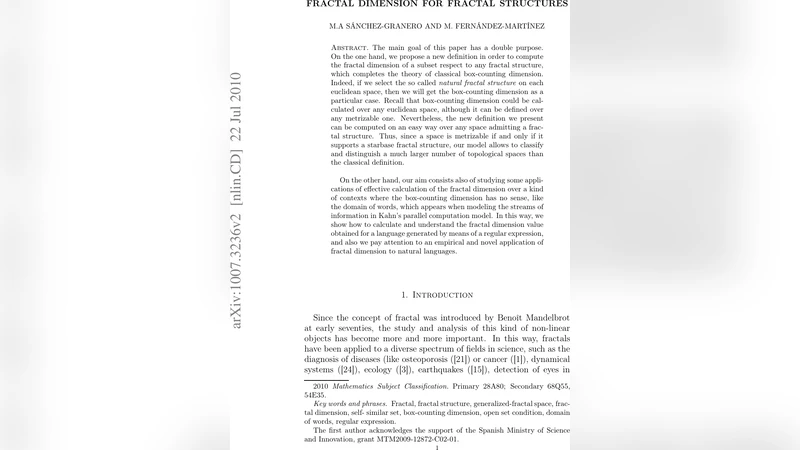
The main goal of this paper has a double purpose. On the one hand, we propose a new definition in order to compute the fractal dimension of a subset respect to any fractal structure, which completes the theory of classical box-counting dimension. Indeed, if we select the so called natural fractal structure on each euclidean space, then we will get the box-counting dimension as a particular case. Recall that box-counting dimension could be calculated over any euclidean space, although it can be defined over any metrizable one. Nevertheless, the new definition we present can be computed on an easy way over any space admitting a fractal structure. Thus, since a space is metrizable if and only if it supports a starbase fractal structure, our model allows to classify and distinguish a much larger number of topological spaces than the classical definition. On the other hand, our aim consists also of studying some applications of effective calculation of the fractal dimension over a kind of contexts where the box-counting dimension has no sense, like the domain of words, which appears when modeling the streams of information in Kahn’s parallel computation model. In this way, we show how to calculate and understand the fractal dimension value obtained for a language generated by means of a regular expression, and also we pay attention to an empirical and novel application of fractal dimension to natural languages.
💡 Research Summary
The paper introduces a novel definition of fractal dimension that works for any space equipped with a fractal structure, thereby extending the classical box‑counting dimension to a far broader class of topological spaces. The authors begin by formalizing the notion of a fractal structure 𝔉 as a sequence of coverings 𝔘₁, 𝔘₂, … where each level refines the previous one. For a subset A of a space X, the new dimension is defined as
\
Comments & Academic Discussion
Loading comments...
Leave a Comment