Saddle-Node Bifurcation to Jammed State for Quasi-One-Dimensional Counter Chemotactic Flow
The transition of a counter chemotactic particle flow from a free-flow state to a jammed state in a quasi-one-dimensional path is investigated. One of the characteristic features of such a flow is that the constituent particles spontaneously form a cluster that blocks the path, called a path-blocking cluster (PBC), and causes a jammed state when the particle density is greater than a threshold value. Near the threshold value, the PBC occasionally desolve itself to recover the free flow. In other words, the time evolution of the size of the PBC governs the flux of a counter chemotactic flow. In this paper, on the basis of numerical results of a stochastic cellular automata (SCA) model, we introduce a Langevin equation model for the size evolution of the PBC that reproduces the qualitative characteristics of the SCA model. The results suggest that the emergence of the jammed state in a quasi-one-dimensional counter flow is caused by a saddle-node bifurcation.
💡 Research Summary
This paper investigates how a counter‑chemotactic particle flow in a quasi‑one‑dimensional channel transitions from a freely moving state to a jammed state. The authors focus on a distinctive collective phenomenon: particles spontaneously aggregate into a “path‑blocking cluster” (PBC) that can completely obstruct the channel when the overall particle density exceeds a certain threshold. Near this threshold the PBC is not permanently stable; it occasionally dissolves, allowing the flow to resume before re‑forming again. Consequently, the time evolution of the PBC size directly governs the macroscopic flux of the system.
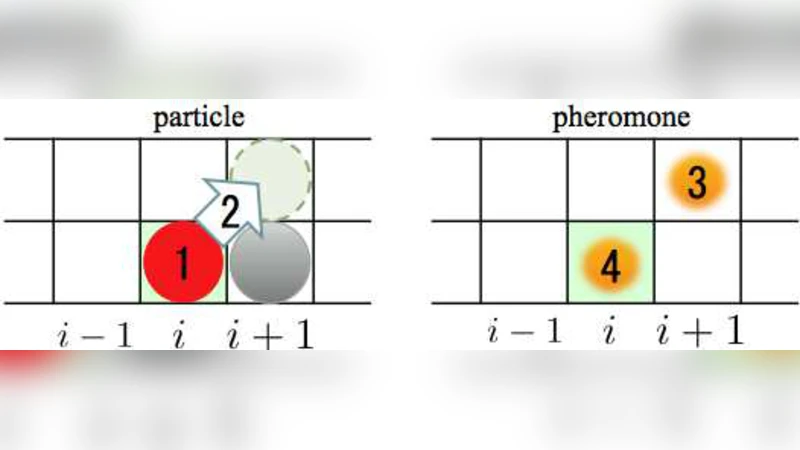
To explore this behavior the authors first construct a stochastic cellular automaton (SCA) model. The lattice is one‑dimensional; each site stores (i) an occupancy variable indicating whether a particle is present and (ii) a scalar chemotactic field (e.g., pheromone concentration). Particles move in opposite directions (left‑to‑right and right‑to‑left). The probability of stepping forward decreases monotonically with the local chemotactic field, embodying the idea that a high concentration of the chemical left behind by particles repels following particles. Each particle deposits a fixed amount of the chemical when it moves, and the field decays exponentially with a rate α. This simple rule set reproduces the essential feedback loop: particles generate a field that hinders subsequent motion, leading to self‑organized clustering.
Systematic SCA simulations reveal a clear density‑driven transition. At low densities the flux J grows roughly linearly with particle density ρ, indicating free flow. As ρ approaches a critical value ρ_c (which itself depends on the decay rate α), a high‑density region emerges: the PBC. Inside the PBC the chemotactic field is maximal, particle motion is strongly suppressed, and the flux drops precipitously. For ρ just below ρ_c the PBC remains small and transient; for ρ just above ρ_c it rapidly expands to occupy the entire channel, producing a jammed state. Moreover, in a narrow band around ρ_c the system exhibits intermittent behavior—periodic growth and dissolution of the PBC—suggesting that stochastic fluctuations can temporarily restore flow.
To capture the essential dynamics of the PBC size N(t), the authors propose a coarse‑grained Langevin equation:
dN/dt = f(N; ρ, α) + ξ(t),
where f(N) is a deterministic drift term derived from the measured growth and shrinkage rates of the PBC in the SCA, and ξ(t) is Gaussian white noise with strength D. Empirically, f(N) is positive for small N (the cluster tends to grow) and becomes negative for large N (the cluster tends to shrink), yielding two fixed points: a stable small‑N point N₁ and an unstable large‑N point N₂. As ρ increases, N₁ and N₂ move toward each other and coalesce at ρ = ρ_c, at which point they annihilate in a saddle‑node (fold) bifurcation. Below the bifurcation the system settles near N₁, allowing occasional excursions toward N₂ that, aided by noise, can trigger a temporary dissolution of the PBC—exactly the intermittent unjamming observed in the SCA. Above the bifurcation the fixed points disappear, the drift term remains negative for all N, and the cluster inevitably grows without bound, leading to a permanent jam.
The paper validates this picture by numerically integrating the Langevin equation, reproducing the SCA flux–density curves, the hysteresis‑like dependence on initial conditions, and the noise‑induced switching events. Parameter sweeps show that larger decay rates α (faster pheromone removal) lower the effective barrier between the two fixed points, making noise‑driven unjamming more likely. Conversely, a small α stabilizes the PBC, suppressing fluctuations.
In the discussion the authors compare their findings with classic traffic‑flow models, emphasizing that the jam formation here is driven not by external bottlenecks but by an internal chemotactic feedback loop. The identification of a saddle‑node bifurcation as the underlying mechanism distinguishes this system from second‑order phase transitions commonly reported in driven diffusive systems. They argue that the coarse‑grained Langevin description provides a versatile framework for analyzing similar quasi‑1D systems, such as bacterial swarms in microchannels, self‑propelled colloids with chemical signaling, or robotic swarms that use virtual pheromones for coordination.
The paper concludes with several outlook points: extending the analysis to higher dimensions, incorporating multiple particle species with antagonistic chemotaxis, and exploring active control strategies (e.g., periodic removal of the chemotactic field) to prevent jam formation. Overall, the work offers a clear mechanistic link between microscopic chemotactic interactions, mesoscopic cluster dynamics, and macroscopic flow properties, and it demonstrates how a simple stochastic differential equation can capture the essential bifurcation structure governing jam emergence in counter‑chemotactic flows.
Comments & Academic Discussion
Loading comments...
Leave a Comment