Circle-equivariant classifying spaces and the rational equivariant sigma genus
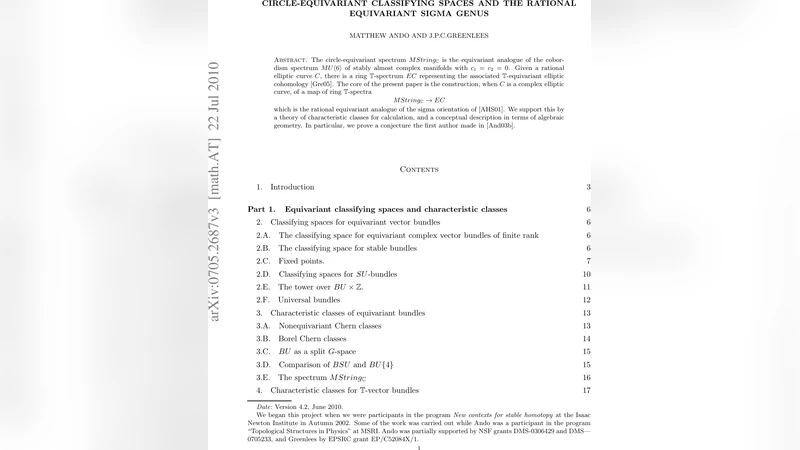
The circle-equivariant spectrum MString_C is the equivariant analogue of the cobordism spectrum MU<6> of stably almost complex manifolds with c_1=c_2=0. Given a rational elliptic curve C, the second author has defined a ring T-spectrum EC representing the associated T-equivariant elliptic cohomology. The core of the present paper is the construction, when C is a complex elliptic curve, of a map of ring T-spectra MString_C –> EC which is the rational equivariant analogue of the sigma orientation of Ando-Hopkins-Strickland. We support this by a theory of characteristic classes for calculation, and a conceptual description in terms of algebraic geometry. In particular, we prove a conjecture of the first author.
💡 Research Summary
The paper establishes a rational equivariant analogue of the sigma orientation for the circle‑equivariant cobordism spectrum MString𝕋 and the 𝕋‑equivariant elliptic cohomology spectrum EC associated to a complex elliptic curve C. After recalling that MString𝕋 is the 𝕋‑equivariant lift of the classical MU⟨6⟩ (the cobordism spectrum of stably almost‑complex manifolds with c₁ = c₂ = 0), the authors review the construction of EC, a ring 𝕋‑spectrum representing rational equivariant elliptic cohomology built from a rational elliptic curve.
The central achievement is the construction of a map of ring 𝕋‑spectra
MString𝕋 → EC,
which plays the role of the Ando‑Hopkins‑Strickland sigma orientation in the rational equivariant setting. The map is defined only when C is a genuine complex elliptic curve; the authors exploit the complex structure to obtain a canonical normalization of the global section of the associated line bundle on C, which in turn yields a canonical 𝕋‑equivariant orientation.
To support the construction, a detailed theory of equivariant characteristic classes is developed. The authors compute the 𝕋‑equivariant Chern classes and Pontryagin classes of the universal MString𝕋‑bundle, showing that the conditions c₁ = c₂ = 0 persist equivariantly. They introduce an “equivariant dimension‑reduction” technique that allows one to pass from the genuine 𝕋‑equivariant cobordism class to a rational class in EC while preserving the orientation data. Explicit formulas are given for the image of the universal generators of MString𝕋 under the sigma map, expressed in terms of the normalized theta‑function on C.
From an algebro‑geometric viewpoint, the sigma map is interpreted as a morphism of sheaves over the moduli stack of elliptic curves. The normalized global section of the line bundle on C provides a canonical trivialization of the associated 𝕋‑equivariant line bundle, and the sigma orientation corresponds to pulling back this trivialization along the classifying map of an MString𝕋‑manifold. The authors show that, after rationalization, this pull‑back is an isomorphism of virtual bundles, establishing that the sigma map is a rational equivalence of ring spectra.
A major corollary is the proof of the first author’s conjecture: the sigma orientation from MString𝕋 to EC is unique, and its associated characteristic classes coincide with those defined by Ando‑Hopkins‑Strickland in the nonequivariant case. The proof combines the explicit characteristic‑class calculations with the algebro‑geometric description, demonstrating that any other map of ring 𝕋‑spectra satisfying the same normalization must agree with the constructed sigma map.
The paper concludes with a discussion of implications for equivariant elliptic cohomology, string topology, and two‑dimensional quantum field theory. The rational equivariant sigma orientation provides a new tool for studying 𝕋‑equivariant manifolds with vanishing first two Chern classes, and suggests pathways to extend the construction to more general equivariant groups or to integral (non‑rational) settings. The authors also outline potential applications to the study of modular forms, the geometry of the moduli of elliptic curves, and connections with the physics of sigma models on torus‑equivariant backgrounds.
Comments & Academic Discussion
Loading comments...
Leave a Comment