Dynamics of person-to-person interactions from distributed RFID sensor networks
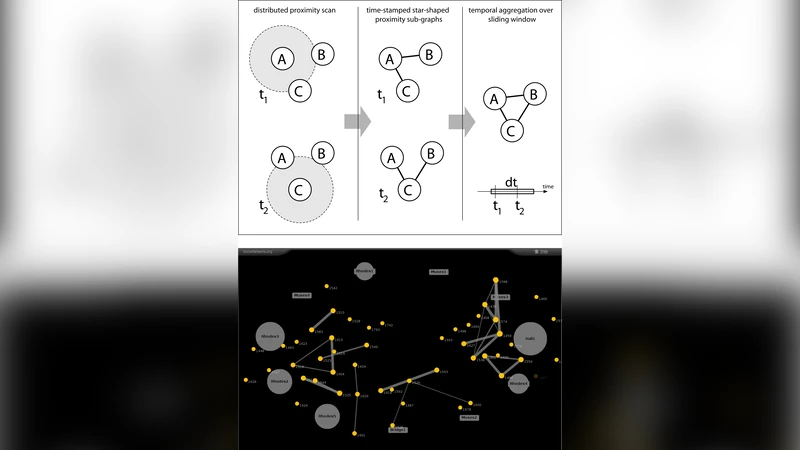
Digital networks, mobile devices, and the possibility of mining the ever-increasing amount of digital traces that we leave behind in our daily activities are changing the way we can approach the study of human and social interactions. Large-scale datasets, however, are mostly available for collective and statistical behaviors, at coarse granularities, while high-resolution data on person-to-person interactions are generally limited to relatively small groups of individuals. Here we present a scalable experimental framework for gathering real-time data resolving face-to-face social interactions with tunable spatial and temporal granularities. We use active Radio Frequency Identification (RFID) devices that assess mutual proximity in a distributed fashion by exchanging low-power radio packets. We analyze the dynamics of person-to-person interaction networks obtained in three high-resolution experiments carried out at different orders of magnitude in community size. The data sets exhibit common statistical properties and lack of a characteristic time scale from 20 seconds to several hours. The association between the number of connections and their duration shows an interesting super-linear behavior, which indicates the possibility of defining super-connectors both in the number and intensity of connections. Taking advantage of scalability and resolution, this experimental framework allows the monitoring of social interactions, uncovering similarities in the way individuals interact in different contexts, and identifying patterns of super-connector behavior in the community. These results could impact our understanding of all phenomena driven by face-to-face interactions, such as the spreading of transmissible infectious diseases and information.
💡 Research Summary
**
The paper introduces a scalable, high‑resolution framework for measuring face‑to‑face human interactions using active RFID tags. Traditional data sources such as Bluetooth, Wi‑Fi, mobile phone logs, or video‑based systems either lack the spatial granularity needed to infer genuine social contact or are limited in scalability, cost, or privacy. The authors therefore designed inexpensive, unobtrusive RFID badges that exchange low‑power radio packets with one another. By tuning the transmission power, the system can detect proximity at different spatial scales: the lowest power level senses face‑to‑face proximity within roughly one metre (the tag’s antenna is exposed only when two people face each other), while higher power levels capture looser proximity up to four or five metres. Data are collected by a modest number of fixed readers, aggregated in real time, and discretised into 20‑second windows; a contact is recorded if at least one low‑power packet is exchanged within a window, and the contact persists as long as this condition holds in successive windows.
Three deployments were carried out: a small workshop (≈25 participants), a medium‑size conference (≈78 participants), and a large conference (≈575 participants). Across all settings, the distribution of contact durations follows a broad, heavy‑tailed form, indicating many brief encounters and a few long‑lasting ones. Importantly, the shape of this distribution is essentially invariant to the spatial resolution (1 m vs 4–5 m), suggesting that the underlying dynamics of human proximity are scale‑free. The authors also analyse inter‑contact intervals—the time between the end of a contact with one person and the start of a contact with another. These intervals also display a power‑law‑like tail, confirming the absence of a characteristic timescale. Notably, the interval distribution is broader for the short‑range (1 m) configuration, implying that direct, face‑to‑face interactions generate more irregular temporal gaps than looser proximity, a factor that could affect contagion processes.
Robustness checks were performed by randomly removing a fraction of tags (simulating participant dropout or technical loss) and recomputing the contact‑duration and triangle‑duration distributions. The functional form remained unchanged, with only the cutoff shifting to smaller values, demonstrating that the observed statistics are resilient to unbiased sampling and random data loss.
Aggregated networks were constructed by collapsing contacts over longer windows (e.g., 12 h). Nodes represent individuals; edges are weighted either by the total number of exchanged packets or by the cumulative contact time, which yield equivalent results. Both weight and node‑strength distributions are highly heterogeneous. A key finding is a super‑linear relationship between node strength (total interaction time) and degree (number of distinct contacts): strength grows faster than linearly with degree. Consequently, individuals with many contacts also spend disproportionately more time interacting—a signature of “super‑connectors.” This contrasts with earlier studies of mobile‑phone communications, where a sub‑linear scaling was reported, highlighting the distinct nature of face‑to‑face interaction dynamics.
The authors discuss the implications for modeling spreading phenomena. Since contact durations and inter‑contact intervals lack a characteristic scale, epidemic or information diffusion models must incorporate the full temporal distribution rather than rely on average rates. The real‑time nature of the system also opens the possibility for adaptive interventions (e.g., targeted alerts, dynamic quarantine) based on live interaction data.
Finally, the paper acknowledges limitations such as voluntary participation bias, potential systematic differences between volunteers and non‑volunteers, and the fact that the two largest deployments were conference‑type events. Ongoing work extends the methodology to hospitals, schools, and museums to test the generality of the observed patterns across different social contexts.
In summary, the study demonstrates that active RFID tags can provide a cost‑effective, scalable, and tunable platform for capturing high‑resolution face‑to‑face interaction data. The resulting datasets reveal universal statistical features—scale‑free contact durations and inter‑contact times, and a super‑linear degree‑strength relationship—offering valuable insights for epidemiology, information diffusion, and the design of socially aware pervasive computing applications.
Comments & Academic Discussion
Loading comments...
Leave a Comment